
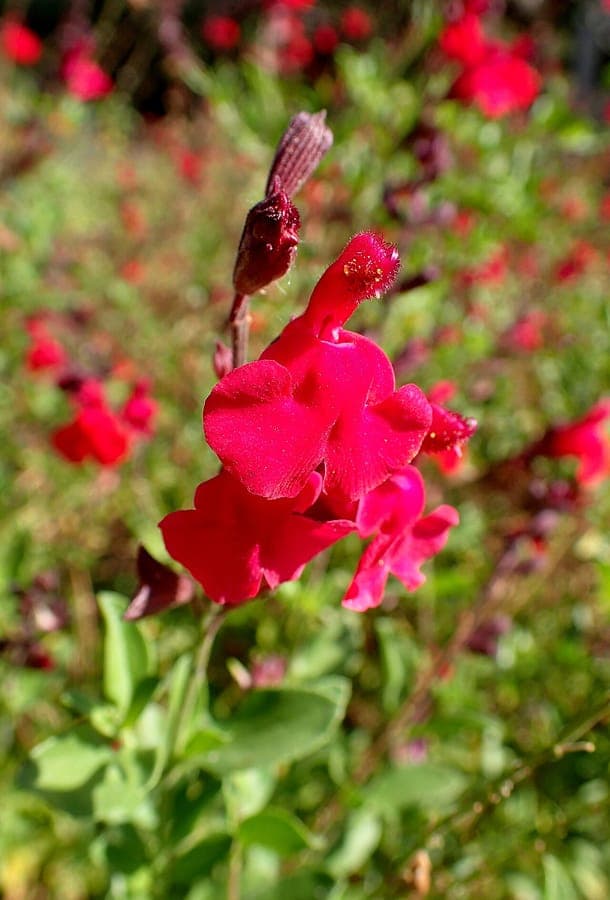
Krzysztof Ziarnek, Kenraiz / CC BY-SA 4.0, via Wikimedia Commons
Salvia greggii: complete guide
Salvia greggii
Want to see Salvia greggii: complete guide in your garden?
1 minute, no credit card
Overview
Salvia greggii, commonly known as autumn sage or San Antone oregano, is a stunning shrub native to Texas and northeastern Mexico. This compact plant has become a defining element in contemporary garden designs due to its extended blooming period and versatile color palette. With minimal maintenance demands and bird-friendly flowers, it stands as an ideal choice for those seeking a low-maintenance garden with maximum visual impact.
Appearance and bloom
Salvia greggii forms a compact, spreading shrub with narrow lance-shaped foliage that emits a pleasant herbal fragrance when brushed. The flowers are tubular and emerge in numerous color variants: red, pink, white, orange, and yellow. These blooms are particularly attractive to hummingbirds and other pollinators. The flowering period extends from early summer deep into autumn, providing months of color to your garden.
Ideal location
Select a sunny site with at least 6 hours of direct sunlight daily. Salvia greggii thrives in full sun and produces the most flowers there. Shield from strong western winds, particularly in hotter regions. The plant tolerates partial shade, but flower production will be reduced. Ensure good air circulation to prevent fungal issues.
Soil
This sage loves well-draining soil and thrives on poor, dry substrates. Heavy clay soils must be amended with sand and organic matter to prevent waterlogging. A pH between 6.0 and 8.0 is ideal. Add compost when planting to stimulate root development, but avoid nitrogen-rich fertilizers that promote leaf growth at the expense of flowering.
Watering
Once established, Salvia greggii is drought tolerant. During the growing season, water when the top 2-3 cm of soil feels dry. In periods of extreme heat, additional water may be needed, but ensure water does not pool. In autumn and winter, reduce watering substantially. Excessive moisture is the primary cause of problems with this species.
Free design
Want to see Salvia greggii: complete guide in your garden? Make a free design now.
Pruning
Pruning helps keep the plant compact and bushy. In spring, after frost has passed, cut the plant back halfway to encourage branching. During the growing season, promptly remove spent flower clusters to encourage blooming. Leave some flower heads for seed formation, which attracts birds. In autumn, light prune to maintain shape, but avoid heavy pruning as frost approaches.
Maintenance calendar
Spring: careful pruning to desired shape, check drainage. Summer: regularly enjoy full bloom, optionally mulch to improve moisture retention. Autumn: consistently encourage flowers, gradually reduce watering. Winter: keep dry, do not fertilize.
Winter hardiness
Salvia greggii is not fully hardy in severe climates. In regions with temperatures below -7 degrees Celsius, the plant may suffer damage or die. In northern regions, cultivate as an annual or keep plants in containers for protected overwintering. Mulching can protect the roots. In southern Europe and Mediterranean-like climates, the plant is hardy.
Companion plants
Salvia greggii combines beautifully with other drought-tolerant plants such as lavender, santolina, and catmint. Plant nearby for contrasting form and color: hardy geranium, sea holly, or small Mediterranean leafy shrubs. Low perennials such as thyme and stonecrop create an attractive carpet at the plant's base.
Closing
Salvia greggii is a collector's plant worthy of every ecologically minded garden. With minimal attention and maximum bird appeal, this autumn sage provides years of intense color enjoyment. Available at major garden centers. For more inspiration, visit gardenworld.app or gardenworld.app for your next garden design.
Want to see Salvia greggii: complete guide in your garden? Make a free design now.
Upload a photo, pick a style, and get a photorealistic design with plant list in under a minute.
No credit card required


Similar plants
Apple mint (Mentha x villosa): complete guide
Mentha x villosa
Meet apple mint (Mentha x villosa): a fruity-scented kitchen herb with woolly leaves, perfect for tea and mojitos.
Salvia peyronii: complete guide
Salvia peyronii
Discover Salvia peyronii, a rare Lebanese mountain sage. Growing tips, hardiness, and companion planting for a Mediterranean gravel garden.
Bigleaf mint (Mentha x rotundifolia): complete guide
Mentha x rotundifolia
Discover bigleaf mint: cultivation, care tips, and garden uses. Learn how to grow this aromatic herb with soft, hairy leaves.