
Salvia peyronii: complete guide
Salvia peyronii
Want to see Salvia peyronii: complete guide in your garden?
1 minute, no credit card
Overview
Salvia peyronii is a little-known sage species in the mint family (Lamiaceae), found only on the limestone slopes of Jabal Moussa in Lebanon, a mountain range that has carried UNESCO biosphere reserve status since 2009. Swiss botanist Pierre Edmond Boissier formally described the plant in 1896, and it commemorates the French botanist Peyron who explored the region. Locally the plant is known by its Arabic name, while English-language references simply call it peyron sage.
Like many Mediterranean sages, Salvia peyronii has adapted to hot, dry summers followed by cooler, wetter winters at altitude. It grows on rocky, calcareous ground between roughly 1,000 and 1,800 meters elevation, often wedged among loose stones and scrub where few other plants can compete. For gardeners hunting for something beyond the familiar Salvia officinalis or Salvia nemorosa, this species offers a genuine slice of Lebanese mountain flora. On gardenworld.app it sits among our collection of rare Mediterranean ornamentals precisely because it shows how versatile the genus Salvia really is.
The plant forms a compact, semi-woody subshrub reaching 30 to 50 centimeters in height with a similar spread. Like every member of the Lamiaceae family, from mint to rosemary, it carries square stems and opposite leaves.
Appearance and bloom
The grey-green leaves of Salvia peyronii are elongated to lance-shaped, lightly hairy, and release the familiar herbal, resinous sage scent when brushed. That aromatic oil deters browsing animals and slows moisture loss under the fierce mountain sun. Leaf margins are gently toothed, with a texture slightly coarser than culinary sage.
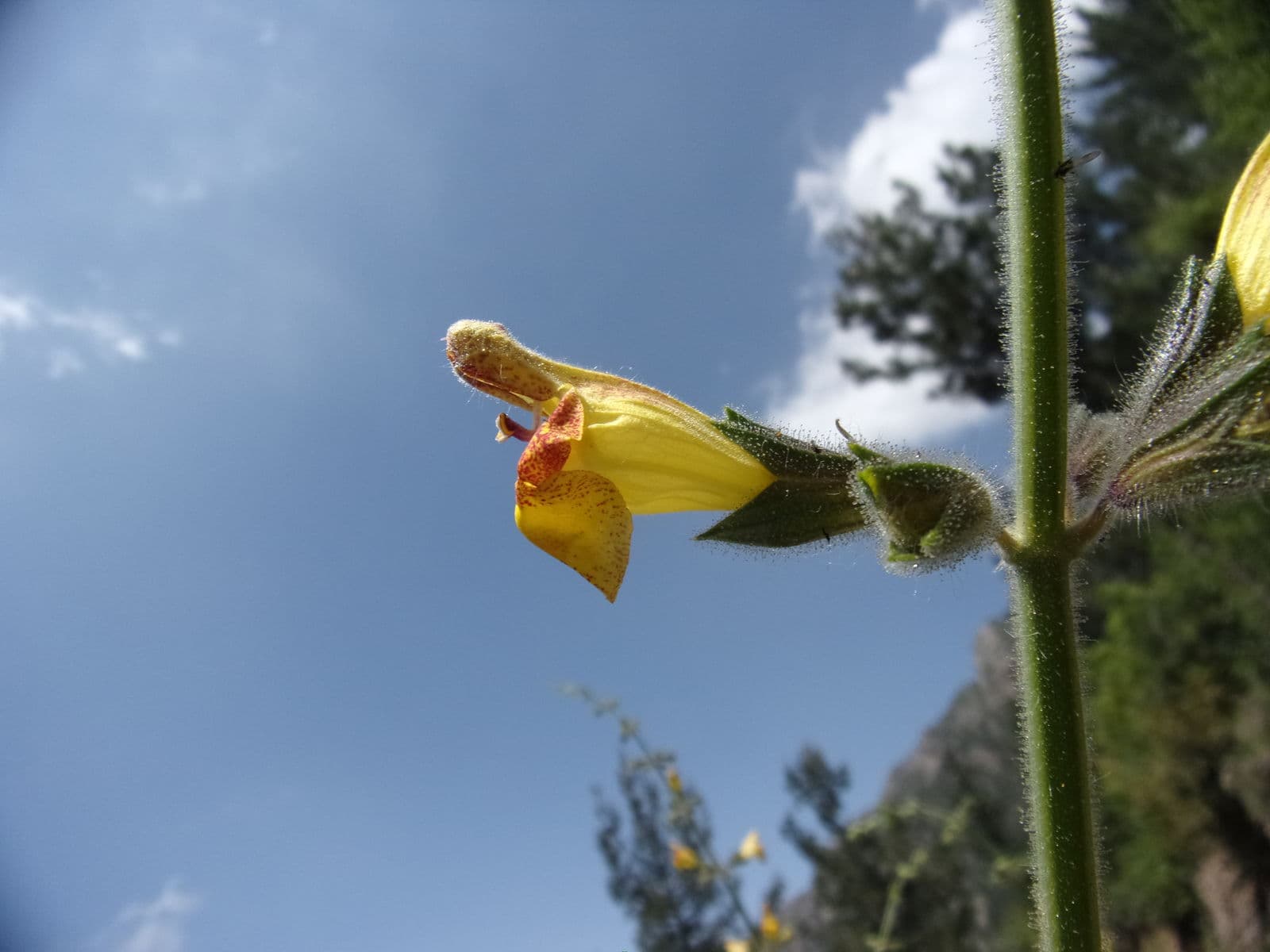
Flowers appear from May through July in whorled clusters called verticillasters, a hallmark of the Lamiaceae family where rings of blooms encircle the stem. Each flower shows the classic two-lipped shape of the family: an arched upper lip and a broader lower lip that acts as a landing pad for pollinating insects. Color ranges from soft lilac to purplish pink, sometimes with darker veining in the throat that guides bees toward the nectar. Wild bees and bumblebees are the main pollinators across its native range.
After flowering, the plant sets small nutlets, typically four per flower, tucked inside the persistent calyx, a fruiting structure typical of the entire mint family.
Ideal location
Salvia peyronii needs full sun, at least six to eight hours of direct light daily. In the wild it grows on open, rocky slopes with no tree cover, so shade slows flowering and invites fungal trouble. A south or southwest exposure against a wall, or a spot in a rock garden, recreates the heat of its native Lebanese hillside well.
Protection from heavy winter rain matters more than cold protection: the plant tolerates drought far better than wet feet. A raised bed, a sloped border, or a gravel garden keeps water away from the roots. Wind shelter is less critical since wild populations are exposed on bare slopes, though young plants benefit from some shelter during their first growing season.
Soil
Soil must drain exceptionally well, ideally calcareous and stony, with a pH between 7.0 and 8.0. Heavy clay is unsuitable unless heavily amended with grit, chippings, or expanded lava rock. Work generous amounts of coarse grit or crushed shell lime into the top 30 centimeters at planting time to guarantee sharp drainage.
Lean to moderately fertile ground suits the plant best; too much nitrogen or compost produces soft, lush growth that is less winter hardy and more prone to flopping. A thin layer of grit or gravel mulch around the base suppresses weeds and reflects heat back onto the foliage, which encourages flowering.
Free design
Want to see Salvia peyronii: complete guide in your garden? Make a free design now.
Watering
For the first six to eight weeks after planting, keep the soil lightly moist so roots establish properly. After that, Salvia peyronii is markedly drought tolerant and rarely needs supplemental water through an average northern European growing season, aside from prolonged heat waves in July and August.
When in doubt, underwater rather than overwater: excess moisture, especially combined with heavy soil, quickly leads to root rot. Water early in the morning at the base of the plant so foliage dries out by evening, denying fungal disease a foothold.
Pruning
Prune Salvia peyronii right after flowering, in late July or early August, cutting spent flower stems back to just above the new foliage. This sometimes triggers a lighter second flush of bloom in September and keeps the plant compact.
Never cut back into old, woody stems, since like many shrubby sages, Salvia peyronii resprouts poorly from old wood. A light shaping prune in early spring, once new shoots become visible, keeps growth dense and prevents a bare, leggy base.
Maintenance calendar
March: gently remove winter dieback and old woody stems. April: check drainage around the root crown after winter rains. May through July: main bloom period, no feeding required. August: prune after flowering to encourage possible rebloom. September: watch for a light second flush. October: leave spent flower stems in place to help protect the crown over winter. November through February: minimal upkeep, with a layer of dry leaves or fleece for extreme frost.
Winter hardiness
Salvia peyronii is hardy to roughly -12 degrees Celsius, corresponding to USDA zone 8a, and possibly 7b in a sheltered, well-drained spot. In its native range, at 1,000 to 1,800 meters in Lebanon, the plant experiences cold, sometimes snowy winters, which gives it better cold tolerance than many lowland Mediterranean sages.
In northern Europe, winter protection with a thick layer of dry straw, leaves, or conifer branches around the base is worthwhile in regions with hard frost or wet winters. On a very well-drained, sunny site, mature plants typically come through without extra protection.
Companion plants
Salvia peyronii pairs beautifully with other Mediterranean drought lovers: lavender (Lavandula angustifolia), thyme (Thymus vulgaris), rosemary (Salvia rosmarinus), and Cistus species combine into a fragrant, bee-friendly gravel garden. Ornamental grasses such as Stipa tenuissima or Festuca glauca add movement and textural contrast, while Santolina chamaecyparissus contributes silvery grey foliage for contrast.
If you want to source Salvia peyronii: garden centers typically stock common Salvia cultivars like Salvia nemorosa 'Caradonna'; ask specifically for this rare Lebanese species or order seed through specialist botanical seed banks and nurseries focused on Mediterranean mountain flora.
Closing
Salvia peyronii is a fascinating pick for gardeners who want to look beyond the standard garden-center sage. Its combination of fragrant silver-grey foliage, a long bloom period from May through July, and a modest 30 to 50 centimeter frame makes it ideal for gravel gardens, rock gardens, and sunny borders. Given well-drained soil and a sunny spot, this Lebanese mountain sage asks for little maintenance while delivering plenty of character. Browse gardenworld.app for related Mediterranean species to build out a complete, drought-tolerant garden design.
Want to see Salvia peyronii: complete guide in your garden? Make a free design now.
Upload a photo, pick a style, and get a photorealistic design with plant list in under a minute.
10,000+ gardens designed already
No credit card required


Similar plants
Apple mint (Mentha x villosa): complete guide
Mentha x villosa
Meet apple mint (Mentha x villosa): a fruity-scented kitchen herb with woolly leaves, perfect for tea and mojitos.
Bigleaf mint (Mentha x rotundifolia): complete guide
Mentha x rotundifolia
Discover bigleaf mint: cultivation, care tips, and garden uses. Learn how to grow this aromatic herb with soft, hairy leaves.
Nepeta agrestis: complete guide
Nepeta agrestis
Nepeta agrestis, Corsican catmint, is endemic to Corsica with white flowers. Cultivation, care and practical tips for this rare plant.