Kurt Stüber [1] / CC BY-SA 3.0, via Wikimedia Commons
Beautyberry (Callicarpa bodinieri): complete guide
Callicarpa bodinieri
Want to see Beautyberry (Callicarpa bodinieri): complete guide in your garden?
Full design in HD: €7.99
Look after your Beautyberry with the GardenWorld app
Identify plants with your camera and get a care calendar with reminders for this plant.


Overview
Beautyberry (Callicarpa bodinieri) is the shrub that stops everyone in their tracks in autumn. As soon as the leaves drop, the twigs are revealed covered in clusters of glossy violet berries so vivid they look almost artificial. They often hang on into January, bringing colour to the garden at a time when little else is on show. The branches are superb in a vase or an autumn arrangement too.
The species belongs to the mint family (Lamiaceae) and is native to central and western China, where it grows on woodland edges and in scrub. Callicarpa comes from the Greek for beautiful fruit, while bodinieri honours the French missionary and plant collector Émile Bodinier, who gathered plants in China in the late nineteenth century.
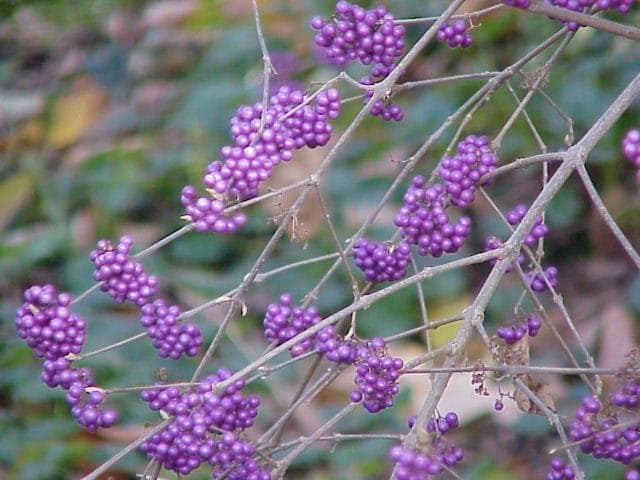
Beautyberry grows 2 to 3 metres tall and 1.5 to 2.5 metres wide, with an upright, slightly open habit. By far the best-known cultivar is 'Profusion', a heavy-fruiting selection that holds the RHS Award of Garden Merit. The photo shows the variety giraldii, which is also widely grown and differs very little.
Appearance and bloom cycle
The leaves are elliptic to lance-shaped, 5 to 12 cm long, finely toothed and matt green. On 'Profusion' the young spring foliage emerges bronze to purplish. In autumn the leaves turn yellow, orange and pink to purple before they fall.
In July and August, small, flat clusters of lilac to pink flowers appear in the leaf axils. They are modest in size, but bees and bumblebees love them. These flowers give rise to the berries, which are still green in September and turn violet from October. Each berry is 3 to 4 mm across, and they sit in tight bunches around the twigs, exactly as in the photo. They really come into their own after leaf fall.
The berries are not seriously poisonous, but they are not for eating either. They contain compounds that can cause stomach and intestinal upset if eaten in quantity. Teach children to leave them alone and keep an eye on pets. Birds tend to eat the berries only late in winter, when other food is scarce.
Ideal location
For the heaviest crop of berries, give beautyberry full sun or light partial shade. It will grow in shade, but it then produces far fewer flowers and therefore fewer berries. A sheltered position, for example in front of a hedge or wall, helps the twigs through winter.
Ideally, plant a group of three or more shrubs together. Beautyberry is self-fertile, but with several plants nearby the shrubs set noticeably more fruit. Choose a spot you can see from the house in winter, or along a path, so you get the most from the purple clusters. Allow a spacing of 1.5 to 2 metres.
Soil requirements
Beautyberry is not fussy. Any ordinary, reasonably fertile garden soil that holds moisture but drains well will do. It grows on sand, loam and clay, and on slightly acid to slightly alkaline ground. Only soil that stays waterlogged for long periods suits it poorly.
When planting, mix some compost into the planting hole and loosen the surrounding soil well. On poor sandy soil, an extra helping of compost gives the plant a good start. A mulch of leaf mould or wood chips keeps the soil cool and moist in summer and suppresses weeds. Plant ideally in autumn or early spring, while the shrub is dormant.
Free preview
Want to see Beautyberry (Callicarpa bodinieri): complete guide in your garden? Make a free preview of your design.
Watering
A newly planted beautyberry needs regular watering in its first year: in dry weather, about one watering can or 10 litres once a week. That way it develops a strong root system. After that, the shrub usually manages on rainfall in open ground.
In long, dry summers the leaves may droop and some berries may drop. During such spells, give a generous soaking at the base every two weeks. Feeding is hardly necessary: a layer of compost in spring is enough. Too much nitrogen means plenty of leaves but fewer berries. The plant calendar at gardenworld.app shows month by month what your plants need, so watering in dry spells and the spring prune do not slip your mind.
Pruning
Beautyberry flowers and fruits on the current year's shoots. Prune in late winter or early spring, in February or March, and never in autumn, or you will cut off the berries. A light annual prune keeps the shrub young and productive.
Each year, remove a third to a quarter of the oldest stems close to the ground. This keeps a steady supply of vigorous young shoots that flower well. Also cut out dead, damaged or crossing branches. If the shrub has become too large or bare, you can cut it back hard to 30 to 50 cm in spring. It regrows well, although you will lose some berries that year. Cutting berried stems for the house is fine; it doubles as a little pruning.
Maintenance calendar
February-March: Pruning time. Remove old stems and shape the shrub. Apply a layer of compost.
April-June: New growth. Water young plants in dry spells. Top up the mulch.
July-August: Small lilac flowers. Water during prolonged drought.
September-October: Berries turn violet and the foliage colours up. A good planting period.
November-January: The berries decorate the bare shrub. Cut stems for indoors. Do not prune.
Winter hardiness
Callicarpa bodinieri is fully hardy and tolerates frost down to about -20 °C. In Britain and the Low Countries it comes through normal winters without any protection. In severe frost the tips of young shoots may be killed, but this is quickly made good in spring, as the shrub flowers on new wood anyway. Simply remove the frosted parts when you prune in spring.
Young plants are a little more vulnerable in their first winter. A layer of leaves or mulch around the base protects the roots. The shrub is happiest in a sheltered spot out of cold easterly winds. Beautyberry can also be grown in a large container, but in that case protect the pot in hard frost with hessian or bubble wrap.
Companion plants
Beautyberry shines brightest in a winter garden alongside other plants that offer something in the cold months. Red-barked dogwood (Cornus alba), with its scarlet stems beside the violet berries, makes a striking combination. Winged spindle (Euonymus alatus) turns a fiery red in autumn and fits neatly into the same season.
Ornamental grasses such as Miscanthus sinensis provide a soft backdrop for the purple clusters with their plumes and straw-coloured leaves. At the base, the Christmas rose (Helleborus niger) flowers white in December and January, and Chinese witch hazel (Hamamelis mollis) extends the show with fragrant yellow flowers in January and February. An underplanting of evergreen ground cover completes the picture.
Would you like a garden that still has something to say in winter? At gardenworld.app you can have a garden design made in which beautyberry combines with coloured stems, grasses and winter-flowering plants for interest in every season.
Final thoughts
Beautyberry is a simple shrub with an exceptional effect: violet berries that brighten the garden from October into winter. It is hardy, undemanding about soil and asks only for a sunny spot, some water in its first year and a prune in spring. Plant a few together for the best crop, and every autumn you will have one of the most eye-catching shrubs on the street.
Frequently asked questions about Beautyberry
Is Beautyberry winter hardy?
Callicarpa bodinieri is fully hardy and tolerates frost down to about -20 °C. In Britain and the Low Countries it comes through normal winters without any protection.
When and how do you prune Beautyberry?
Beautyberry flowers and fruits on the current year's shoots. Prune in late winter or early spring, in February or March, and never in autumn, or you will cut off the berries.
How much water does Beautyberry need?
A newly planted beautyberry needs regular watering in its first year: in dry weather, about one watering can or 10 litres once a week. That way it develops a strong root system.
Where does Beautyberry grow best?
For the heaviest crop of berries, give beautyberry full sun or light partial shade. It will grow in shade, but it then produces far fewer flowers and therefore fewer berries.
What soil does Beautyberry need?
Beautyberry is not fussy. Any ordinary, reasonably fertile garden soil that holds moisture but drains well will do.

See it in your garden
See Beautyberry in your garden
One photo of your garden and a few questions. You see the result in about a minute.
Try it with a photoIdentify this plant in your own garden. Identify a plant
Similar plants
Siberian Dogwood: complete guide
Cornus alba
Learn how to grow and care for Cornus alba (Siberian Dogwood) in your garden. Ideal conditions, pruning, winter color and companion plants explained.
Burning Bush: complete guide
Euonymus alatus
Discover everything about the Burning Bush (Euonymus alatus). Cultivation tips, care instructions and companion planting for your autumn garden.
Chinese Silver Grass: complete guide
Miscanthus sinensis
Everything about Chinese Silver Grass (Miscanthus sinensis): planting, cutting back, cultivars and winter silhouette. Expert tips for a spectacular ornamental grass.
