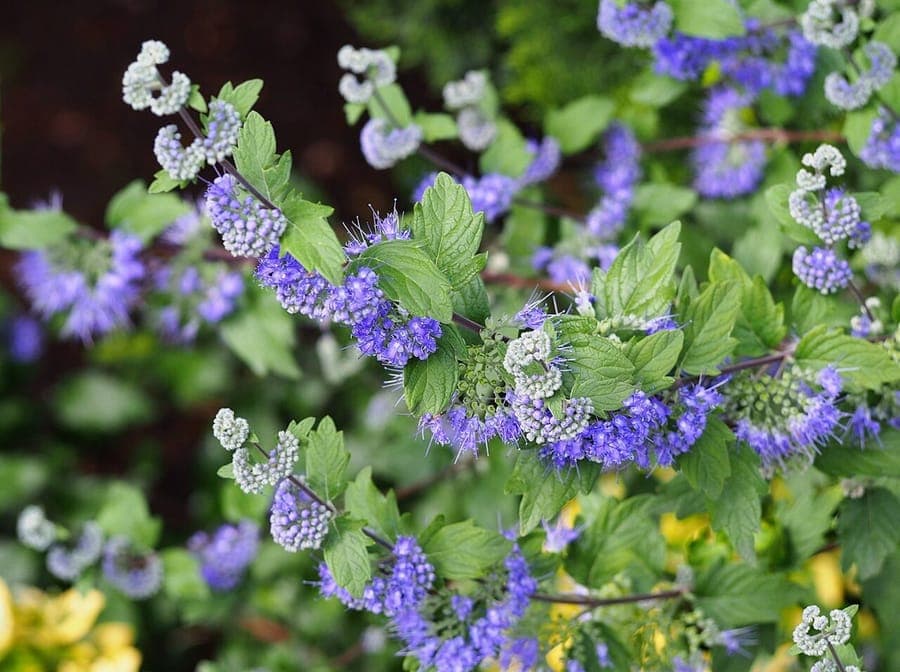
Agnieszka Kwiecień, Nova / CC BY-SA 4.0, via Wikimedia Commons
Bluebeard (Caryopteris × clandonensis): complete guide
Caryopteris × clandonensis
Want to see Bluebeard (Caryopteris × clandonensis): complete guide in your garden?
Full design in HD: €7.99
Look after your Bluebeard with the GardenWorld app
Identify plants with your camera and get a care calendar with reminders for this plant.


Overview
Bluebeard (Caryopteris × clandonensis) is a small deciduous shrub that flowers just when many gardens start to look tired: from late August into October. Dozens of sky-blue flower clusters then appear above the grey-green foliage, and the shrub hums with bees, bumblebees and butterflies. You may also hear it called blue spiraea, although it is not related to true spiraeas.
Bluebeard belongs to the mint family (Lamiaceae), like lavender and sage. It arose by chance in the 1930s in the garden of Arthur Simmonds at West Clandon in Surrey, as a cross between Caryopteris incana and Caryopteris mongholica, two species from East Asia. Caryopteris literally means winged nut, after its small winged fruits. The common name bluebeard refers to the long stamens that protrude like a little beard from each flower.
The plant grows 60 cm to 1 m tall and roughly as wide. Well-known cultivars include 'Heavenly Blue' (bright blue, compact, the plant in the photo), 'Kew Blue' (dark blue), 'Dark Knight' (deep violet-blue, silvery leaves), 'Worcester Gold' (golden foliage) and 'Grand Bleu' (dark leaves, deep blue flowers).
Appearance and bloom cycle
The leaves are narrowly lance-shaped, 3 to 6 cm long, lightly toothed and grey-green with a silvery underside. Brush against them and you will notice a fresh, herby scent, somewhere between sage and mint.
Flowering starts in late August and carries on into October. Dense clusters of small, tubular flowers in pale blue to violet-blue appear in the leaf axils along the upper part of the shoots. Each flower has a fringed lower lip and long, projecting stamens, which give the clusters a fluffy look. In the photo you can clearly see how the buds first appear as greyish-white balls before opening to vivid blue.
After flowering, the grey seed clusters stay on the plant for a while. They are not showy, but with a coating of frost they add soft texture to the winter garden. Bluebeard is not known to be toxic to people or pets.
Ideal location
Caryopteris × clandonensis is a true sun lover. Give it at least six hours of sunshine a day, ideally in a warm spot facing south or west, against a wall or in a gravel garden. In shade it becomes floppy, flowers poorly and is more prone to frost damage.
Bluebeard suits the front or middle of a border, a prairie-style planting, a Mediterranean corner or the edge of a patio. It also grows well in a large container of at least 30 litres, provided it stands in sun. Space plants 60 to 80 cm apart; in groups of three or five the blue really comes into its own.
Soil requirements
Good drainage matters more than anything. Bluebeard is happy on sandy, loamy and even chalky soils, and copes with fairly poor ground. What it hates is wet soil in winter, which causes the roots to rot.
On heavy clay, work coarse grit or fine gravel into the top 30 cm when planting, or plant on a slight mound. Extra manure or compost is unnecessary and can even be counterproductive: the plant grows too lush, flops open and flowers less. A pH of 6 to 8 is ideal. Plant in spring so the shrub has a full season to root before its first winter.
Watering
During the first growing season, give about 5 to 10 litres once a week in dry weather until the plant is established. After that, bluebeard is pretty drought tolerant. In open ground, watering is needed only during long, hot dry spells, and then a thorough soak beats frequent sprinkles.
Container plants dry out faster. Check them every few days in summer and water when the top few centimetres are dry, but make sure excess water can drain away: a saucer full of water in autumn and winter is fatal. Feeding is barely needed; a thin layer of compost in spring is plenty. The plant calendar at gardenworld.app shows month by month what your plants need, so the spring pruning and the first summer waterings do not slip your mind.
Free preview
Want to see Bluebeard (Caryopteris × clandonensis): complete guide in your garden? Make a free preview of your design.
Pruning
Bluebeard flowers on the current year's growth, and that determines how you prune. Each spring, in late March or April, once the hardest frosts are over and you can see the first buds swelling low on the stems, cut it back hard. Shorten all shoots to 10 to 20 cm above the ground, just above a pair of healthy buds. These buds produce strong new shoots that flower generously in late summer.
Do not prune in autumn. The old stems protect the base from cold, and fresh cuts are vulnerable to frost. Left unpruned, the shrub becomes woody, opens up and flowers less and less, only at the tips. In spring, cut any dead grey stems without buds back to live wood.
Maintenance calendar
March-April: Main prune to 10 to 20 cm above ground once the worst frosts are over. A good time to plant. Spread a thin layer of compost.
May-July: New shoots grow quickly. Water young plants in dry spells. Otherwise very little to do.
August-October: Flowering time. Enjoy the bees and butterflies. Check containers regularly for dryness.
November-February: Rest period. Leave the spent stems in place as protection. In their first winter, give young plants a layer of dry leaves or straw around the base.
Winter hardiness
Caryopteris × clandonensis is reasonably hardy. The Royal Horticultural Society rates it H4, and in practice, in a dry, sunny spot, it tolerates frost down to about -15 °C. In severe cold the stems can die back close to the ground, but the woody base usually sprouts again in spring. Since you prune it hard anyway, some frosted stems are no great loss.
The bigger danger is wet soil rather than cold. On well-drained ground, bluebeard comes through most winters in Britain and the Low Countries without help. Young plants in their first winter and container plants are more vulnerable. In hard frost, move pots against a sheltered wall and make sure no water sits in the saucer.
Companion plants
The blue of bluebeard looks wonderful with silver foliage and with warm yellows and pinks. Russian sage (Perovskia atriplicifolia) shares its needs and flowers at the same time in lavender blue above silvery leaves, a classic late summer pairing. English lavender (Lavandula angustifolia) carries the blue through June and July, so your bed stays blue from early to late.
Ice plant (Hylotelephium spectabile) flowers alongside in dusky pink and also draws butterflies. Fountain grass (Pennisetum alopecuroides) brings movement and softness to autumn with its plumes. At the front of the border, Balkan clary (Salvia nemorosa) fills early summer with purple spikes. Yellow flowers such as rudbeckias or coreopsis, like those in the background of the photo, make the blue glow even brighter.
Would you like a sunny border that flowers from June to October? At gardenworld.app you can have a garden design made in which bluebeard joins grasses and perennials in a border that stays interesting for months.
Final thoughts
Bluebeard is a small shrub that adds a great deal: blue flowers when they are scarce, aromatic leaves, a steady stream of pollinators and very modest care. Remember three things: full sun, dry roots in winter and a firm prune in spring. Do that, and every late summer you will have a compact blue shrub buzzing with bees.
Pruning
Frequently asked questions about Bluebeard
Is Bluebeard winter hardy?
Caryopteris × clandonensis is reasonably hardy. The Royal Horticultural Society rates it H4, and in practice, in a dry, sunny spot, it tolerates frost down to about -15 °C.
When and how do you prune Bluebeard?
Bluebeard flowers on the current year's growth, and that determines how you prune. Each spring, in late March or April, once the hardest frosts are over and you can see the first buds swelling low on the stems, cut it back hard.
How much water does Bluebeard need?
During the first growing season, give about 5 to 10 litres once a week in dry weather until the plant is established. After that, bluebeard is pretty drought tolerant.
Where does Bluebeard grow best?
Caryopteris × clandonensis is a true sun lover. Give it at least six hours of sunshine a day, ideally in a warm spot facing south or west, against a wall or in a gravel garden.
What soil does Bluebeard need?
Good drainage matters more than anything. Bluebeard is happy on sandy, loamy and even chalky soils, and copes with fairly poor ground.

See it in your garden
See Bluebeard in your garden
One photo of your garden and a few questions. You see the result in about a minute.
Try it with a photoIdentify this plant in your own garden. Identify a plant
Similar plants
Perovskia atriplicifolia: complete guide
Perovskia atriplicifolia
Russian sage is a semi-shrub with purple-blue flowers and grey-green foliage that blooms from July to October. Perfect for dry gardens and landscape design.
English Lavender: complete guide
Lavandula angustifolia
Everything about English Lavender (Lavandula angustifolia): planting, pruning, care and overwintering. Practical tips for lush purple blooms.
Showy stonecrop: complete guide
Hylotelephium spectabile
Everything about Showy stonecrop (Hylotelephium spectabile): flowering, cultivation and care. Tips for successful frost resistance, drought tolerance and maintenance in borders and containers.
