
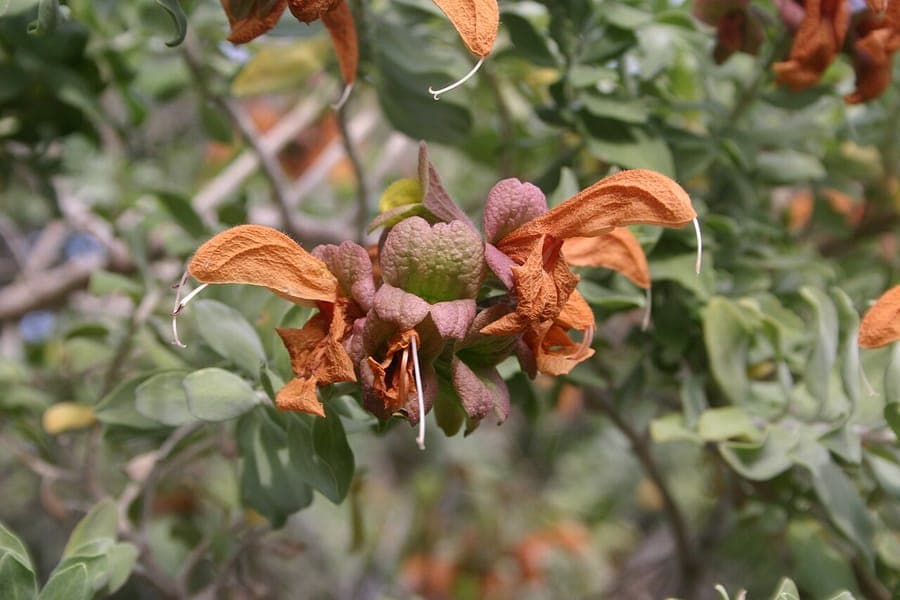
Androstachys / CC BY-SA 3.0, via Wikimedia Commons
Salvia africana-lutea: complete guide
Salvia africana-lutea
Want to see Salvia africana-lutea: complete guide in your garden?
1 minute, no credit card
Overview
Salvia africana-lutea, known as yellow dune sage or brown sage, is a South African sage species from the Lamiaceae family (mint family). The plant grows naturally along the coasts of South Africa where it tolerates salty wind and dry conditions. The name "africana-lutea" refers to South African origin and yellow flower color.
This is a Mediterranean sage ideal for gardens with dry, sunny conditions. The plant offers not only beautiful flowers but also aromatic leaves usable in the kitchen. In Western Europe, this sage thrives in south-facing gardens.
Appearance and bloom
Salvia africana-lutea grows as a compact to medium-sized shrub (60-90cm) with gray-green, strongly aromatic foliage. The leaves are linear to lance-shaped, quite tough and feeling dry. This is an adaptation to dry climates.
The flowers are the highlight - bright yellow to orange-yellow, appearing July through September. The flowers are characteristic for sages with two lips - upper and lower. The plant blooms long and produces abundant nectar for pollinators.
After blooming, small seed heads form, remaining interesting through winter. The plant retains its foliage year-round - no leaf drop. This makes it suitable for year-round winter structure.
Ideal location
Salvia africana-lutea grows best in full sun locations. At least 6-8 hours direct sunlight daily is essential. The plant tolerates shade poorly - in partial shade growth becomes weak.
The plant loves warm, sheltered locations. In the Netherlands and Belgium, south-facing walls and raised beds work well. Avoid cold, windy places where the plant suffers.
In garden design, this sage fits perfectly in Mediterranean gardens, drought-garden designs, and bird gardens. The plant can also be used for container plants brought indoors in winter.
Soil
Salvia africana-lutea grows best on very well-drained, lean soils. Heavy clay soils are unsuitable - adding lots of sand is essential. The plant accepts acidic to neutral pH (6-7.5).
Organic-rich soils can be problematic - this sage grows better in lean conditions. A soil mix of 40% garden soil, 40% sand, 20% gravel works well. This seems like a lot of sand, but it's necessary for drainage.
Avoid clay or peat soils. These retain too much water causing rot.
Free design
Want to see Salvia africana-lutea: complete guide in your garden? Make a free design now.
Watering
Salvia africana-lutea is very drought-tolerant once established. In the first growing year, moderate watering is helpful - especially in dry heat. After establishment (after 1-2 years), no extra water is needed.
From May through October, depending on rainfall, give minimal water. In normal years rain is usually sufficient. Only in extremely dry summers (more than 6 weeks drought) add water.
Autumn and winter: don't water unless extremely dry. The plant enters minimal growth. Wet winter conditions are bad - drainage is more important than water.
Pruning
Salvia africana-lutea requires minimal pruning. In late spring (April) old, dead branches can be removed. This stimulates new growth from the base.
Spent flowers don't need removal - the plant naturally sheds these. The plant doesn't tolerate rough pruning well. Work carefully and remove only dead and very weak wood.
Complete rejuvenation (cutting back to half height) can be done in early spring, but this doesn't need to be annual.
Maintenance calendar
April: Inspection, remove dead branches May-June: Monitor growth, minimal watering July-September: Enjoy blooms, no deadheading needed October: Winter preparation November-March: Winter rest, no water
Winter hardiness
Salvia africana-lutea is moderately hardy to about -5 to -8degC. In the Netherlands and Belgium, this plant can survive mild winters outdoors, but freezing can occur in severe winters. This is the biggest limitation of this plant.
In cold regions (northern Netherlands, Belgium), it's advisable to grow this sage in pots brought indoors for winter. A bright windowsill or cold frame (0-5degC) is ideal. In south-facing, sheltered spots outdoor overwintering can succeed.
Young plants absolutely need protection in their first winter with mulch (10-15cm) or burlap cloth.
Companion plants
Salvia africana-lutea combines well with other Mediterranean plants:
- Lavender (Lavandula) - similar drought tolerance
- Rosemary (Rosmarinus) - classic combination
- Santolina - yellow blooms together
- Cistus - pink flowers for contrast
- Ornamental grasses - structure contrast
- Yarrow (Achillea) - yellow color echo
Conclusion
Salvia africana-lutea offers Mediterranean beauty and kitchen value. This South African sage thrives in dry, sunny gardens and delivers yellow flowers for pollinators. The plant is ideally suited for sustainable, drought-tolerant gardens.
For this southern sage: grow in pots in colder regions, or plant in very sheltered, south-facing locations. You won't find this plant in standard garden centers - specialized herb nurseries or online growers have it.
On gardenworld.app, combine this exotic sage with other Mediterranean plants for a sunny, dry front garden design.
Want to see Salvia africana-lutea: complete guide in your garden? Make a free design now.
Upload a photo, pick a style, and get a photorealistic design with plant list in under a minute.
No credit card required


Similar plants
Sage: complete guide
Salvia officinalis
Everything you need to grow and care for Salvia officinalis: ideal spot, soil needs, pruning, and winter hardiness for gardens in temperate climates.
Salvia greggii: complete guide
Salvia greggii
Discover the benefits of Salvia greggii, a vibrant autumn sage with attractive flowers and minimal maintenance needs. Perfect bird plant for Mediterranean gardens.
Woodland sage: complete guide
Salvia nemorosa
Everything about Woodland Sage (Salvia nemorosa): planting, care, pruning and combinations. Expert tips for months of blue-violet flower spikes.