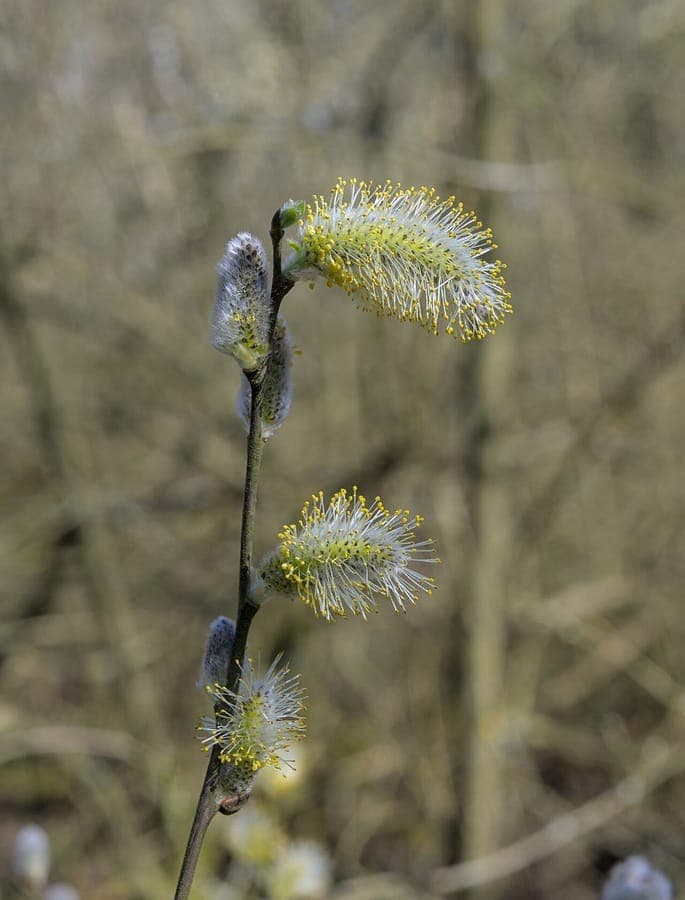
Trougnouf (Benoit Brummer) / CC BY 4.0, via Wikimedia Commons
Goat willow (Salix caprea): complete guide
Salix caprea
Want to see Goat willow (Salix caprea): complete guide in your garden?
Full design in HD: €7.99
Look after your Goat willow with the GardenWorld app
Identify plants with your camera and get a care calendar with reminders for this plant.


Overview
The goat willow (Salix caprea), also known as pussy willow or great sallow, is the willow of the catkins. As early as February or March, while the rest of the garden is still grey and bare, its branches are studded with soft, silvery buds that burst within weeks into yellow, pollen-laden flower spikes. For bees and bumblebees it is one of the most important food sources of early spring, and for gardeners one of the most cheerful signs that winter is ending.
Salix caprea belongs to the willow family (Salicaceae) and is native to almost all of Europe and much of Asia. In the wild you will find it along woodland edges, in clearings, on railway embankments and on rough ground. Unlike many willows, it does not need a wet riverbank and grows happily on fairly dry soil. In the garden you can use it as a loose shrub, a small multi-stemmed tree or part of a mixed native hedge. There is also the well-known weeping form 'Kilmarnock', a compact weeping tree that fits even a small garden. At gardenworld.app you can have a garden design made in which a goat willow takes its place as an early bee plant, for example at the back of a naturalistic border.
Appearance and flowering period
In the wild the goat willow grows into a large shrub or small tree of 3 to 10 metres, occasionally taller, with a broad, open crown 4 to 8 metres across. Young twigs are downy at first, later smooth and reddish-brown to olive green. The leaves are unusually broad for a willow: elliptic to almost round, 5 to 12 cm long, with a short tip that is often bent to one side. The upper surface is dark green, the underside grey and felted. In autumn they turn yellow before falling.
The goat willow is dioecious, meaning each plant carries either male or female catkins. Flowering runs from late February to April, well before the leaves emerge. The male catkins are the familiar ones. They start as egg-shaped, silver-grey tufts 2 to 4 cm long and then become covered in yellow anthers full of pollen, as in the photograph above. Female catkins are greenish grey, slightly longer and less showy. In May their seed capsules split and release countless seeds with white fluff that drift on the wind. If you would rather avoid the fluff, choose a male plant; 'Kilmarnock' is always male.
The catkins are a feast for insects. Queen bumblebees, honeybees and many solitary bees, including some species that forage almost exclusively on willow, collect their first pollen and nectar here. Later in the year the caterpillars of the purple emperor butterfly, among others, feed on the leaves.
Ideal position
Give the goat willow full sun or light partial shade. It flowers most generously in sun. It tolerates wind well, which makes it suitable for open, rural gardens and windbreaks. In shade it grows sparser and produces fewer catkins.
Bear the roots in mind. Like all willows, the goat willow develops an extensive, shallow root system that seeks out water. Plant it at least 5 to 8 metres from buildings, drains, land drains and pond liners. For a small town garden or patio, the grafted weeping form 'Kilmarnock' is a better choice: it reaches only 1.5 to 2.5 metres in height and 1.5 to 2 metres in width, and can even grow in a large container.
Soil requirements
The goat willow is undemanding. It grows on sand, loam and clay, on acidic and on chalky soils. A moisture-retentive, reasonably fertile soil gives the fastest growth, but it copes with drier spots better than most other willows. Only permanently waterlogged, airless ground and very poor, dry sand are less suitable.
Work some compost into the planting hole and loosen the soil well. Plant bare-root stock during the dormant season, from November to March, in frost-free weather. Container plants can go in at any time of year, provided you water well in summer. Feeding is unnecessary afterwards; a mulch of leaf mould around the base is enough.
Free preview
Want to see Goat willow (Salix caprea): complete guide in your garden? Make a free preview of your design.
Watering
In the first and second year after planting, give 10 to 20 litres of water weekly during dry spells so the roots can establish properly. After that, a mature goat willow in open ground usually looks after itself, even in dry summers. A long spring drought can, however, lead to smaller leaves and early leaf fall.
A 'Kilmarnock' in a container dries out much faster. Check the compost every few days in summer and water as soon as the top few centimetres are dry. Make sure there are good drainage holes, because even a willow dislikes a pot that is permanently waterlogged.
Pruning
Always prune the goat willow after flowering, in April or May. That way you enjoy the catkins and the bees get their food. A shrub can be coppiced every few years to 30 to 50 cm above ground, after which it regrows vigorously. For a tree form, gradually remove the weakest stems and keep three to five strong ones. Cut out dead and crossing wood.
The weeping form 'Kilmarnock' is grafted onto a straight stem of about 1 to 1.8 metres. Prune it every year after flowering: thin the crown by removing some of the oldest and densest branches at their base, and shorten branches that trail on the ground. Importantly, remove straight away any upright shoots that appear below the graft from the stem or roots. These are suckers from the rootstock, which would otherwise smother the weeping head.
Care calendar
January–February: plant bare-root stock in frost-free weather. In mild winters the first silver catkins appear in late February.
March–April: full flower. Leave the branches for the bees. Only cut stems for a vase from your own garden; in the wild, leave them be.
April–May: prune after flowering. Remove suckers from 'Kilmarnock'. Female plants release their fluffy seed.
June–August: water young and container plants during dry spells. Check for willow leaf beetle, aphids and rust.
September–October: the leaves turn yellow. Spread a layer of leaf mould around the base.
November–December: ideal planting time for bare-root stock. Do not prune now, or you will lose the catkins.
Hardiness
Salix caprea is exceptionally hardy. It withstands temperatures well below -30 °C and grows wild as far north as Scandinavia and Siberia. In Britain and north-west Europe it needs no winter protection at all. Late night frosts rarely do serious damage to the catkins either.
Only a 'Kilmarnock' in a container deserves some attention: in severe winters, move the pot against a sheltered wall or wrap it in hessian so that the root ball does not freeze solid.
Toxicity and allergy
The goat willow is not known to be poisonous to people or pets. The bark contains salicin, the compound from which aspirin was later developed, but in the small amounts a nibbling animal might take in this is not a concern. Rabbits and goats love the twigs, which explains the scientific name caprea, from the Latin for goat. People with hay fever may, however, react to willow pollen in March and April.
Companion plants
The goat willow fits beautifully into a natural, bee-friendly garden. Combine it with other early flowers for insects, such as hazel (Corylus avellana) with its yellow catkins and the cornelian cherry (Cornus mas). For a mixed hedge with berries, add hawthorn (Crataegus monogyna) and rowan (Sorbus aucuparia); that gives you flowers and fruit for birds and insects from February to autumn.
Beneath the shrub, where it is still light in spring, snowdrops (Galanthus nivalis), crocuses and wood anemones feel at home. They flower at the same time as the catkins and together create the first picture of spring.
Final thoughts
Salix caprea is a simple, tough and valuable plant for any garden with a little space. It needs little care, grows almost anywhere and provides food for dozens of insect species at a time when hardly anything else is in flower. Plant it well away from buildings and drains, prune after flowering and enjoy its silver catkins every spring. If space is tight, choose the weeping form 'Kilmarnock'.
Want to know when to plant, prune or remove suckers? The plant calendar at gardenworld.app lists the jobs for your goat willow and the rest of your garden month by month.
Frequently asked questions about Goat willow
Is Goat willow winter hardy?
Salix caprea is exceptionally hardy. It withstands temperatures well below -30 °C and grows wild as far north as Scandinavia and Siberia.
When and how do you prune Goat willow?
Always prune the goat willow after flowering, in April or May. That way you enjoy the catkins and the bees get their food.
How much water does Goat willow need?
In the first and second year after planting, give 10 to 20 litres of water weekly during dry spells so the roots can establish properly. After that, a mature goat willow in open ground usually looks after itself, even in dry summers.
What soil does Goat willow need?
The goat willow is undemanding. It grows on sand, loam and clay, on acidic and on chalky soils.

See it in your garden
See Goat willow in your garden
One photo of your garden and a few questions. You see the result in about a minute.
Try it with a photoIdentify this plant in your own garden. Identify a plant
Similar plants
Hazel (Corylus avellana): complete guide
Corylus avellana
Everything about Hazel (Corylus avellana): planting, pruning, harvesting hazelnuts and best cultivars. Practical tips for this versatile native shrub.
Cornelian-cherry: complete guide
Cornus mas
Everything you need to know about Cornus mas: growth, flowering, planting tips, care and companion plants. Perfect for UK and US gardens, hardy to zone 5.
Hawthorn: complete guide
Crataegus monogyna
Learn how to grow and care for Hawthorn (Crataegus monogyna): ideal location, pruning, soil needs, and companion plants for UK and European gardens.
