
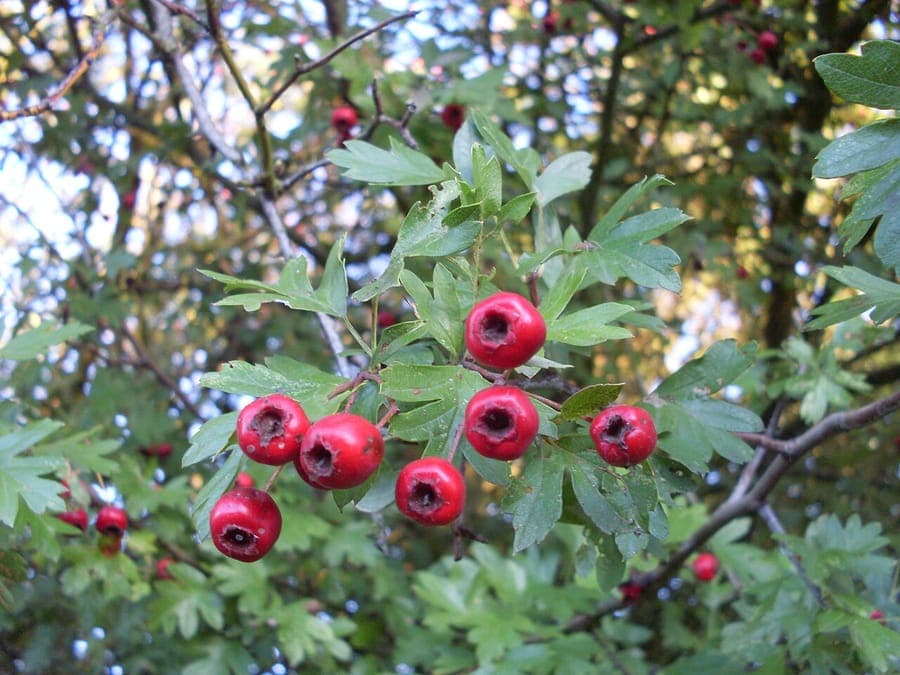
Elstro / CC BY 3.0, via Wikimedia Commons
Hawthorn: complete guide
Crataegus monogyna
Want to see Hawthorn: complete guide in your garden?
1 minute, no credit card
Overview
Hawthorn (Crataegus monogyna) is a resilient, deciduous shrub or small tree native to much of Europe, including the Baltic States, Balkans, and parts of North Africa. Belonging to the Rosaceae family, it's a staple in traditional hedgerows and woodland gardens. Hardy, low-maintenance, and ecologically valuable, hawthorn thrives in both rural and suburban settings. Whether you're planting a wildlife hedge or a solitary specimen near a garden border, this plant delivers year-round interest. On gardenworld.app, you can design a garden layout that integrates hawthorn perfectly into native planting schemes or formal hedges.
Appearance & bloom cycle
Hawthorn grows to a height of 4–8 meters with a spread of 3–5 meters, forming a dense, bushy structure. Its branches are armed with sharp thorns up to 3 cm long, making it excellent for security hedging. The deeply lobed leaves are dark green in summer, turning golden-yellow to orange-red in autumn. In May, clusters of fragrant white flowers bloom - a sight so iconic it inspired the common name "May tree". Each flower has five petals and a single style (hence monogyna). By late summer, these develop into small, red pome fruits (haws), about 1 cm in diameter. These persist into winter, feeding birds like thrushes and finches. The bark becomes fissured with age, adding winter texture.
Ideal location
Hawthorn prefers full sun to light shade (light level 7/10). It needs at least 5–6 hours of direct sunlight daily for optimal flowering and fruiting. It tolerates exposed, windy sites and coastal conditions, making it ideal for boundary plantings. Avoid deep shade, which leads to sparse growth and reduced blooms. It's often planted as a hedge (spaced 30–50 cm apart), as a standalone tree in cottage gardens, or as part of a mixed native screen. Keep it away from high-traffic areas due to its thorns.
Soil requirements
This species is adaptable to a wide range of soils - clay, loam, or sand - as long as drainage is adequate. It struggles in waterlogged or permanently wet ground. The ideal pH range is 6.0–7.2 (slightly acidic to neutral). On heavy clay, improve drainage with grit or compost. On sandy soils, add organic matter to boost moisture retention. It tolerates chalky soils but may show lime-induced chlorosis if pH exceeds 7.5. A mulch of well-rotted compost in spring helps maintain soil structure.
Free design
Want to see Hawthorn: complete guide in your garden? Make a free design now.
Watering
Young plants need consistent watering in their first growing season - about 10–15 liters once a week during dry spells. After establishment (year two onwards), hawthorn is highly drought-tolerant and rarely needs supplemental water, except during prolonged droughts (over 4 weeks without rain). Established trees can access deep moisture with their extensive root system. Avoid overwatering, as this can lead to root rot.
Pruning
Prune in late winter or early spring (February–March) to maintain shape or keep hedges tight. Avoid summer pruning, which can reduce flowering the following year. Use sharp, disinfected secateurs and wear thick gloves - those thorns are no joke. Remove dead, crossing, or inward-growing branches to improve airflow. For hedges, trim lightly once a year; for specimen trees, minimal pruning is needed beyond structural shaping when young.
Maintenance calendar
- Jan: Inspect for damage, remove any broken branches
- Feb: Prepare for pruning, check for bird nests
- Mar: Prune, apply compost mulch around the base
- Apr: Monitor new growth, water if dry
- May: Full bloom - do not prune!
- Jun: Watch for aphids or mildew on new leaves
- Jul: Check for drought stress, no feeding required
- Aug: Haws begin to form, keep an eye on pests
- Sep: Foliage starts to change, avoid pruning
- Oct: Rake fallen leaves, haws still present
- Nov: Mulch young plants for winter protection
- Dec: Final check, no active care needed
Winter hardiness
Hawthorn is fully hardy down to -25°C (USDA zones 5–8). It handles cold winds and frost without issue. Young plants benefit from a 5–10 cm mulch layer to insulate roots. Mature trees require no protection. It's commonly used in agroforestry and windbreaks across temperate Europe.
Companion plants
Pair hawthorn with other native shrubs like blackthorn (Prunus spinosa), dogwood (Cornus sanguinea), or hazel (Corylus avellana) for a mixed hedge. Underplant with woodland species such as bluebells (Hyacinthoides non-scripta), wood anemone (Anemone nemorosa), or bugle (Ajuga reptans). Avoid fast-spreading perennials that may compete for root space. On gardenworld.app, you can plan companion groupings that balance aesthetics, growth rates, and seasonal interest.
Closing
Hawthorn is a tough, reliable plant that earns its place in any garden. It supports biodiversity, provides structure, and asks for little in return. Available at most garden centres across the UK and Europe, including online retailers and local nurseries, it's typically sold as bare-root plants in winter or potted specimens year-round. Look for healthy stems, undamaged bark, and strong branching. Whether you're restoring a countryside hedge or designing a wildlife-friendly garden, hawthorn delivers. Plant it right, give it space, and it will thrive for decades.
Want to see Hawthorn: complete guide in your garden? Make a free design now.
Upload a photo, pick a style, and get a photorealistic design with plant list in under a minute.
No credit card required


Similar plants
Siberian crab apple: complete guide
Malus x robusta
Complete guide to the Siberian crab apple (Malus x robusta): location, soil, pruning, winter hardiness and the best companion plants for your garden.
Chinese flowering crabapple (Malus x spectabilis): complete guide
Malus x spectabilis
Meet the Chinese flowering crabapple (Malus x spectabilis): a classic spring bloomer with carmine buds and pink blossom.
Potentilla crassinervia: complete guide
Potentilla crassinervia
Potentilla crassinervia, the Corsican cinquefoil, grows wild on Corsica and Sardinia's peaks. Discover how to grow this hardy alpine rock garden gem.