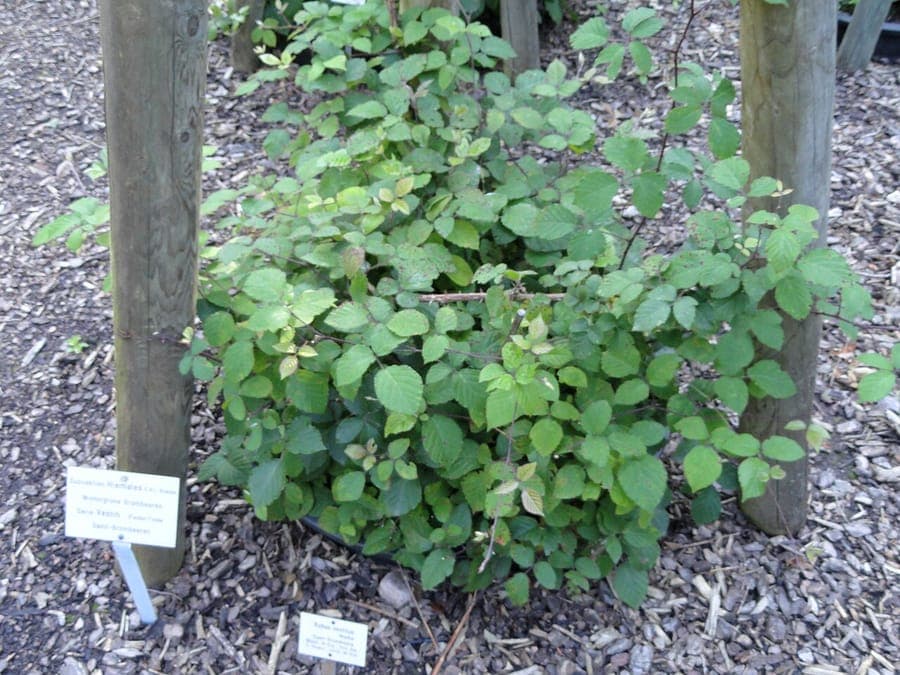
Daderot / CC0, via Wikimedia Commons
European blackberry: complete guide
Rubus vestitus
Want to see European blackberry: complete guide in your garden?
Full design in HD: €7.99
Look after your European blackberry with the GardenWorld app
Identify plants with your camera and get a care calendar with reminders for this plant.


Overview
The European blackberry (Rubus vestitus) is a versatile bramble species native to much of Western, Central, and Southern Europe. Unlike many brambles that appear rough or invasive, this species is distinguished by its softly hairy, velvety stems - the feature that earned its name (vestitus = clothed). The plant offers not only aesthetic value with its white-pink flowers and glowing red ripening fruits, but also delicious, sweet blackberries for harvest.
Appearance & bloom cycle
The European blackberry grows as a perennial shrub reaching 2-2.5 meters tall, or higher if supported. The defining characteristic is the soft, velvety covering of the stems - this feels warm and smooth to the touch, unlike the harsh thorns of many other brambles.
Leaves are trifoliate, green with finely serrated edges. Flowers appear May-June: white-pink or pale pink blooms approximately 1.5-2 cm wide, with a fresh, herbal scent. They attract insects readily.
Fruits mature from green through red to glossy black. Ripe blackberries measure about 1-1.5 cm across, are soft, sweet, and aromatic - considerably superior to many commercial cultivars. They ripen July-September depending on weather.
Ideal location
Plant European blackberry where it receives at least 5-6 hours of sunlight daily. Full sun provides the best fruiting, but the plant tolerates light shade. This makes it suitable for semi-natural gardens and woodland edge planting.
The plant is hardy to USDA zone 5 (-25°C) and grows successfully in virtually all temperate European climates. In warm regions, it tolerates drought better than many other brambles.
Soil requirements
European blackberry is not demanding regarding soil type. It performs best, however, on well-draining soil with adequate organic matter. A soil pH of 5.5-7.0 is suitable. The plant is quite salt-tolerant, making it appropriate for coastal gardens.
Amend poor soils with compost or leaf mold for better growth. Heavy clay soils should be improved with sawdust and sand. Waterlogging should be avoided, though the plant tolerates wetter conditions better than American bramble cultivars.
Free preview
Want to see European blackberry: complete guide in your garden? Make a free preview of your design.
Watering
Regular watering is essential upon planting, especially during the first dry weeks. Water newly planted specimens regularly until they establish firm roots (first year).
Once established, the plant can rely largely on natural rainfall in temperate climates. During dry periods - especially during fruiting - provide supplemental water. A good mulch layer aids moisture retention.
Pruning
European blackberry flowers and fruits on two-year-old canes. Maintenance pruning:
- Immediately after harvest (September): Remove all canes that bore fruit at ground level.
- Winter (December-January): Cut back lateral shoots to 40-60 cm.
- Early spring (March): Remove damaged or dead wood.
This plant can also be trained against a trellis if desired. Pinch back lateral shoots regularly.
Maintenance calendar
March: Spring pruning; check soil condition.
April: New growth emerges - no special measures.
May-June: Flowering period - ornamental and attracts insects.
July-September: Fruiting and harvest; maintain regular watering.
October-February: Quiet period; adjust pruning as needed.
Winter hardiness
European blackberry is extremely hardy to -25°C. In severe winters, young shoots may freeze, but the rootstock recovers quickly. Protection with mulch in very cold years (below -20°C) may benefit young plants.
Companion plants
European blackberry pairs well with:
- Native fruit plants: Hawthorn, blackthorn - same cultural requirements.
- Shrubs: Hazel, bird cherry - for a natural woodland edge.
- Ground covers: Ivy, beech hedge - plantable beneath the bramble.
Conclusion
The European blackberry is a wild, native bramble that has been valued for centuries for its fruits and natural charm. With its soft velvety stems, lovely flowers, and flavorful berries, it's a worthy addition to genuinely food-producing gardens.
Want to integrate brambles into your garden plan? Discover on gardenworld.app how to position fruit-bearing structures efficiently. View examples of productive gardens on gardenworld.app.
Frequently asked questions about European blackberry
Is European blackberry winter hardy?
European blackberry is extremely hardy to -25°C. In severe winters, young shoots may freeze, but the rootstock recovers quickly.
When and how do you prune European blackberry?
European blackberry flowers and fruits on two-year-old canes. Maintenance pruning: - Immediately after harvest (September): Remove all canes that bore fruit at ground level. - Winter (December-January): Cut back lateral shoots to 40-60 cm. - Early spring (March): Remove damaged or dead wood.
How much water does European blackberry need?
Regular watering is essential upon planting, especially during the first dry weeks. Water newly planted specimens regularly until they establish firm roots (first year).
Where does European blackberry grow best?
Plant European blackberry where it receives at least 5-6 hours of sunlight daily. Full sun provides the best fruiting, but the plant tolerates light shade.
What soil does European blackberry need?
European blackberry is not demanding regarding soil type. It performs best, however, on well-draining soil with adequate organic matter.

See it in your garden
See European blackberry in your garden
One photo of your garden and a few questions. You see the result in about a minute.
Try it with a photoIdentify this plant in your own garden. Identify a plant
Similar plants
New Zealand bur (Acaena microphylla): care guide
Acaena microphylla
Acaena microphylla forms a low, bronze-green carpet with red spiny burs in summer. Advice on position, soil, trimming, hardiness and keeping its spread in check.
Apple serviceberry: complete guide
Amelanchier × grandiflora
Everything about apple serviceberry (Amelanchier × grandiflora): white April flowers, edible berries, autumn colour, position, pruning and cultivars such as 'Ballerina'.
Dwarf goat's beard (Aruncus aethusifolius): complete guide
Aruncus aethusifolius
Everything about dwarf goat's beard (Aruncus aethusifolius): position, soil, watering, pruning and hardiness. A compact perennial with lacy leaves for shade and rock gardens.
