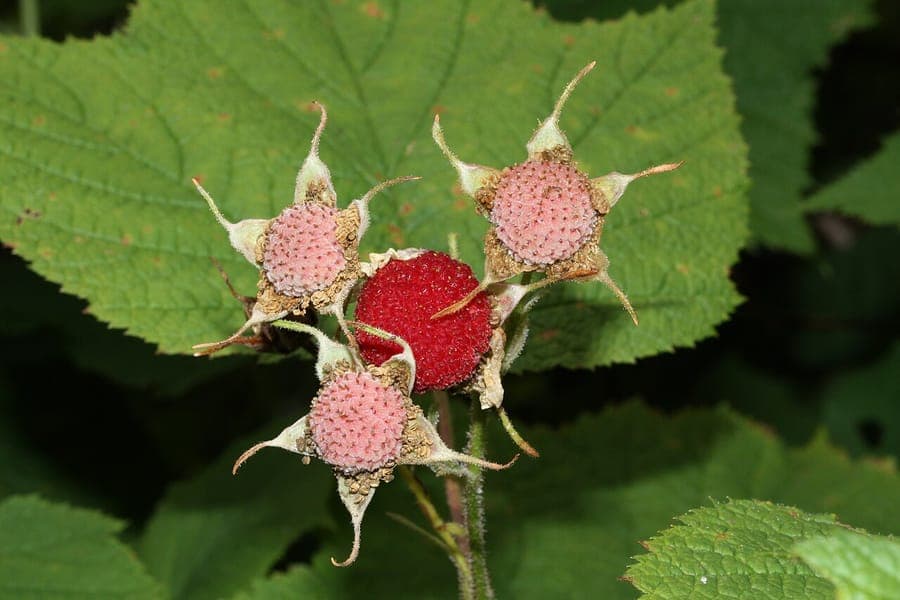
Walter Siegmund (talk) / CC BY-SA 3.0, via Wikimedia Commons
Thimbleberry: complete guide
Rubus parviflorus
Want to see Thimbleberry: complete guide in your garden?
Full design in HD: €7.99
Look after your Thimbleberry with the GardenWorld app
Identify plants with your camera and get a care calendar with reminders for this plant.


Overview
Rubus parviflorus, commonly called thimbleberry or salmonberry (German: Nutka-Himbeere), is a North American bramble of the rose family (Rosaceae). Ranging from British Columbia to California and New Mexico, this plant reaches 100-150 centimeters tall and is distinguished by extraordinarily large, five-fingered leaves (up to 25 centimeters diameter) and soft, red raspberries with warm summer flavor. Hardy in USDA zones 5-8, it suits cooler climates throughout Europe and North America. This is truly a plant for those wanting to combine exotic beauty with practical use. The leaves alone justify its garden position.
Appearance and Fruits
Rubus parviflorus forms a loose, thorn-free (!) shrub with thick, reddish-brown canes. Leaves are the most striking feature: extremely large, palmately lobed, with five to nine wavy lobes, reaching 25 centimeters across. The foliage is soft, pleasantly textured, and possesses subtle sheen. In summer, white flowers (3 centimeters), small (hence "parviflorus"), appear in umbel-like clusters. Fruits are soft, juicy red-orange raspberries of 1-2 centimeters in diameter, ripening July through August, with pleasant tart-sweet, walnut-like flavor and enchanting aroma.
Ideal Location
Rubus parviflorus thrives in half-shade to moderate shade (two to four hours of sunlight daily). In full sun in hot climates, foliage can scorch badly. The plant tolerates north-facing sites and forest-edge positions excellently. In North America, it naturally inhabits forests and along mountain streams. Plant in cool-climate gardens with adequate moisture and some protection from extreme afternoon heat. In Mediterranean climates it may suffer heat stress and prefers additional shade.
Soil
Rubus parviflorus prefers moist, humus-rich soils with good drainage. It dislikes dry sand. Improve soil with abundant organic matter: peat, leafmold, composted bark to a depth of 30 centimeters. A slightly acidic pH of 5.0 to 6.5 is ideal; the plant tolerates highly alkaline soils poorly. Drainage is critical; waterlogging causes root rot. This is not a plant for lean soils.
Free preview
Want to see Thimbleberry: complete guide in your garden? Make a free preview of your design.
Watering
After establishment (3-4 weeks), water regularly: keep soil consistently lightly moist, never soggy. During the growth phase (May-August), water deeply twice weekly in dry periods. In cooler, more humid climates with regular rainfall, supplemental water is usually unnecessary. The plant tolerates drought worse than brambles; complete drying can reduce fruit quality significantly. This is truly a moisture-lover.
Pruning and Shaping
Rubus parviflorus requires minimal pruning. After the fruiting season (August-September), remove dead, damaged, or diseased canes. The plant naturally forms itself in loose, graceful growth. Very old canes (older than four years) may be removed to encourage vitality. Because the plant is thornless, pruning is far more pleasant than other brambles.
Maintenance Calendar
March-April: Prepare growth period. Light pruning of dead canes. Water if dry. Observe buds unfurling. May-June: Bloom period. Abundant white flowers. Regular watering essential. Bird sounds increase. July-August: Harvest period. Pick red raspberries daily for best flavor. Water regularly. Plant bristles with promise. September-October: Fruiting ends. Prune damaged canes. Prepare for winter. Foliage turns attractively. November-February: Dormancy. Minimal watering. Plant drops leaves.
Winter Hardiness
Winterhardiness in USDA zones 5-8 (minimum -25 to -5 degrees Celsius). This means hardiness throughout much of Europe, including Britain, France, and Central Europe. In zone 5, extreme cold may kill canes back to certain levels, but the plant resprouts from the base. In cold zone 5 winters, mulch lightly around the base for protection.
Companion Plants
Pair Rubus parviflorus with other shade-lovers and cool-climate plants: Hydrangea arborescens with matching preference for half-shade and moist soil; Sambucus canadensis (American elder) with similar moisture and shade preference; Ferns which screen well with Thimbleberry; Astilbe with pink plumes nestling under large leaves; Heuchera (coral bells) with interesting foliage texture contrast. Avoid drought-stressed plants and full-sun lovers entirely.
Closing
Rubus parviflorus (thimbleberry) is a North American jewel offering exotic appeal to cool-climate gardens. With massive, palmate leaves, thorn-free growth, and delicious red raspberries, it is a striking alternative to traditional brambles. For shady corners in cool regions, Rubus parviflorus deserves recognition and prominent placement.
Frequently asked questions about Thimbleberry
Is Thimbleberry winter hardy?
Winterhardiness in USDA zones 5-8 (minimum -25 to -5 degrees Celsius). This means hardiness throughout much of Europe, including Britain, France, and Central Europe.
When and how do you prune Thimbleberry?
Rubus parviflorus requires minimal pruning. After the fruiting season (August-September), remove dead, damaged, or diseased canes.
How much water does Thimbleberry need?
After establishment (3-4 weeks), water regularly: keep soil consistently lightly moist, never soggy. During the growth phase (May-August), water deeply twice weekly in dry periods.
Where does Thimbleberry grow best?
Rubus parviflorus thrives in half-shade to moderate shade (two to four hours of sunlight daily). In full sun in hot climates, foliage can scorch badly.
What soil does Thimbleberry need?
Rubus parviflorus prefers moist, humus-rich soils with good drainage. It dislikes dry sand.

See it in your garden
See Thimbleberry in your garden
One photo of your garden and a few questions. You see the result in about a minute.
Try it with a photoIdentify this plant in your own garden. Identify a plant
Similar plants
New Zealand bur (Acaena microphylla): care guide
Acaena microphylla
Acaena microphylla forms a low, bronze-green carpet with red spiny burs in summer. Advice on position, soil, trimming, hardiness and keeping its spread in check.
Apple serviceberry: complete guide
Amelanchier × grandiflora
Everything about apple serviceberry (Amelanchier × grandiflora): white April flowers, edible berries, autumn colour, position, pruning and cultivars such as 'Ballerina'.
Dwarf goat's beard (Aruncus aethusifolius): complete guide
Aruncus aethusifolius
Everything about dwarf goat's beard (Aruncus aethusifolius): position, soil, watering, pruning and hardiness. A compact perennial with lacy leaves for shade and rock gardens.
