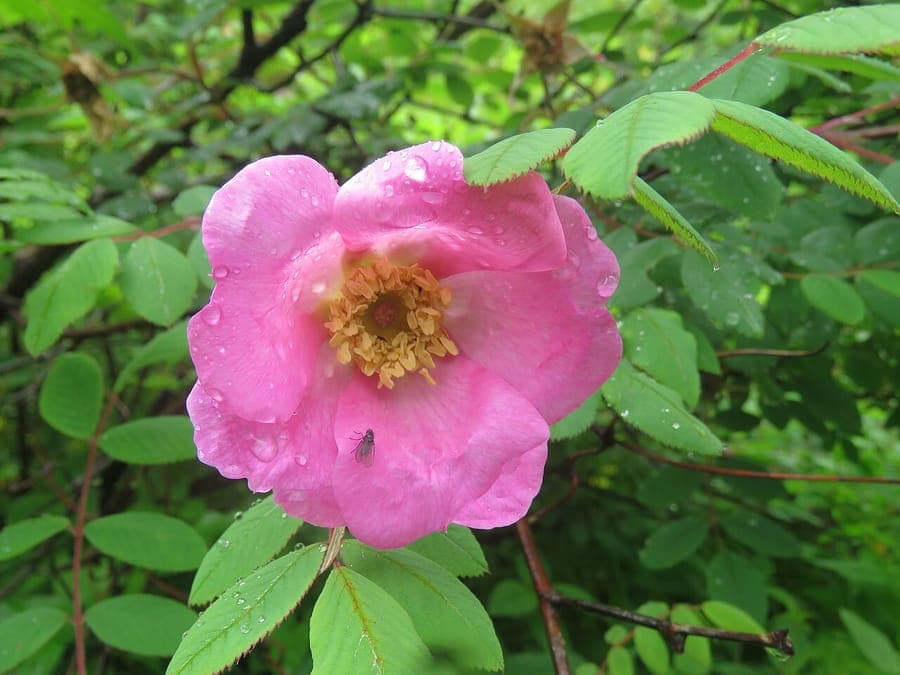
Vinayaraj / CC BY-SA 4.0, via Wikimedia Commons
Rosa macrophylla: complete guide
Rosa macrophylla
Want to see Rosa macrophylla: complete guide in your garden?
Full design in HD: €7.99
Look after your Rosa macrophylla with the GardenWorld app
Identify plants with your camera and get a care calendar with reminders for this plant.


Overview
Rosa macrophylla, commonly called Big-hip Rose or Himalayan Rose, is a striking deciduous shrub from the Rosaceae family. Native to the Himalayan range from Afghanistan to China and Tibet, this plant provides dramatic accents to contemporary gardens. With its pink flowers in May and June and exceptionally large red hips persisting through October, it delivers drama and bird-feeding bounty throughout the season.
The plant is named for its notably large foliage and spectacular oversized fruits. It remains popular among European and international gardeners for its impressive appearance and bird-attracting hips.
Appearance and Bloom
Big-hip Rose develops into a striking deciduous shrub reaching 200-350 centimeters tall with an open, elegantly branched structure. This is among Roses with the largest foliage: 8-12 centimeter long leaves with 7-9 leaflets per leaf. Foliage is glossy green in color. In autumn, leaves turn yellow to orange before dropping.
Flowering consists of single to semi-double pink flowers in clusters of 2-5 blooms per stem. Flowers measure approximately 4-5 centimeters across, bright pink in color, with yellow stamens. They appear May through June. Flowers offer subtle sweet fragrance.
After flowering, exceptionally characteristic large red hips develop, approximately 2-3 centimeters long, slightly bristly. These are unusually large for Roses and persist through October on the shrub. Hips strongly attract birds and are highly valued.
Ideal Location
Big-hip Rose performs best in fully sunny positions, though it tolerates dappled shade. Minimum 5-6 hours direct sunlight daily is optimal for best flowering and fruiting. This makes it suitable for open gardens and woodland edges.
This shrub excels in modern informal gardens, mixed shrub plantings, woodland edges, and landscape gardens. Its striking form and large hips make it an impressive specimen plant. Ensure adequate space for full development.
Soil
Rosa macrophylla is reasonably tolerant of various soil types, performing best in well-drained, neutral to lightly acidic soil. Optimal conditions exist in pH 6.0-7.0 range. However, the plant also accepts more alkaline soils.
The species prefers well-draining soil without waterlogging. Heavy, waterlogged soils can cause root rot. In heavy clay soils, improve drainage with sand or compost.
Free preview
Want to see Rosa macrophylla: complete guide in your garden? Make a free preview of your design.
Watering
Big-hip Rose is reasonably drought-tolerant once established. However, as a mountain native, it prefers regular watering. Provide regular watering during the first growing season until well established.
Once established, minimal supplemental water is needed as long as the plant receives regular moisture. The plant thrives with consistent watering, especially during dry summers. In winter, provide moderate watering. Mulch around the base aids moisture retention.
Pruning
Light pruning after flowering (July-August) promotes shape maintenance. Remove spent flowers and prune overextended canes back to suitable buds. This stimulates bushier growth.
During dormancy, dead wood can be removed. Remove only damaged or very old canes. Extensive pruning is not recommended as it can limit fruit set.
Maintenance Calendar
Winter (November-February): Dormant period. Hips remain on shrub. Minimal watering. Spring (March-May): Active growth commences. Regular watering begins. Flowering appears. Summer (June-August): Flowering declines. Prune after flowering. Regular watering continues. Fall (September-October): Hips ripen dramatically. Birds consume hips. Minimal water requirement.
Winter Hardiness
Big-hip Rose is winter-hardy to approximately -15 to -20 degrees Celsius, making it suitable for most UK and northern European gardens. The species tolerates frost provided drainage is excellent.
In extremely wet winters, protection of young plants may prove beneficial. Generally, it exhibits good winter hardiness.
Companion Plants
Combine Big-hip Rose with complementary informal landscape plants:
- Other Rosa species, for color variation
- Sambucus (elderberry), for green structure
- Viburnum, for winter interest
- Cornus (dogwood), for winter twig interest
- Syringa (lilac), for spring interest
Closing
Rosa macrophylla is a striking shrub with large foliage, pink blooms in May and June, and spectacular oversized red hips through October. Perfect for modern informal gardens seeking drama and bird-feeding value. With moderate pruning and regular watering, expect years of natural splendor.
Available from specialty rose nurseries.
Want more roses with bird-attracting hips? Visit gardenworld.app/en for wildlife garden expertise. Also check gardenworld.app/nl for Dutch language wildlife gardening guidance.
Frequently asked questions about Rosa macrophylla
Is Rosa macrophylla winter hardy?
Big-hip Rose is winter-hardy to approximately -15 to -20 degrees Celsius, making it suitable for most UK and northern European gardens. The species tolerates frost provided drainage is excellent.
When and how do you prune Rosa macrophylla?
Light pruning after flowering (July-August) promotes shape maintenance. Remove spent flowers and prune overextended canes back to suitable buds.
How much water does Rosa macrophylla need?
Big-hip Rose is reasonably drought-tolerant once established. However, as a mountain native, it prefers regular watering.
Where does Rosa macrophylla grow best?
Big-hip Rose performs best in fully sunny positions, though it tolerates dappled shade. Minimum 5-6 hours direct sunlight daily is optimal for best flowering and fruiting.
What soil does Rosa macrophylla need?
Rosa macrophylla is reasonably tolerant of various soil types, performing best in well-drained, neutral to lightly acidic soil. Optimal conditions exist in pH 6.0-7.0 range.

See it in your garden
See Rosa macrophylla in your garden
One photo of your garden and a few questions. You see the result in about a minute.
Try it with a photoIdentify this plant in your own garden. Identify a plant
Similar plants
New Zealand bur (Acaena microphylla): care guide
Acaena microphylla
Acaena microphylla forms a low, bronze-green carpet with red spiny burs in summer. Advice on position, soil, trimming, hardiness and keeping its spread in check.
Apple serviceberry: complete guide
Amelanchier × grandiflora
Everything about apple serviceberry (Amelanchier × grandiflora): white April flowers, edible berries, autumn colour, position, pruning and cultivars such as 'Ballerina'.
Dwarf goat's beard (Aruncus aethusifolius): complete guide
Aruncus aethusifolius
Everything about dwarf goat's beard (Aruncus aethusifolius): position, soil, watering, pruning and hardiness. A compact perennial with lacy leaves for shade and rock gardens.
