Ulf Eliasson / CC BY 2.5, via Wikimedia Commons
Kiftsgate rose (Rosa filipes): complete guide
Rosa filipes
Want to see Kiftsgate rose (Rosa filipes): complete guide in your garden?
Full design in HD: €7.99
Look after your Kiftsgate rose with the GardenWorld app
Identify plants with your camera and get a care calendar with reminders for this plant.


Overview
Rosa filipes is a wild rambling rose from western China and, in the form of the cultivar 'Kiftsgate', one of the most vigorous roses you can plant in a garden. The species was introduced to Europe in the early twentieth century by the plant hunter Ernest Wilson. Its most famous form has grown since the 1930s at Kiftsgate Court in Gloucestershire, where the original plant became a giant more than 20 m across, swallowing an entire tree. It was given the name 'Kiftsgate' there in the 1950s.
The species name filipes means thread-footed and refers to the long, slender flower stalks. Rosa filipes belongs to the rose family (Rosaceae). Anyone planting it should know what they are taking on: a mature 'Kiftsgate' easily reaches 10 to 15 m high and wide, and can put on several metres in a good year. It is far too big for a pergola, a house wall or a small garden. Grown into an old tree, over a barn or along a long wall, however, it is an unforgettable sight. On gardenworld.app you can have a garden design drawn up that allows for the space a giant rambler like this needs.
Appearance and bloom cycle
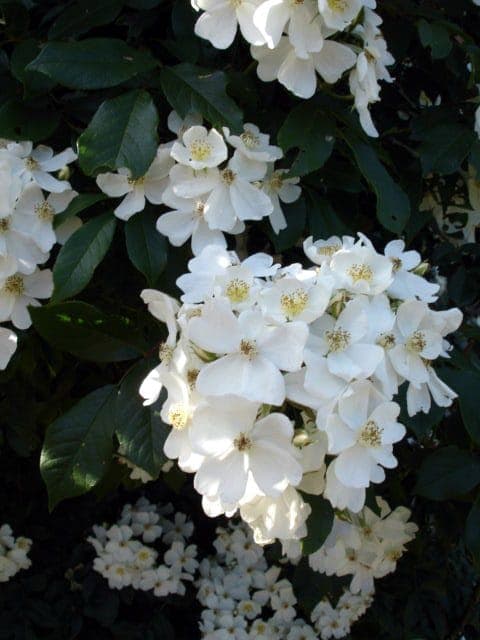
In late June and July Rosa filipes flowers in huge, loose clusters of sometimes more than a hundred blooms at once. Each flower is single, 2 to 3 cm across, creamy white with a ring of golden stamens, as the photo shows. The scent is sweet and musky, strongest on warm evenings, and draws bees, bumblebees and hoverflies. Flowering lasts three to four weeks and comes once a year.
In autumn small oval hips of about 1 cm follow, orange at first and then red, hanging on the branches well into winter. Blackbirds and thrushes love them. The leaves have five to seven leaflets and are a striking coppery red when they unfurl, turning glossy green later. The long, pliable stems carry hooked prickles that the rose uses to grip onto branches.
Ideal location
Rosa filipes grows in sun or partial shade. In the wild it scrambles through woodland edges and thickets in search of light, which makes it ideal for growing into a large tree. Choose a sturdy, healthy tree with an open crown, such as an old apple, an oak or a large hawthorn. A young or weak tree may buckle under the weight or lose too much light.
Plant the rose 1 to 1.5 m from the trunk on the side of the prevailing wind, so the wind blows the stems into the tree rather than away from it. Guide the first shoots to the lowest branches with a rope or an angled cane. Keep it at least 3 m from paths and seating areas, as the prickles snag on clothes and skin.
Soil requirements
This rose is not fussy about soil as long as it does not stay waterlogged. A fertile, humus-rich loam or clay is ideal, but it also does well on sandy soil if you work plenty of compost and well-rotted manure into the planting hole. A pH from slightly acidic to slightly alkaline is fine.
The ground beneath a tree is often dry and full of roots, so dig a generous hole of 60 by 60 cm and fill it with improved soil. Plant in autumn or early spring, with the graft union, if there is one, 5 cm below the surface. A mulch of compost or bark chips holds moisture and suppresses weeds.
Watering
For the first two years after planting Rosa filipes needs regular water, especially beneath a tree that takes up a lot of moisture itself. In dry spells give 15 to 20 litres once or twice a week, preferably in the morning and at the base of the plant. Once the roots are deep enough the rose usually fends for itself.
On sandy soil or during long heatwaves a thorough soaking remains worthwhile later on. A 5 cm layer of mulch cuts evaporation. A spring dressing of rose fertiliser or compost in March is enough; extra feeding is rarely needed for such a strong grower.
Free preview
Want to see Kiftsgate rose (Rosa filipes): complete guide in your garden? Make a free preview of your design.
Pruning
Like other ramblers, Rosa filipes flowers on the previous year's wood. Never prune it in spring, or you will cut away the flowers. In practice this rose needs very little pruning, as it is meant to grow freely. In August, after flowering, simply remove dead or damaged wood and any stems hanging in the way.
If the plant becomes too large, you can take a few of the oldest stems down to the ground after flowering; the rose will then shoot strongly from the base. This kind of renewal pruning does cost some of the following year's flowers. Leave the hips if you want to help the birds. Always wear stout gloves and eye protection.
Maintenance calendar
November to March: Best planting season for bare-root or container roses, as long as the ground is not frozen.
March: Apply rose fertiliser or compost and renew the mulch.
April and May: Guide young stems towards the tree or support. Check for aphids.
June and July: Full flower. Water during dry spells, especially in the first few years.
August: Remove dead wood and stems hanging over paths. Renewal pruning if needed.
September and October: The hips colour up. No more pruning.
December to February: Rest. The hips stay on as winter food for birds.
Winter hardiness
Rosa filipes is fully hardy throughout the British Isles and the Low Countries, tolerating temperatures down to around -20 °C. In severe winters the tips of young stems may be frosted, but the plant simply regrows in spring. No protection is needed beyond a mulch around the base of newly planted roses.
It is a fairly healthy rose. Black spot and powdery mildew can occur but are rarely serious, because the plant grows high in an airy tree canopy. As for pets, roses are regarded as non-toxic to dogs and cats. The real hazard is the hooked prickles, which can injure animals and children.
Companion plants
Let a clematis such as Clematis montana climb into the tree alongside the rose: it flowers in May and fills the gap before the rose opens. At the base, choose plants that cope with partial shade and some dryness. Foxglove (Digitalis purpurea) flowers at the same time as the rose and adds vertical spires in pink and white; note that foxglove is highly poisonous. Bigroot cranesbill (Geranium macrorrhizum) forms a dense, aromatic ground cover.
If you want more roses, plant the Chinese species Rosa moyesii nearby for its flask-shaped red hips. As a host tree, an old crab apple (Malus sylvestris) or an orchard apple is ideal, with white roses hanging like garlands among the fruit.
Final thoughts
Rosa filipes 'Kiftsgate' is not a rose for every garden, but where there is room it delivers a spectacle you will never forget: a whole tree turning white and musky in July, followed by thousands of red hips through winter. Give it space, a sturdy host tree and enough water in its early years, and then simply let it grow.
The plant calendar on gardenworld.app shows month by month when to plant, feed and prune, so you never accidentally remove next year's flowers. If you have an old tree that could use some extra sparkle, plant a Rosa filipes at its foot this winter.
Frequently asked questions about Kiftsgate rose
Is Kiftsgate rose winter hardy?
Rosa filipes is fully hardy throughout the British Isles and the Low Countries, tolerating temperatures down to around -20 °C. In severe winters the tips of young stems may be frosted, but the plant simply regrows in spring.
When and how do you prune Kiftsgate rose?
Like other ramblers, Rosa filipes flowers on the previous year's wood. Never prune it in spring, or you will cut away the flowers.
How much water does Kiftsgate rose need?
For the first two years after planting Rosa filipes needs regular water, especially beneath a tree that takes up a lot of moisture itself. In dry spells give 15 to 20 litres once or twice a week, preferably in the morning and at the base of the plant.
Where does Kiftsgate rose grow best?
Rosa filipes grows in sun or partial shade. In the wild it scrambles through woodland edges and thickets in search of light, which makes it ideal for growing into a large tree.
What soil does Kiftsgate rose need?
This rose is not fussy about soil as long as it does not stay waterlogged. A fertile, humus-rich loam or clay is ideal, but it also does well on sandy soil if you work plenty of compost and well-rotted manure into the planting hole.

See it in your garden
See Kiftsgate rose in your garden
One photo of your garden and a few questions. You see the result in about a minute.
Try it with a photoIdentify this plant in your own garden. Identify a plant
Similar plants
Himalayan clematis: complete guide
Clematis montana
Everything you need to know about Clematis montana: fast-growing climber with spring flowers, perfect for walls, fences, and arbors. Care, pruning, and planting tips.
Foxglove: complete guide
Digitalis purpurea
Everything about the foxglove (Digitalis purpurea): dramatic flower spires, shade performer, self-seeder and toxicity. Expert tips for this spectacular border plant.
Rock crane's-bill: complete guide
Geranium macrorrhizum
Rock crane's-bill (Geranium macrorrhizum) is a tough groundcover thriving in sun or partial shade. Great for rock gardens and dry spots. Grows 20-30 cm tall.
