
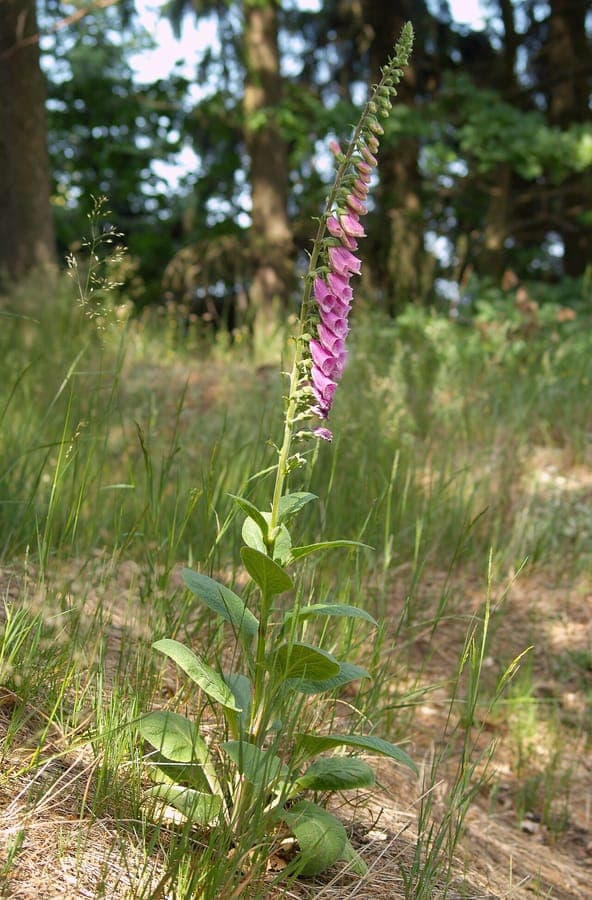
Jörg Hempel / CC BY-SA 3.0 de, via Wikimedia Commons
Foxglove: complete guide
Digitalis purpurea
Want to see Foxglove: complete guide in your garden?
1 minute, no credit card
Overview
The foxglove (Digitalis purpurea) is one of the most dramatic presences in the summer border. Those tall, upright flower spires - reaching up to one-and-a-half metres and sometimes nearly two - packed with bell-shaped flowers in shades of pink, purple, and white, conjure images of English cottage gardens, woodland edges, and wild places. It is a plant that brings vertical punch to spots where few other plants can match it.
Digitalis purpurea grows wild across western and southwestern Europe, from Portugal to Norway, and is native to the British Isles where it colonises woodland clearings, hedgerows, and heathland with abandon. The plant is biennial: in year one it forms a leaf rosette, in year two it sends up the spectacular flower tower, sets seed, and dies. But do not let that put you off - foxgloves self-seed so freely that after two years you will never be without them again. On gardenworld.app you can create a garden design where foxgloves provide vertical accents in a shady border or a naturalistic planting scheme.
A critical warning: all parts of the foxglove are highly toxic. The plant contains digitalis glycosides, compounds that affect the heart and are used in pharmaceutical manufacturing as the basis for cardiac medications. Wear gloves when handling and do not plant foxgloves where small children play unsupervised.
Appearance and bloom
In its first year, Digitalis purpurea forms a flat rosette of large, oval, velvety-hairy leaves that are grey-green on top and silvery beneath. The rosette is striking and decorative in its own right, but gives no hint of the spectacle that will follow the next year.
In year two - typically June and July - a robust, straight stem rises from the centre of the rosette, reaching 100 to 180 centimetres in height. Along one side of this stem hang densely packed, tubular to bell-shaped flowers 4 to 6 centimetres long. The flowers open from bottom to top, which extends the flowering period to three or four weeks.
The colour of the wild species is a characteristic rosy purple on the outside, with the interior displaying a white to cream ground peppered with dark purple spots ringed by a white halo. This patterning serves as a landing guide for bumblebees, the primary pollinators. White-flowered forms also occur naturally in wild populations.
Popular cultivars and strains: the Excelsior Group (flowers held all around the stem rather than one-sided, in various colours), the Camelot series (compact, sometimes flowers in year one), the Dalmatian series (compact, 45–60 cm, reliably flowers in year one from seed, ideal for containers), 'Pam's Choice' (white with maroon spots), and 'Sutton's Apricot' (apricot-pink, distinctive).
Ideal location
The foxglove is one of the few spectacularly flowering plants that excels in partial shade to light shade. In nature, the plant grows along woodland edges and in clearings where it receives filtered light. Translate this to the garden: a spot beneath the canopy of tall trees, along the north side of a wall or fence, or in a partially shaded border is ideal.
In full sun the foxglove also grows, but the flowers fade faster and the plant requires more water. In deep, permanent shade the stems become lank and the bloom sparse. The plant tolerates shelter well and actually benefits from a position out of the wind, as the tall flower stems can topple in strong gusts - particularly specimens exceeding 150 centimetres.
Foxgloves self-sow abundantly on open, slightly disturbed ground. Leave the seed spires standing after flowering, and the following spring young rosettes will appear throughout the border. This self-seeding habit is a gift for anyone who loves a natural, relaxed garden style.
Soil requirements
Digitalis purpurea prefers a moisture-retentive, humus-rich soil that is slightly acidic to neutral (pH 5.5–7.0). The plant grows naturally in woodland soil rich in leaf mould and organic matter. On heavy clay, the leaf rosette may rot in a wet winter if drainage is insufficient.
When planting, mix the soil with compost or leaf mould. A mulch of composted leaves mimics the woodland floor where the plant naturally grows and improves conditions significantly. On poor, dry sandy soil the foxglove grows smaller and flowers less abundantly - add extra compost and ensure adequate water.
Strongly alkaline, chalky soil is less suitable. Improvement with acidic compost or peat substitutes can help. In practice, however, foxgloves are remarkably tolerant: the plant appears in feral form in the most unexpected places, from building sites to railway embankments across the UK, as long as there is some light and a degree of moisture.
Free design
Want to see Foxglove: complete guide in your garden? Make a free design now.
Watering
The foxglove prefers evenly moist soil but tolerates brief dry spells. In the first year, when the leaf rosette is establishing, regular watering matters: give a good soaking once a week in dry weather. In year two, when the flower stem is growing rapidly and the blooms are developing (May–July), adequate moisture is crucial for strong, tall flower spires.
Water at the root zone and avoid wetting the leaf rosette - prolonged wet foliage can encourage leaf spot disease and powdery mildew. A mulch layer retains soil moisture and cools the roots, mimicking the ideal conditions of a moist woodland edge.
After flowering and seed set, water needs diminish as the plant dies. The young seedlings that appear in autumn typically establish without supplementary water unless conditions are extremely dry.
Pruning
With foxgloves, the pruning strategy is a deliberate choice that shapes the future look of your garden. There are two approaches:
Strategy 1 - Encourage self-seeding: Leave the spent flower spires standing until the seed has ripened (August–September). Each seed spike produces thousands of tiny seeds that germinate in the surrounding area. Remove the dead stems afterwards. The following spring, young rosettes will appear throughout the border, ready to be left in place or transplanted.
Strategy 2 - Controlled growth: Cut the spent flower spire immediately after flowering, before the seed ripens. This prevents uncontrolled self-sowing and can sometimes prompt the plant to produce a modest second flush from side shoots.
In both cases, remove the dead rosettes that remain after flowering in the first autumn. Leave the first-year rosettes of young plants intact through winter - they will produce the flower stems of the coming season.
Maintenance calendar
March–April: Overwintered rosettes resume growth. The flower stem appears. Apply a light dressing of compost. Seedlings from last year are now clearly visible as small rosettes - transplant them if desired.
May–June: Flower spires grow rapidly. Stake the tallest specimens if needed. Begin supplementary watering in dry weather. Enjoy the emerging bloom.
June–July: Full bloom. The flower spires are at their peak. Bumblebees and bees visit the tubular flowers. Remove spent spires to limit self-seeding, or leave them for seed.
August–September: Seed spires ripen (if left standing). New seedlings appear as small rosettes on open ground. Remove dead flower stems.
October–November: Young rosettes are clearly visible. Leave them to overwinter where they stand or transplant to preferred positions. Apply a light mulch.
December–February: Rosettes overwinter as evergreen leaf rosettes. No specific action required. In severe frost, a layer of straw can protect the rosettes.
Winter hardiness
Digitalis purpurea is fully hardy across the UK, most of the USA, and the cooler regions of Australia and South Africa, tolerating temperatures down to -20°C and below (USDA zones 4–8). The plant is, after all, a native European wildflower. The overwintering leaf rosettes are evergreen and handle frost without difficulty. Only during prolonged severe frost without snow cover may the uppermost leaves suffer, but the plant always recovers in spring.
Seedlings that germinate in autumn are just as hardy as mature rosettes. They survive their first winter without any protection. The toughness of the foxglove is one reason the plant maintains itself so successfully in the wild and in naturalised gardens from Cornwall to the Scottish Highlands, from the Appalachian mountains to the Pacific Northwest.
Companion plants
The foxglove is the ideal plant for a partially shaded cottage garden or woodland garden. The vertical flower spires create a dramatic contrast with low-growing, broad-leaved plants such as hostas (Hosta), ferns (Dryopteris, Athyrium), and shade grasses (Hakonechloa macra, Luzula nivea). Rodgersia and Brunnera macrophylla offer textural contrast at the base.
In a more romantic setting, combine foxgloves with roses (Rosa rugosa), peonies (Paeonia lactiflora), and delphiniums for a lush, layered picture. Hydrangeas (Hydrangea macrophylla) flower after the foxgloves and carry the colour relay through summer.
For a naturalistic effect, plant foxgloves among wild grasses, Joe Pye weed (Eupatorium), and rosebay willowherb (Epilobium angustifolium). In a woodland-edge planting, the foxglove combines beautifully with Juneberry (Amelanchier lamarckii) and Japanese dogwood (Cornus kousa) in the tree layer above.
Closing
The foxglove is one of those magical garden plants that delivers maximum impact with minimum effort. The tall flower spires bring vertical drama to shady corners where few other plants can compete, and the self-seeding habit ensures the plant returns year after year without any intervention. It is a plant of wonder - each spring, those majestic towers appear seemingly from nowhere, as if by magic.
Buy seed or young plants from a garden centre and sow them in a partially shaded spot with moist, humus-rich soil. On gardenworld.app you can create a garden design where foxgloves provide the vertical structure in a shady border, a woodland garden, or a romantic cottage scheme. Respect the toxicity, wear gloves, and enjoy one of the most enchanting wild plants in the European flora.
Want to see Foxglove: complete guide in your garden? Make a free design now.
Upload a photo, pick a style, and get a photorealistic design with plant list in under a minute.
No credit card required


Similar plants
Bigleaf Hydrangea: complete guide
Hydrangea macrophylla
Everything about the Bigleaf Hydrangea (Hydrangea macrophylla): planting, pruning, flower colour control and winter protection. Practical tips for lush blooms.
Rugosa Rose: complete guide
Rosa rugosa
Everything about the Rugosa Rose (Rosa rugosa): planting, pruning, care and winter hardiness. Practical tips for abundant blooms in your garden.
Hosta: complete guide
Hosta
Everything about hostas (plantain lilies): varieties, planting, care and slug control. Expert tips for stunning foliage in shade gardens.