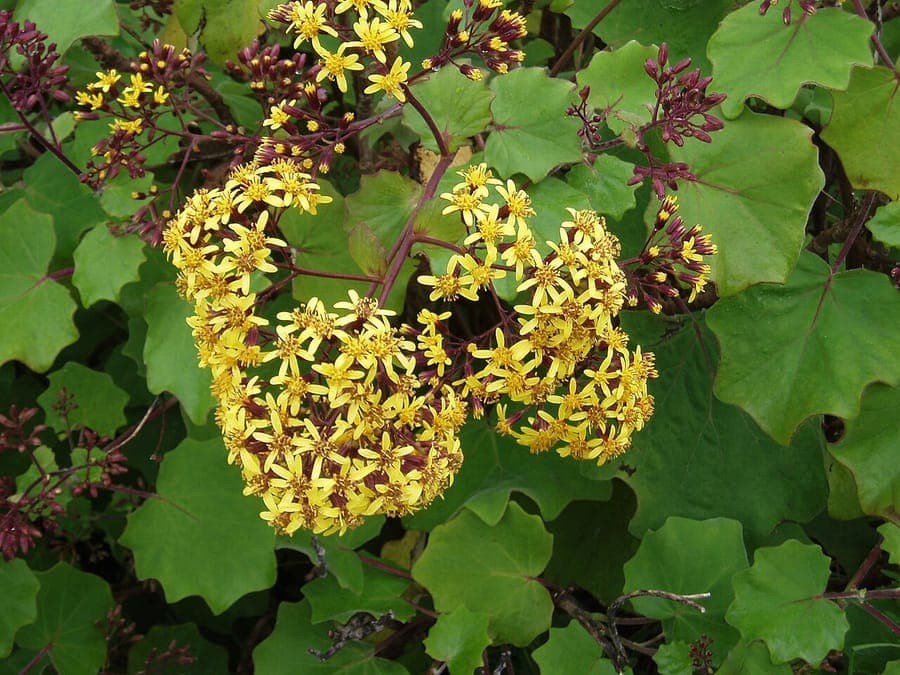
Ewen Cameron / CC BY 4.0, via Wikimedia Commons
Roldana petasitis: complete guide
Roldana petasitis
Want to see Roldana petasitis: complete guide in your garden?
Full design in HD: €7.99
Look after your Roldana petasitis with the GardenWorld app
Identify plants with your camera and get a care calendar with reminders for this plant.


Overview
Roldana petasitis, commonly known as California geranium or velvet groundsel, is a tropical shrub from Mexico with a preference for warmth and light. Despite its Californian name, the plant is native to Mexican highlands, where it grows in moderately dry forest margins. This plant belongs to the Asteraceae family (the same family as sunflowers) and is valued for its decorative foliage and cheerful yellow flowers. In front yard and container gardens, it forms a striking exotic accent.
Appearance and Bloom
Roldana petasitis grows into a compact shrub 60-150 centimeters tall with a voluminous, vase-shaped silhouette. The leaves are most distinctive: large (20-35 centimeters), heart-shaped, velvety green with distinct leaf veins. The upper surface feels soft due to fine hairs; the underside is lighter green with prominent veins. Flowers appear in September-November in clusters of small, bright yellow disc flowers on 5-8 centimeter long stalks. The flowering period is long and sustained until the first frost.
Ideal Location
Roldana petasitis thrives best in full sunlight (at least 6 hours of direct sun per day), although light partial shade is acceptable in warmer climates. Too little light causes elongated stems and sparse blooms. The plant tolerates no full shade. Protect from strong winds that can damage large leaves. Ideal is a south- or west-facing spot, sheltered from cold winds. In areas with very hot summers, afternoon shade can be beneficial.
Soil
Roldana petasitis thrives in well-drained, moderately fertile soil. Heavy clay is undesirable and causes root rot. Add sand, bark, and organic matter to improve drainage. In containers, use potting soil supplemented with 20% perlite or bark. The pH should be neutral to slightly acidic (6.0-7.5). Avoid strongly alkaline soil which can cause leaf yellowing.
Free preview
Want to see Roldana petasitis: complete guide in your garden? Make a free preview of your design.
Watering
Water regularly during the growing season (April-October) so the soil remains moist but not waterlogged. Check container moisture daily; pots dry quickly. In winter and cold periods, reduce drastically. Soft water is preferable. Excessive moisture leads to fungal infections; ensure adequate air circulation around the plant.
Pruning
Roldana petasitis responds well to pruning. Regularly pinch out growing tips to encourage a more compact, bushy plant. After flowering (November-December), drastic pruning back to 30-50 centimeters helps maintain shape and stimulates next season's blooming. Remove dead, damaged, or diseased wood at any time.
Maintenance Calendar
January-February: Overwintering in cold environment; minimal watering. March-April: Resume growth; begin moderate watering; apply balanced fertilizer. May-August: Water regularly; mist during dry periods; pinch out growing tips for compact form. September-October: Enjoy blooming; maintain watering. November-December: Blooming declines; prune back; reduce water supply.
Winter Hardiness
Roldana petasitis is not winter hardy in temperate climates. It tolerates minimum temperatures above 5-10°C; frost kills the plant. In temperate climates (Netherlands, Belgium, Germany), it is grown as an annual or container plant that must be brought indoors for winter. Seeds can be germinated indoors in February, or cuttings can be taken from mature plants.
Companion Plants
Roldana petasitis pairs well with:
- Pentas: for simultaneous long blooming
- Begonias: for contrasting leaf texture
- Echeverias: for textural contrast and arid look
- Solenostemon: for dramatic foliage patterns
- Ipomoea: for vertical dimension
Closing
Roldana petasitis offers an exotic twist on standard container and front yard gardens. Its velvety soft leaves and cheerful blooms reward the gardener with visual impact. Whether grown as an annual cultivar or overwintered, this Mexican plant adds character to any garden design. Consult Truffaut or Jardiland for plant sources, or GardenWorld.app for adaptations to your specific climate.
Frequently asked questions about Roldana petasitis
Is Roldana petasitis winter hardy?
Roldana petasitis is not winter hardy in temperate climates. It tolerates minimum temperatures above 5-10°C; frost kills the plant.
When and how do you prune Roldana petasitis?
Roldana petasitis responds well to pruning. Regularly pinch out growing tips to encourage a more compact, bushy plant.
How much water does Roldana petasitis need?
Water regularly during the growing season (April-October) so the soil remains moist but not waterlogged. Check container moisture daily; pots dry quickly.
Where does Roldana petasitis grow best?
Roldana petasitis thrives best in full sunlight (at least 6 hours of direct sun per day), although light partial shade is acceptable in warmer climates. Too little light causes elongated stems and sparse blooms.
What soil does Roldana petasitis need?
Roldana petasitis thrives in well-drained, moderately fertile soil. Heavy clay is undesirable and causes root rot.

See it in your garden
See Roldana petasitis in your garden
One photo of your garden and a few questions. You see the result in about a minute.
Try it with a photoIdentify this plant in your own garden. Identify a plant
Similar plants
Frikart's aster (Aster × frikartii): complete guide
Aster × frikartii
Everything about Frikart's aster (Aster × frikartii): position, soil, pruning and hardiness of the aster that flowers lavender-blue from July to October.
False aster (Boltonia asteroides): complete guide
Boltonia asteroides
False aster (Boltonia asteroides) covers itself in white daisies from late August to October. How to plant, cut back and combine this tough, tall perennial.
Daisy bush (Brachyglottis greyi): care guide
Brachyglottis greyi
Brachyglottis greyi, formerly Senecio greyi, pairs silver felted leaves with yellow summer daisies. Advice on position, soil, pruning, hardiness and companions.
