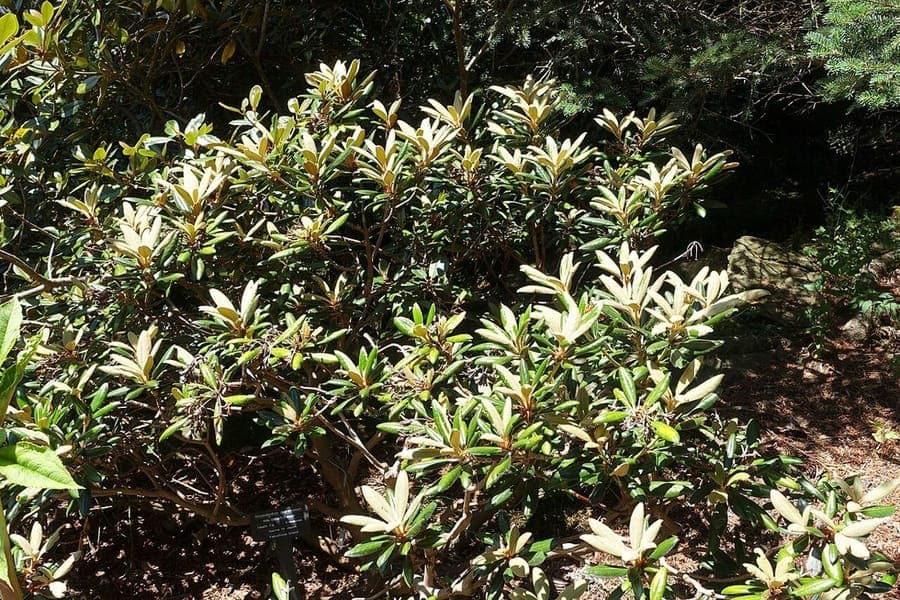
Daderot / CC0, via Wikimedia Commons
Yakushima rhododendron (Rhododendron yakushimanum): complete guide
Rhododendron yakushimanum
Want to see Yakushima rhododendron (Rhododendron yakushimanum): complete guide in your garden?
Full design in HD: €7.99
Look after your Yakushima rhododendron with the GardenWorld app
Identify plants with your camera and get a care calendar with reminders for this plant.


Overview
Rhododendron yakushimanum comes from a single island: Yakushima, south of Kyushu in Japan. There it grows high in the mountains, on windswept summits above the tree line where it rains almost every day and snow lies in winter. Those harsh conditions explain its compact, domed habit and its tough, felted leaves. Botanists now often treat it as a subspecies of Rhododendron degronianum, but gardeners still use the name yakushimanum, or simply Yak. Its English name is Yakushima rhododendron.
The first plants reached the English garden at Exbury in the 1930s. After the Second World War, the clone 'Koichiro Wada' caused a sensation: a low shrub covered in pink buds that open apple-blossom pink and fade to white. Since then the species has parented hundreds of compact hybrids, the so-called Yak hybrids, with names such as 'Percy Wiseman', 'Golden Torch' and 'Schneekrone'. They are especially suitable for smaller gardens.
What sets this rhododendron apart is that it looks good all year. In spring there are the flowers, then the silvery-white young shoots, and for the rest of the year the dark green leaves with felty brown undersides. If you want to choose a spot where a rhododendron can thrive alongside other acid-loving plants, you can have a garden design made on gardenworld.app that takes shade and soil type into account.
Appearance and bloom cycle
Rhododendron yakushimanum grows slowly into a dense, rounded dome. After ten years it is usually 80 cm to 1 m tall and 1 to 1.5 m wide, and it rarely grows much larger later on. The leaves are 7 to 10 cm long, narrow, leathery and with rolled-under edges. The upper side is glossy dark green; the underside is covered in a thick, cinnamon-brown felt known as indumentum.
The best moment outside flowering comes in May and June, when the new shoots appear. They are covered in silvery-white to fawn felt, making the shrub look as if it is studded with candles. After a few weeks the felt wears off the upper surface and the leaves turn green.
Flowering usually falls in the second half of May. Each truss holds about ten bell-shaped flowers 4 to 5 cm across. The buds are deep pink, the open flowers pale pink and, after a few days, almost white. As a result, one plant shows three shades at once. A mature shrub can flower so heavily that the foliage is barely visible.
Ideal location
Compared with most rhododendrons, this species tolerates more light. In a British or north-west European climate it grows well in morning sun or light shade. In a fully south-facing spot with fierce midday sun the leaves may scorch, especially if the soil dries out. An east- or west-facing spot, or a place under the light canopy of a taller tree, is ideal.
Shelter the shrub from cold, drying winter winds: evergreen leaves lose water while the ground is frozen. Its compact shape suits the front of a shrub border, the edge of a path, a Japanese-style garden or a large pot on the patio. Allow about 1 m between plants.
Soil requirements
Like all rhododendrons, Rhododendron yakushimanum needs acidic, humus-rich and open soil with a pH between 4.5 and 5.5. On chalky or heavy ground the leaves yellow through iron deficiency and the plant gradually declines. On acidic sandy soil it feels at home straight away, especially if you work plenty of leaf mould or ericaceous compost into the top 30 cm when planting.
If your garden is neutral or slightly alkaline, plant it in a raised bed filled with ericaceous compost or in a large pot. The roots are fine and shallow, so never plant too deeply: the top of the root ball should be level with the soil. A 5 cm mulch of bark, pine needles or leaf mould keeps the roots cool and moist. Avoid hoeing around the plant, as you will easily damage the roots.
Watering
The shallow roots dry out quickly. Keep the soil lightly moist at all times, but never waterlogged, as roots sitting in water rot. In dry spells, water thoroughly once or twice a week, about 10 to 20 litres per shrub.
Use rainwater where possible. Tap water is hard in many areas and gradually raises the pH. Pay particular attention in August and September: that is when next year's flower buds form, and a shortage of water means fewer flowers. During a dry, sunny late winter an extra watering can also help, as long as the ground is not frozen.
Free preview
Want to see Yakushima rhododendron (Rhododendron yakushimanum): complete guide in your garden? Make a free preview of your design.
Pruning
This rhododendron barely needs pruning, as its natural shape is already compact. It is worth carefully snapping off the faded trusses after flowering, though. Use your thumb and forefinger, and take care not to damage the young shoot buds just below the truss. That way the plant puts its energy into new growth and flower buds rather than seed.
An odd wayward or damaged branch can be cut back after flowering to just above a whorl of leaves. Hard pruning is rarely necessary, and this slow-growing species tolerates it less well than larger rhododendrons. Wear gloves when pruning and wash your hands afterwards, as the sap is poisonous.
Toxicity: grayanotoxins
Like all rhododendrons and azaleas, Rhododendron yakushimanum is poisonous to people and animals. Every part contains grayanotoxins: leaves, flowers, nectar and even honey from bees that collect a lot of rhododendron nectar. These compounds interfere with nerve and heart muscle function.
In people, eating leaves or flowers causes a burning sensation in the mouth, heavy salivation, nausea, vomiting, diarrhoea, dizziness and sweating. In serious cases blood pressure drops and the heart rate slows. Children who suck the flowers are therefore at risk. Teach them that this shrub is not for tasting.
The plant is dangerous to pets. In dogs and cats, just a few leaves can cause serious symptoms: vomiting, drooling, diarrhoea, weakness, a slow heartbeat and, in severe cases, collapse. Rabbits, guinea pigs, goats, sheep and horses are also highly sensitive. Never throw prunings over the fence into a paddock and never give them to small pets. If a child or adult has eaten part of the plant, contact a doctor or NHS 111 straight away. If an animal is involved, call your vet at once.
Maintenance calendar
March-April: Apply an ericaceous fertiliser or a layer of leaf mould. Top up the mulch. A good time to plant.
May: Flowering. Water in dry weather. Enjoy the buds fading from pink to white.
June: Snap off spent trusses. The silvery new shoots appear.
July-September: Next year's flower buds are forming, so watering in dry spells is now crucial. Check for notched leaf edges, a sign of vine weevil.
October-November: Another good planting period. Top up the mulch with fallen leaves.
December-February: Dormant season. Protect young plants from cold winds. Water in dry, sunny weather when the ground is not frozen.
The plant calendar on gardenworld.app lists the monthly jobs for rhododendrons and other shrubs in one place.
Winter hardiness
Thanks to its origins on windswept mountain tops, Rhododendron yakushimanum is very hardy, down to about -25 °C. In Britain and the Low Countries it survives without protection. In hard frost the leaves curl up; this is a natural defence against drying out, not a sign of damage.
The greatest winter risk is desiccation from frost combined with sun and wind. A sheltered spot and a good mulch are the best precautions. Plants in pots are more vulnerable; move them against a wall in severe winters and insulate the container.
Companion plants
Rhododendron yakushimanum combines well with other acid-loving plants. Pieris japonica, with its red young shoots, and Japanese maple (Acer palmatum) are perfect partners. For underplanting, choose hostas (Hosta sieboldiana), soft shield fern (Polystichum setiferum) and the low, evergreen wintergreen (Gaultheria procumbens) with its red berries.
In a Japanese-inspired garden, moss, boulders and a single Kousa dogwood (Cornus kousa) create a calm whole. Avoid pairing it with lime-loving plants such as lavender, whose soil needs are the opposite.
Final thoughts
Rhododendron yakushimanum is the ideal rhododendron for smaller gardens: compact, hardy, more tolerant of light than most and attractive all year with its pink-and-white flowers, silvery shoots and felted leaves. Give it acidic, open soil, rainwater and a sheltered spot in light shade, and over the decades it will grow into a perfect dome.
Do keep its toxicity in mind. In a garden with young children, small pets or grazing animals, choose its position carefully so the shrub stays out of their reach.
Frequently asked questions about Yakushima rhododendron
Is Yakushima rhododendron winter hardy?
Thanks to its origins on windswept mountain tops, Rhododendron yakushimanum is very hardy, down to about -25 °C. In Britain and the Low Countries it survives without protection.
When and how do you prune Yakushima rhododendron?
This rhododendron barely needs pruning, as its natural shape is already compact. It is worth carefully snapping off the faded trusses after flowering, though.
How much water does Yakushima rhododendron need?
The shallow roots dry out quickly. Keep the soil lightly moist at all times, but never waterlogged, as roots sitting in water rot.
Where does Yakushima rhododendron grow best?
Compared with most rhododendrons, this species tolerates more light. In a British or north-west European climate it grows well in morning sun or light shade.
What soil does Yakushima rhododendron need?
Like all rhododendrons, Rhododendron yakushimanum needs acidic, humus-rich and open soil with a pH between 4.5 and 5.5. On chalky or heavy ground the leaves yellow through iron deficiency and the plant gradually declines.

See it in your garden
See Yakushima rhododendron in your garden
One photo of your garden and a few questions. You see the result in about a minute.
Try it with a photoIdentify this plant in your own garden. Identify a plant
Similar plants
Japanese pieris: complete guide
Pieris japonica
Complete care guide for Japanese pieris (Pieris japonica): ideal location, soil, watering, pruning and companion plants. Perfect for shaded, acidic gardens.
Japanese Maple: complete guide
Acer palmatum
Everything about Japanese Maple (Acer palmatum): planting, pruning, cultivars and autumn colour. Expert tips for a spectacular ornamental tree in your garden.
Hosta sieboldiana: complete guide
Hosta sieboldiana
Hosta sieboldiana growing guide: large blue-green shade plant from Japan. Complete care tips, placement and maintenance for shady gardens and woodland areas.
