
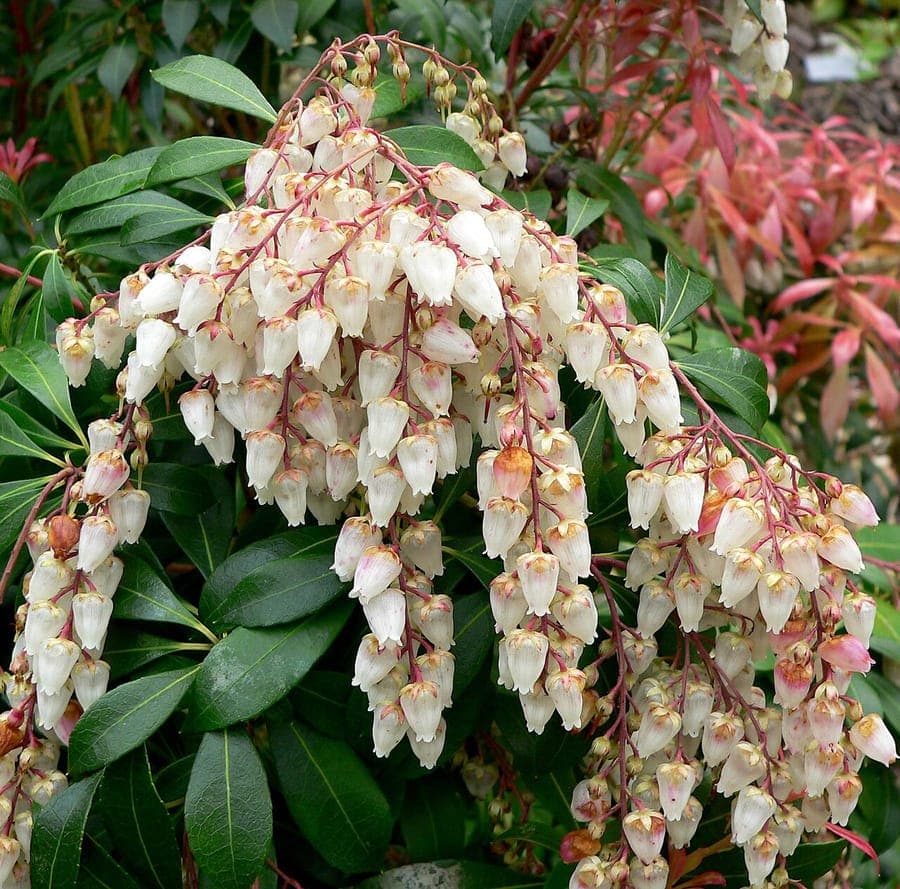
Stan Shebs / CC BY-SA 3.0, via Wikimedia Commons
Japanese pieris: complete guide
Pieris japonica
Want to see Japanese pieris: complete guide in your garden?
1 minute, no credit card
Overview
Pieris japonica, commonly known as Japanese pieris, is a graceful, evergreen shrub that brings year-round structure and seasonal drama to shaded gardens. Native to forested slopes in Japan, Taiwan, and parts of southern China, this member of the Ericaceae family thrives where many other shrubs struggle - in cool, acidic, well-drained soils with light to partial shade. It's a plant that earns its place not through flashy spectacle but through quiet consistency, offering fresh foliage, delicate blooms, and excellent form over decades.
Mature plants typically reach 1.5 to 2.5 meters in height and spread, growing at a steady pace of 15–25 cm per year. Hardy in USDA zones 7b to 9, it often survives even colder winters with minimal protection, especially when planted in sheltered spots. In colder regions, young specimens benefit from wind protection and a thick layer of mulch.
If you're planning a woodland garden or a shaded border, Japanese pieris deserves a spot. On gardenworld.app, you can explore design ideas that highlight its role in naturalistic planting schemes.
Appearance & bloom cycle
One of the standout features of Japanese pieris is its dramatic spring display. From late February to early April, depending on local climate, drooping clusters of urn-shaped flowers appear in shades of white to pale pink. These 10–15 cm long panicles hang elegantly from the branch tips and attract early pollinators like bees and bumblebees.
Even more striking are the new leaves that emerge just before or alongside the flowers. They start in vibrant bronze, red, or pinkish hues, gradually maturing to glossy dark green. This color transition lasts for weeks, adding dynamic interest to the garden. The foliage is leathery, lance-shaped, and 5–10 cm long, forming a dense, upright habit.
Ideal location
Choose a spot with dappled shade or morning sun and afternoon shade. Full sun is acceptable only in cool, moist climates - otherwise, it can lead to leaf scorch and stress. An east- or north-facing location works best. Japanese pieris enjoys sheltered areas, such as under deciduous trees, near building foundations, or along woodland edges.
For container growing, use a large pot (at least 40 cm diameter) with excellent drainage. Place it on pot feet to avoid waterlogging. In colder areas, move containers near a wall for extra protection. You can find inspiration for container combinations on gardenworld.app, including pairings with dwarf conifers and ferns.
Soil requirements
This shrub demands acidic soil with a pH between 4.2 and 5.5. It will struggle or decline in neutral to alkaline soils. Yellowing leaves with green veins (chlorosis) are a classic sign of high pH. Test your soil before planting.
Prepare the planting hole with a mix of 60% ericaceous compost, 30% leaf mold, and 10% horticultural sand. Avoid adding lime, chalk, or alkaline mulches. Never use compost from municipal sources - it's often too alkaline. Keep the rootball surrounded by acidic medium, even in heavy clay soils.
Free design
Want to see Japanese pieris: complete guide in your garden? Make a free design now.
Watering
Japanese pieris prefers consistently moist, well-drained soil. It's shallow-rooted, so it dries out faster than deep-rooted shrubs. Water deeply but infrequently, especially during the first two growing seasons and extended dry spells in summer. Use rainwater when possible - tap water often contains lime, which raises pH over time.
In containers, check moisture daily during hot weather. Water when the top 3–5 cm of soil feels dry. Mulching with pine bark or leaf litter helps retain moisture and maintains soil acidity.
Pruning
Pruning is rarely needed. Japanese pieris grows slowly and naturally into a pleasing shape. If needed, prune lightly right after flowering, between May and early June. Remove only damaged or crossing branches. Avoid cutting into old wood - it won't regenerate well.
Use sharp, clean secateurs. Sterilize tools between plants to prevent spreading diseases like honey fungus or phytophthora.
Maintenance calendar
- Jan: Inspect for winter damage, especially on young plants
- Feb: Watch for early blooms; protect from hard frosts
- Mar: Begin feeding with ericaceous fertilizer
- Apr: Peak bloom; monitor for aphids on new growth
- May: Light pruning after flowering; check soil moisture
- Jun: Water during dry spells
- Jul: No feeding; avoid disturbing roots
- Aug: Continue monitoring for drought stress
- Sep: Apply organic mulch with pine needles or bark
- Oct: Test soil pH; avoid lime-based products
- Nov: Protect container plants from freezing
- Dec: Wrap young plants with burlap if exposed to wind
Winter hardiness
Hardy in USDA zones 7b (–15°C) to 9, Japanese pieris can handle most UK and Pacific Northwest winters. However, late frosts can damage emerging flower buds. In exposed sites, use fleece or burlap wraps for young plants. Mature shrubs usually survive with little care.
Companion plants
Pair Japanese pieris with other acid-loving plants: Rhododendron, Azalea, Kalmia, and blueberries (Vaccinium). Ferns like Dryopteris or Matteuccia add texture below. Hostas, heucheras, and epimediums also work well in the understory.
In garden centres across the UK, you'll often find cultivars like 'Mountain Fire' (red new growth) or 'Valley Valentine' (deep pink flowers). Look for healthy, bushy specimens with no yellowing leaves.
Closing
Japanese pieris is a long-term investment in your garden's character. With the right soil and location, it rewards patience with decades of beauty. It's not a plant for sunny, chalky gardens - but in the right setting, it's unmatched. When in doubt, check gardenworld.app for planting guides, companion suggestions, and seasonal care tips tailored to Pieris japonica.
Want to see Japanese pieris: complete guide in your garden? Make a free design now.
Upload a photo, pick a style, and get a photorealistic design with plant list in under a minute.
No credit card required


Similar plants
Zenobia pulverulenta: complete guide
Zenobia pulverulenta
Everything about Zenobia pulverulenta (honeycup): siting, acid soil, pruning and the fragrant white bells, in this complete care guide.
Dwarf huckleberry: complete guide
Gaylussacia dumosa
Everything about dwarf huckleberry (Gaylussacia dumosa): acidic soil, partial shade, pruning and care for this compact North American berry shrub.
Drooping leucothoe: complete guide
Leucothoe fontanesiana
Everything about drooping leucothoe (Leucothoe fontanesiana): shade tolerance, soil, watering, pruning, hardiness and companion plants.