
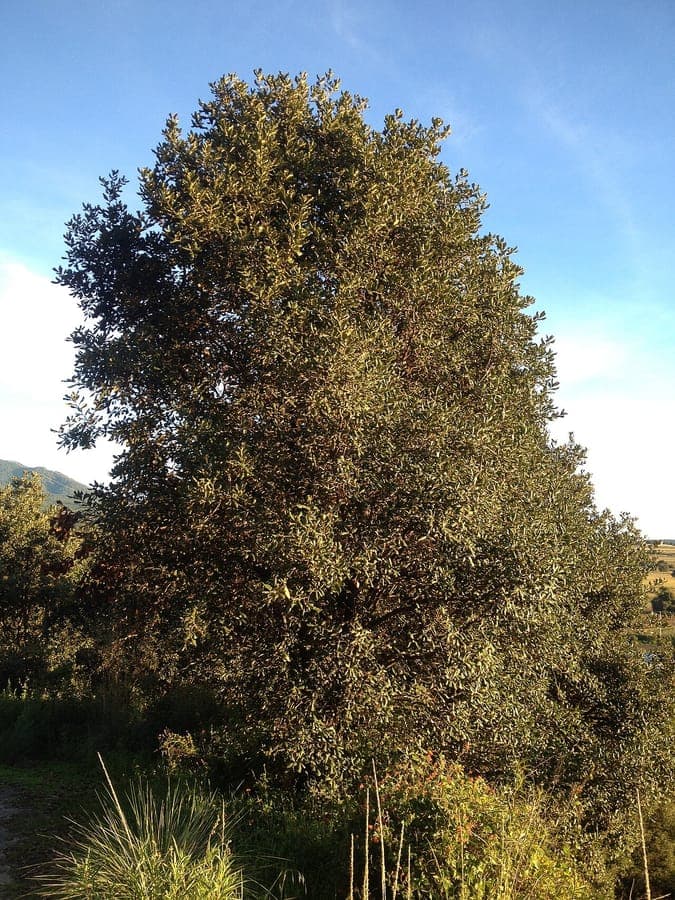
Bodofzt / CC BY-SA 4.0, via Wikimedia Commons
Netleaf oak: complete guide
Quercus rugosa
Want to see Netleaf oak: complete guide in your garden?
1 minute, no credit card
Overview
The netleaf oak (Quercus rugosa), also known as Net-leaf oak, is a native oak species from the Fagaceae family. This tree grows natively in the mountains of Arizona, New Mexico, Texas and further into Mexico and Guatemala. The name "rugosa" refers to the wrinkled texture of the leaves.
This evergreen oak is fully adapted to mountainous and desert environments with extreme temperature fluctuations. The tree grows on steep slopes, canyons and rocky terraces where water is scarce. It plays an important role in native ecosystems and also holds cultural significance in local communities.
Appearance and Bloom
The netleaf oak has very characteristic leaves. The leaves are small, rounded to obovate, with strong, wrinkled venation that distinguishes the leaf lamina. The leaf is leathery and dark green, with a coarse, net-like texture on the surface.
The tree is evergreen, meaning it retains its leaves year-round. In early spring, inconspicuous male and female flowers appear. The fruits are characteristic acorns in cupules with fine scales.
The tree grows slowly to moderately and eventually forms a broad, open crown with gray-brown bark. The branching structure is attractive and gives a natural form.
Ideal Location
The netleaf oak prefers fully sunny locations with at least 8 hours of direct sunlight daily. This tree thrives in open, exposed mountainous locations and tolerates extremely windy conditions.
It is ideal for mountainous gardens, canyons and slopes where water is scarce. The tree works well as a specimen tree in xeriscapes or as part of native planting schemes for southwestern regions.
In cities, it can be used in water-saving public spaces and mountainous gardens.
Soil
The netleaf oak grows on very poor, dry mountain soils. It is completely adapted to sandy, gravelly, rocky and clayey grounds with minimal organic matter.
The tree can grow on alkaline soils, with pH up to 8.5. This gives gardeners much flexibility, as many mountain soils are alkaline.
Good drainage is not critical for this tree, though it prefers well-draining locations. The tree can even grow on extremely marginal soils.
Free design
Want to see Netleaf oak: complete guide in your garden? Make a free design now.
Watering
Once established, the netleaf oak is extremely drought-tolerant. This is one of this tree's strongest points. Young trees do require some water until their root system becomes established.
When planting and during the first season, water regularly, but not excessively. Once the tree is 2-3 years old and deeply rooted, irrigation can be virtually eliminated.
Adult trees can survive years without irrigation in their natural climate. This makes the tree economically very attractive for water-conscious areas.
Pruning
The netleaf oak has a naturally attractive form and requires minimal pruning. The tree grows slowly, so pruning is rarely needed.
If pruning is needed, do it in late winter. Remove only dead or damaged branches. Heavy pruning is not recommended, as healing is very slow.
The tree does not benefit from shape adjustments and heals poorly from heavy pruning.
Maintenance Calendar
January-February: Check for winter damage at higher elevations. Perform minimal pruning.
March-May: Growing season begins. Provide water for young trees.
June-September: Peak growth and drought period. Tolerates both well.
October-December: Growth slows. Dormant period in cold zones.
Winter Hardiness
The netleaf oak is cold-resistant, though not extremely. In its natural habitat, it experiences winters with temperatures down to -15 degrees Celsius at higher elevations.
This makes it suitable for USDA zones 6-10. In very cold zones, protection may be needed. The tree grows best in moderate mountain climates.
Companion Plants
The netleaf oak functions well with other drought-tolerant mountain and desert species:
Juniper (Juniperus species) - For contrasting form Pinyon pine (Pinus edulis) - For woodland effect Manzanita (Arctostaphylos) - For low structure Desert marigold (Baileya) - For yellow flowers Atriplex and sage species - For low accent Other oaks (Q. grisea) - For similar ecology Grasses (Muhlenbergia) - For texture
Closing
The netleaf oak is an essential choice for gardeners in mountainous regions of southwestern North America. With its characteristic wrinkled leaves and extreme drought tolerance, it offers sustainable beauty without irrigation. This makes it perfect for xeriscapes and water-conscious mountain landscapes.
The netleaf oak proves that beauty and sustainability go hand in hand. Discover this native treasure and elevate your mountain landscape with a tree built for the extremity of its native habitat. For more information about mountain gardens, visit gardenworld.app.
Want to see Netleaf oak: complete guide in your garden? Make a free design now.
Upload a photo, pick a style, and get a photorealistic design with plant list in under a minute.
No credit card required


Similar plants
Lucombe oak: complete guide
Quercus crenata
Lucombe oak (Quercus crenata): a majestic semi-evergreen giant with corky bark, perfect for large gardens, parks, and country estates.
Blue oak: complete guide
Quercus douglasii
Discover the blue oak, a drought-tolerant Californian shade tree with striking blue-green foliage, ideal for large, climate-resilient gardens.
Quercus montana: complete guide
Quercus montana
Quercus montana, the chestnut oak, is a rugged American shade tree with deeply furrowed bark and large acorns, well suited to dry, rocky, spacious gardens.