
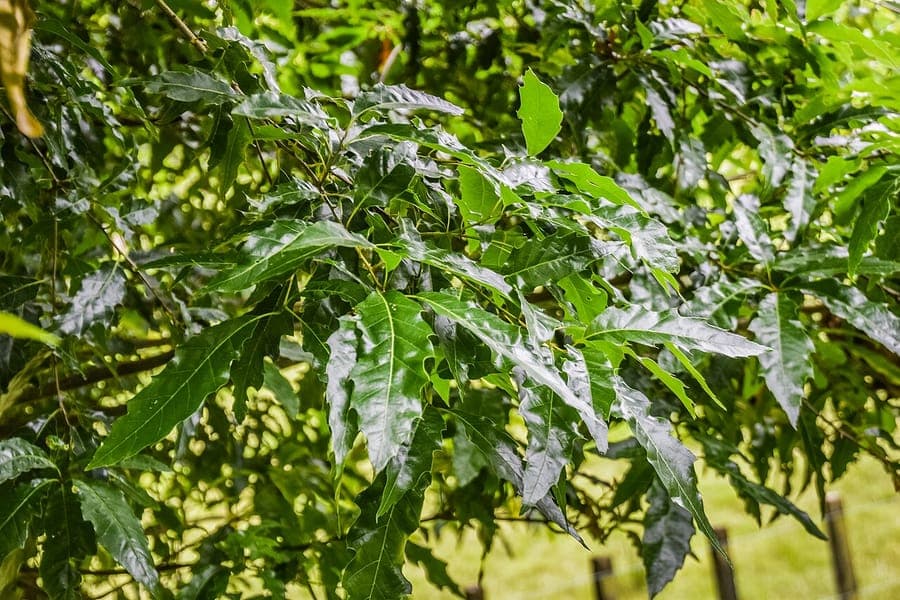
Krzysztof Golik / CC BY-SA 4.0, via Wikimedia Commons
Quercus canbyi: complete guide
Quercus canbyi
Want to see Quercus canbyi: complete guide in your garden?
1 minute, no credit card
Overview
Quercus canbyi, also known as Chisos oak or Slender oak, is an elegant tree from the beech family (Fagaceae). This tree originates from southwestern Texas and northeastern Mexico, where it grows in dry, rocky mountain areas at elevation. Quercus canbyi is an exceptional choice for garden owners seeking a tree that thrives excellently in dry conditions with minimal care. This tree displays beauty throughout the year, with elegant foliage and a beautiful silhouette.
On gardenworld.app, you will find designs where this tree is perfectly integrated into modern, drought-tolerant gardens. The tree is not only highly practical but also ornamentally valuable for its fine foliage texture and elegant crown form. This makes the Chisos oak a perfect choice for gardens in warmer, drier climates or for garden owners prioritizing sustainable landscaping. The tree was first scientifically described in 1924 and remains relatively rare outside its native growing range, making it a unique addition to gardens.
The Chisos oak grows naturally in the Chisos Mountains of West Texas at elevations between 1,500 and 2,500 meters, which explains why it is so exceptionally drought-tolerant. In gardens, it fits perfectly in xeriscaped landscapes, rock gardens, and dry slopes where many other trees would fail.
Appearance and Bloom Cycle
Quercus canbyi grows into a tree typically reaching 500 to 800 centimeters in height, though specimens in optimal conditions can become even larger. The tree displays an elegant, slender growth habit with numerous thin, wiry branches. This gives the tree a very graceful silhouette, especially when backlit. The leaves are small, lance-shaped to oblong, approximately 2 to 5 centimeters long, green to gray-green in color, with subtle texture.
In spring, small, inconspicuous flowers typical of oaks appear. These flowers are wind-pollinated and not spectacular in appearance, but are functionally important for fruit set. Following pollination, small acorns develop in cupules (cups). The tree is evergreen to semi-evergreen, depending on region and winter temperatures. In warm climates, the tree retains most foliage; in cooler conditions, partial leaf drop may occur.
Ideal Location
Quercus canbyi thrives best in completely sunny locations. Ensure at least eight hours of direct sunlight daily. The tree can grow in partial shade, but will be thinner and less vigorous. On gardenworld.app, we always recommend placing this tree in completely sunny locations, preferably with southern exposure.
The tree is highly wind-resistant and grows well even in windy conditions. This makes it an excellent choice for exposed, rocky gardens. The tree can be used as a freestanding specimen, in tree clusters, or as an accent element. The tree also grows well against slopes and rocky outcrops, where its strong root system establishes well.
Soil Requirements
Quercus canbyi is very adaptable regarding soil texture. The tree grows optimally in poor to moderately fertile, well-draining soil. This is one of its greatest strengths: it grows well on soils where many other trees would fail. Light sandy soils, rocky soils, and even soils with low nutrient content pose no problem.
The tree does not tolerate heavy clay soils well and prefers light to moderate soils. For planting, it is sufficient to simply dig the hole and fill it with the original soil, provided it drains well. If your tree grows in heavy clay, you can add extra drainage with sand or gravel. The tree is highly drought-tolerant and does not need mulch, though a thin layer can help.
Watering
At planting time, ensure the soil is thoroughly moist. During the first growing year, regular watering must be given to stimulate root establishment. Once well-established (after 2 to 3 years), this tree is highly drought-tolerant and can survive without supplemental water in dry climates.
In the first year, water when the top 5 centimeters of soil feel dry. Water must drain well; waterlogging is harmful. After establishment, supplemental watering is only needed in extreme drought situations. The tree can endure dry summers without problems.
Free design
Want to see Quercus canbyi: complete guide in your garden? Make a free design now.
Pruning
Quercus canbyi requires minimal pruning. The tree grows naturally into an attractive form. Perform only corrective pruning when branches are damaged or develop unnaturally. Remove dead or diseased branches as soon as you notice them. For shaping, you can prune very lightly, preserving the natural form. Always cut branches at an angle approximately 0.5 centimeters above a growth bud.
Given the elegant natural form of Quercus canbyi, heavy pruning is actually undesirable. The graceful silhouette is precisely one of the primary reasons to choose this tree. In rare cases where you must rejuvenate the tree after storm damage or serious neglect, you can perform careful pruning in late spring.
Maintenance Calendar
January through February: The tree is at rest. In cold regions, partial leaf drop may occur. Perform inspection for damaged branches. Water only during drought.
March through April: New growth begins gradually. This is the optimal time for any needed pruning. Extra watering can help in dry regions.
May through June: Bloom with inconspicuous flowers. Growth accelerates. Water as needed. Inspect for pest infestations.
July through August: The tree grows fully. Drought may occur; water during extreme conditions. Acorns begin forming.
September through October: Continued growth. Acorns ripen. Minimal watering except in very dry periods.
November through December: The tree enters dormancy. Minimal care required. Enjoy the graceful silhouette.
Winter Hardiness (USDA Zones)
Quercus canbyi is winter-hardy in USDA climate zones 8 through 11. This means this tree grows best in warm to warm-temperate climate. In the Netherlands and Belgium, this tree can grow outdoors, but only in the warmest gardens (southern regions, protected locations). In France, particularly in the south, this tree grows well.
In very cold climates (USDA zone 7 and colder), frost can be problematic. In such circumstances, you can better cultivate the tree in a pot and provide winter protection. The tree is, however, reasonably frost-resistant and can tolerate brief frosts down to minus 10 degrees Celsius.
Companion Plants
Quercus canbyi works well in combination with other drought-tolerant shrubs and trees. Combine with other drought-tolerant plants such as lavender, rosemary, or other Mediterranean species for a cohesive design. The tree works well with grasses and perennials that tolerate drought.
Beneath the tree, you can plant drought-tolerant groundcovers such as Euphorbia myrsinites or Sedum species. This provides color and texture without competing for water. For a more natural look, combine with rocky elements and gravel.
In landscaping designs, this tree works well in tree clusters with similar drought-tolerant species. In large gardens, you can plant multiple specimens for maximum visual impact.
Closing
Quercus canbyi is an exceptional choice for garden owners seeking a tree that thrives excellently in dry conditions with minimal care. With its elegant foliage, fine silhouette, and extraordinary drought-tolerance, this tree offers many years of visual satisfaction. The tree is available from specialized tree nurseries and some garden centers. With basic planting and minimal maintenance effort, this tree will adorn your garden for many years.
The Chisos oak is particularly valuable for sustainable landscaping because it requires no supplemental water once established. This makes it ideal for water conservation in garden and landscape designs. The tree also works excellently in xeriscaped gardens, Mediterranean gardens, and other drought-tolerant designs. In gardens with extreme drought and heat conditions, this tree is one of the best choices available.
Use gardenworld.app to discover garden designs where this durable, elegant tree fits perfectly in dry, warm gardens.
Want to see Quercus canbyi: complete guide in your garden? Make a free design now.
Upload a photo, pick a style, and get a photorealistic design with plant list in under a minute.
10,000+ gardens designed already
No credit card required


Similar plants
Lucombe oak: complete guide
Quercus crenata
Lucombe oak (Quercus crenata): a majestic semi-evergreen giant with corky bark, perfect for large gardens, parks, and country estates.
Blue oak: complete guide
Quercus douglasii
Discover the blue oak, a drought-tolerant Californian shade tree with striking blue-green foliage, ideal for large, climate-resilient gardens.
Quercus montana: complete guide
Quercus montana
Quercus montana, the chestnut oak, is a rugged American shade tree with deeply furrowed bark and large acorns, well suited to dry, rocky, spacious gardens.