
Quercus montana: complete guide
Quercus montana
Want to see Quercus montana: complete guide in your garden?
1 minute, no credit card
Overview
Quercus montana, commonly known as chestnut oak or rock chestnut oak, is a large deciduous tree in the beech family (Fagaceae), native to the eastern United States. Its natural range runs from Maine and Vermont in the northeast down to Alabama and Georgia in the south, with a stronghold in the Appalachian Mountains, where the species typically occupies the dry, rocky ridgetops too poor and steep for most other oak species.
The common name refers to the leaf's striking resemblance to that of the American chestnut (Castanea), with the same wavy, scalloped margin. This is very much a long-term tree: growth is slow, but the lifespan can stretch to three or four centuries. For anyone shaping a large, characterful property or a parkland-style garden on gardenworld.app, Quercus montana offers an authentic, tough choice for spots where other trees disappoint on poor, rocky ground.
Given its eventual size, this oak is emphatically not a tree for a small front garden; plan for a spacious setting where the crown can develop unhindered for decades. Anyone looking for a lasting, stately centerpiece for a large property or a parkland-style backyard gets, with this species, a tree that will outlive generations and only grow more impressive with time.
Appearance and bloom
A mature Quercus montana reaches 20 to 30 meters in height in its natural habitat, with a broad, rounded crown that often ends up as wide as it is tall. The bark is its most distinctive feature: deeply furrowed, almost blocky in its cracking pattern, dark grey to blackish brown, and it keeps its ornamental value through winter once the leaves have fallen.
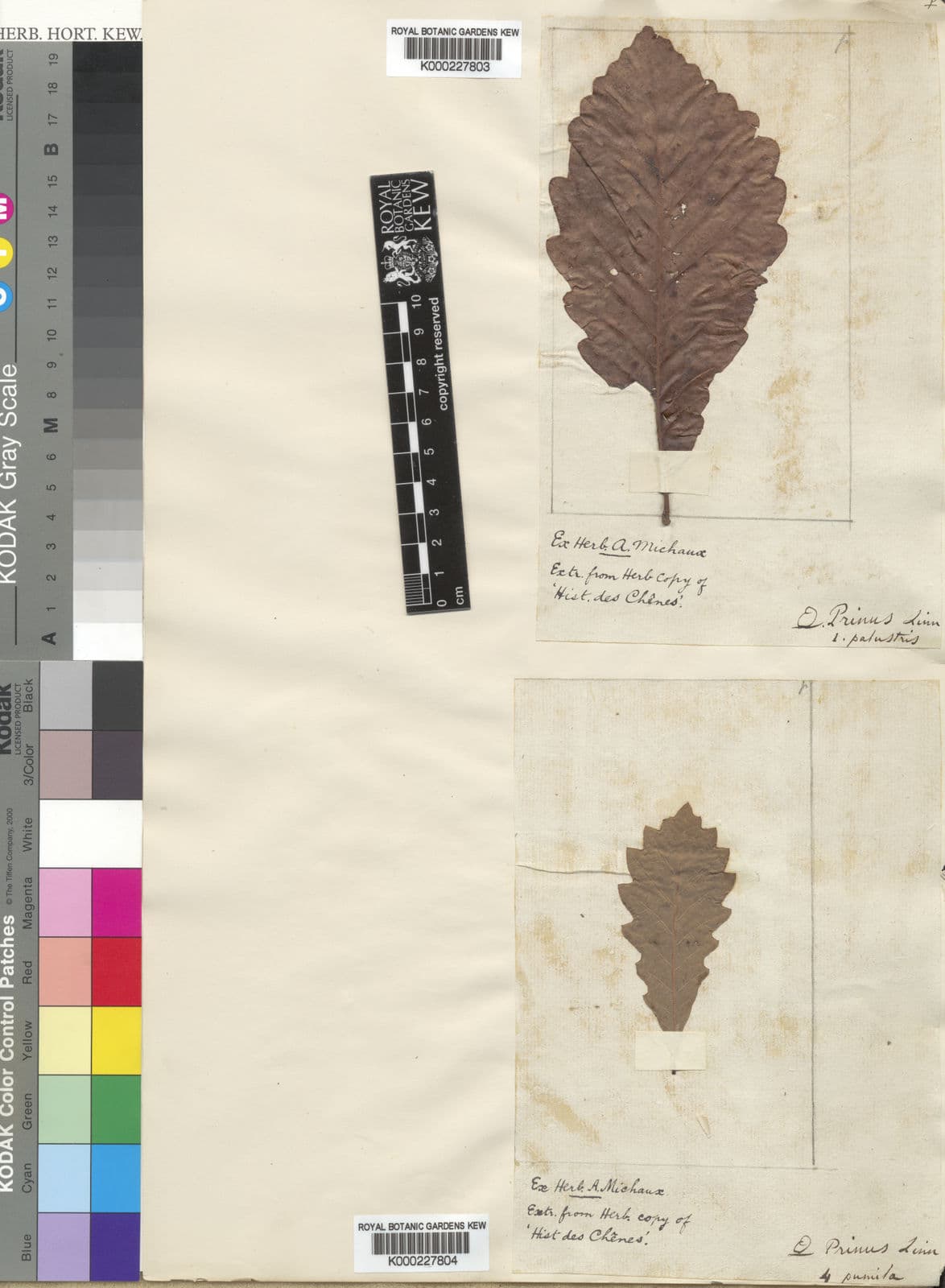
The leaves are large, 10 to 20 centimeters long, oval to oblong, with a wavy, scalloped margin strongly reminiscent of chestnut foliage. In autumn the foliage turns yellow-bronze to orange. The bloom itself is inconspicuous: in April and May, long, drooping catkins appear that are wind-pollinated and hold no ornamental value. Far more striking are the acorns, which at 2.5 to 3.5 centimeters rank among the largest of any North American oak and contain relatively little tannin, making them a favored food source for deer, squirrels, and wild turkeys.
Ideal location
This oak needs full sun for proper crown development; young trees tolerate some temporary shade, but grow more slowly and less vigorously under it. Choose an open, spacious site without competition from other large trees nearby.
In the wild the species prefers dry, rocky ridgetops and steep slopes where few other trees survive. Translated to the garden, this means Quercus montana is superbly suited to difficult sites with poor, stony ground, provided there is enough room for its eventual size. Avoid boggy, permanently wet ground, where the roots struggle.
Soil
The ground needs above all to be well-drained and on the acidic side: this species tolerates a pH of 4.6 to 6, meaning moderately to fairly acidic. In the wild the tree grows on thin, rocky, nutrient-poor ground where many other species simply fail to establish.
When planting in richer garden soil, little adjustment is needed, as long as the ground does not stay permanently wet. On lime-rich or highly alkaline soil, the tree can suffer from leaf yellowing caused by iron deficiency; in that case, adjusting the soil pH with a sulfur-based product before planting is advisable.
Free design
Want to see Quercus montana: complete guide in your garden? Make a free design now.
Watering
Young, newly planted trees need regular water during the first two to three growing seasons, roughly once a week with a deep soak during dry weather, to build a strong root system. Once well established, usually after three to four years, Quercus montana is remarkably drought tolerant and needs almost no supplemental water thereafter.
This drought tolerance is exactly why the species thrives in the wild on rocky, fast-draining ridgetops: the root system is adapted to search deeply and efficiently for moisture. Avoid overwatering mature trees, since that tends to do more harm than good for a species this well adapted to dry conditions.
Pruning
In the first years after planting, light formative pruning helps establish a single, strong central leader; remove competing tops and low-hanging branches during winter dormancy, between November and February, when the tree is fully bare. This keeps the structure clean and prevents later splitting of heavier limbs.
Mature specimens need barely any pruning beyond removing dead or damaged wood. Larger pruning work is best handled by a professional arborist, given the eventual size and weight of the branches involved.
Maintenance calendar
November to February: formative pruning on young trees, check for dead wood. March to April: bloom of inconspicuous catkins, no maintenance needed. May to August: growing season, weekly watering for young trees during dry spells. September to October: acorns drop, autumn color, no intervention needed. Year-round: mature trees require almost no maintenance beyond periodic checks.
Winter hardiness
Quercus montana is winter hardy across USDA zones 4 to 8, a range that comfortably covers the entire climate of the United Kingdom and northern Europe without any winter protection whatsoever. The species is adapted to cold Appalachian winters with snow and frost and shows no sensitivity to frost damage once the tree is established.
Young trees in their first winter benefit from a thick layer of mulch around the root zone to buffer extreme ground frost, but this matters mainly in the first year. After that, winter hardiness is one of this species' major advantages over many more delicate ornamental trees.
Companion plants
Quercus montana naturally combines well with other plants from dry, acidic woodland edges. Kalmia latifolia adds attractive bell-shaped flowers under the same lean, acidic conditions. Vaccinium species such as blueberry thrive without issue under the light, dappled shade of the crown. Ferns such as Dryopteris fill the ground layer in slightly more sheltered spots, while Cornus florida blooms in spring before the oak's crown is fully leafed out.
Closing
Quercus montana is a rugged, long-lived shade tree for gardens and parks where space, character, and drought tolerance matter more than a fast result. Its deeply furrowed bark, chestnut-like foliage, and large, valuable acorns make this oak particularly well suited to large properties on poor, rocky ground.
On gardenworld.app you can place this oak virtually into your garden design and see how its eventual crown size relates to existing structures and planting, something especially valuable to anticipate for a tree with such a long lifespan. For this botanical species, a specialist tree nursery is usually the best source, since general garden centers typically stock other, smaller oak species better suited to an average garden.
Want to see Quercus montana: complete guide in your garden? Make a free design now.
Upload a photo, pick a style, and get a photorealistic design with plant list in under a minute.
10,000+ gardens designed already
No credit card required


Similar plants
Lucombe oak: complete guide
Quercus crenata
Lucombe oak (Quercus crenata): a majestic semi-evergreen giant with corky bark, perfect for large gardens, parks, and country estates.
Blue oak: complete guide
Quercus douglasii
Discover the blue oak, a drought-tolerant Californian shade tree with striking blue-green foliage, ideal for large, climate-resilient gardens.
Dwarf chinkapin oak: complete guide
Quercus prinoides
Dwarf chinkapin oak (Quercus prinoides): a compact, cold-hardy North American shrub with sweet acorns after just two to three years.