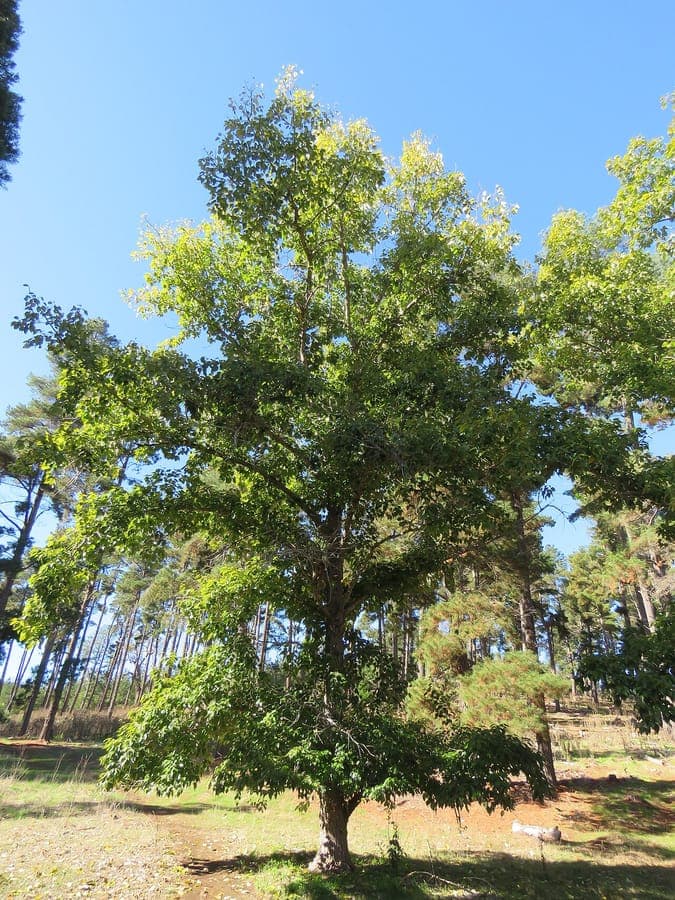
Calistemon / CC BY-SA 4.0, via Wikimedia Commons
Yunnan poplar: complete guide
Populus yunnanensis
Want to see Yunnan poplar: complete guide in your garden?
Full design in HD: €7.99
Look after your Yunnan poplar with the GardenWorld app
Identify plants with your camera and get a care calendar with reminders for this plant.


Populus yunnanensis, commonly known as Yunnan poplar or Chinese balsam poplar, is a fast-growing deciduous tree native to the Yunnan, Guizhou, and Sichuan regions of central-south China. This poplar species is ideal for large gardens and landscaping projects where rapid growth and scale are desired.
Appearance & Growth
The Yunnan poplar is a large deciduous tree that can reach 20 to 30 meters in height under favorable growing conditions. The leaves are oblong-lanceolate with a fine, velvety texture. During growth, young leaves often display a red-bronze tint that gradually becomes green. In autumn the leaves turn a beautiful yellow before dropping.
The tree grows very rapidly in its youth - annual growth of 60 to 100 centimeters is not uncommon under optimal conditions. The trunk becomes thick and strong, giving a majestic silhouette.
Ideal Location
Give this tree plenty of sunlight and space. The Yunnan poplar grows best in open positions with at least 6 to 8 hours of direct sun per day. Don't plant too close to buildings or other trees, as this species needs considerable space and doesn't tolerate competition.
The tree is suited to moderate wind conditions, becoming strong quickly. Do provide protection as a young plant. A location on a southwest-facing aspect with some protection from larger trees is ideal.
Soil
The Yunnan poplar grows best in deep, moisture-retentive soil with good drainage. This tree loves moderately nutrient-rich soil. Sand, clay, and compost should be well mixed.
A pH range of 6.0 to 7.5 is ideal. Heavy clay soil can be amended with sand and organic material. In very poor soils supplementation with compost and manure is needed. The root zone must be deep, so dig at least 60 centimeters deep at planting.
Watering
Water regularly in the first growing year to promote good root development. After establishment this tree is fairly drought-tolerant. In dry summers water carefully if needed. The tree is adaptable to various moisture conditions.
Heavy rainfall in spring and autumn usually provides sufficient water. In very dry areas extra attention is needed. Ensure good drainage in winter to prevent root rot.
Free preview
Want to see Yunnan poplar: complete guide in your garden? Make a free preview of your design.
Pruning & Maintenance
This tree grows very rapidly and will need pruning to maintain shape. In the first year you can form a central leader. Lateral branches can be shortened to promote tree form.
Annual pruning of dead or weak branches is needed. In older years pruning can be limited to removal of dead wood and crossing branches. Best perform pruning during winter dormancy (December-January).
Maintenance Calendar
March-April: Start of growth. Check soil moisture and add compost. May-August: Regular watering in dry periods. September-October: Reduce watering frequency. November-January: Winter; minimal care, perform pruning during dormancy. February: Preparation for growth start.
Winter Hardiness
The Yunnan poplar is suitable for USDA zones 7 to 10 (hardiness to approximately -15 to -5 degrees Celsius). The tree survives mild winters well but needs protection in zones colder than -20 degrees. In mountainous regions with severe winters this species may encounter problems.
In zones 6 and colder this tree will experience frost damage. This is truly a warm-climate tree.
Companion Plants
This tree grows well as a solitary specimen or in groups. Underplanting can be hazel, birch, and shrubs. This tree casts significant shade so underplants must tolerate shade.
Ensure underplants don't grow too close to the tree due to root competition. The tree is not suitable for very small gardens because of its ultimate size.
Final Thoughts
The Yunnan poplar is a spectacular fast-growing tree perfect for large gardens and landscape designs in mild climates. With its impressive height, rapid growth, and beautiful seasonal changes it brings dramatic effect. Regular maintenance and good placement are essential. This tree is truly for gardens with space!
GardenWorld tip: Want a quick screen? Plant this tree in groups for rapid privacy effect. Perfect for large landscape projects in temperate zones.
Frequently asked questions about Yunnan poplar
Is Yunnan poplar winter hardy?
The Yunnan poplar is suitable for USDA zones 7 to 10 (hardiness to approximately -15 to -5 degrees Celsius). The tree survives mild winters well but needs protection in zones colder than -20 degrees.
When and how do you prune Yunnan poplar?
This tree grows very rapidly and will need pruning to maintain shape. In the first year you can form a central leader.
How much water does Yunnan poplar need?
Water regularly in the first growing year to promote good root development. After establishment this tree is fairly drought-tolerant.
Where does Yunnan poplar grow best?
Give this tree plenty of sunlight and space. The Yunnan poplar grows best in open positions with at least 6 to 8 hours of direct sun per day.
What soil does Yunnan poplar need?
The Yunnan poplar grows best in deep, moisture-retentive soil with good drainage. This tree loves moderately nutrient-rich soil.

See it in your garden
See Yunnan poplar in your garden
One photo of your garden and a few questions. You see the result in about a minute.
Try it with a photoIdentify this plant in your own garden. Identify a plant
Similar plants
Goat willow (Salix caprea): complete guide
Salix caprea
Everything about the goat willow (Salix caprea): catkins for bees, best position, roots, pruning after flowering and the weeping 'Kilmarnock' form.
Swiss willow (Salix helvetica): complete guide
Salix helvetica
Everything about Swiss willow (Salix helvetica), a silver-grey dwarf willow for rock gardens, pond edges and pots: position, soil, watering, pruning, companions.
Dappled willow (Salix integra): complete guide
Salix integra
Everything about Salix integra 'Hakuro-nishiki': position, moist soil, the yearly prune for pink and white leaves, and care of shrubs and standards.
