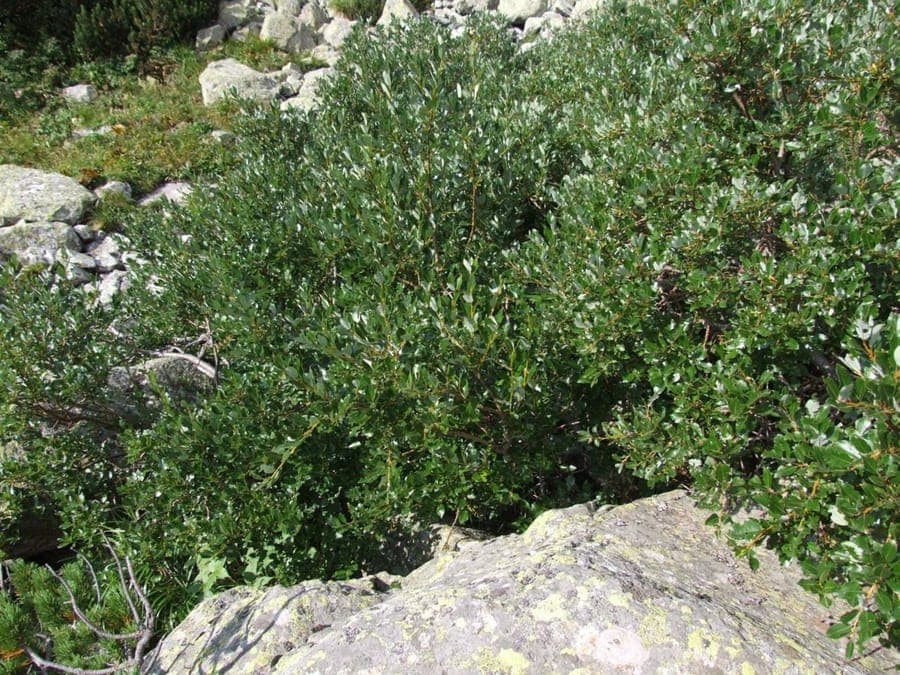
Jerzy Opioła / CC BY-SA 4.0, via Wikimedia Commons
Swiss willow (Salix helvetica): complete guide
Salix helvetica
Want to see Swiss willow (Salix helvetica): complete guide in your garden?
Full design in HD: €7.99
Look after your Swiss willow with the GardenWorld app
Identify plants with your camera and get a care calendar with reminders for this plant.


Overview
Swiss willow (Salix helvetica) is one of the few willows you can plant in a small garden without a second thought. Most willows grow into large shrubs or trees with thirsty, far-reaching roots, but this one stays a compact, silvery dwarf shrub that rarely tops a metre. In the wild it grows high in the Alps and the Tatras, among boulders, on damp scree and beside mountain streams.
In the garden, Salix helvetica belongs in the rock garden, in a gravel bed with some moisture below the surface, at the edge of a pond or in a generous container on a patio. You grow it for its foliage: small, narrowly oval, silver-grey leaves with a white, felted underside that flashes in every breeze. In spring it adds silky catkins, which on male plants turn golden as the pollen ripens. If you would like to give it a proper place among other alpines, gardenworld.app can draw up a garden design in which the Swiss willow plays the part it does best: a calm grey accent between cushion plants and stone.
Do not confuse it with its large relatives. This willow has none of the invasive roots of a pollard or weeping willow and does not need to stand tens of metres from the house.
Appearance and bloom cycle
In gardens a mature Swiss willow usually reaches 50 to 80 cm tall and about as wide, occasionally a metre in a good spot. It grows slowly to moderately and branches densely from the base, forming a rounded, slightly hummocky shrub. Young shoots are downy at first, then turn reddish-brown to dark brown, which looks attractive in winter against grey rock or snow.
The leaves are 2 to 5 cm long, elliptic to narrowly lance-shaped, with smooth or barely toothed edges. The upper surface is grey-green and lightly hairy, while the underside is densely white-felted. From a distance the whole shrub looks silvery, a colour that sits comfortably beside the grey foliage of many rock plants.
Like all willows, Salix helvetica is dioecious, meaning plants are either male or female. Catkins appear in April and May, at the same time as or just before the leaves. They open silver-white and softly hairy. On male plants the anthers split to show bright yellow pollen, and for a few weeks the little shrub glows. Early bumblebees and solitary bees visit the catkins eagerly, since pollen is still scarce at that time of year.
Ideal location
Think of the mountain slope where this plant comes from: plenty of light, fresh air and cool, moist roots. Give it full sun to light shade. In the mild, fairly cool climate of north-west Europe it copes well in full sun, provided the soil never dries out. On a very hot, sheltered south-facing terrace or against a warm wall it suffers in dry summers, so some afternoon shade is wise there.
A rock garden with large stones is ideal, because the soil beneath the stones stays cool and damp while the foliage enjoys the light. The edge of a pond or stream also works well, as long as the roots are not permanently waterlogged. In a pot or trough at least 40 cm across it makes an elegant patio plant that can stay in the same container for years. For a low, silvery group, plant several specimens 50 to 60 cm apart.
Soil requirements
Salix helvetica wants humus-rich soil that holds moisture yet drains freely. That sounds contradictory, but it is exactly what alpine plants know: plenty of water that keeps moving, without the roots ever sitting in a bog. On heavy clay, mix coarse sand, fine gravel and some leaf mould into the planting hole. On poor sandy soil, work in extra compost or leaf mould so the ground holds water.
In the wild the species grows mainly on lime-poor rock, so neutral to slightly acidic soil is the safest choice. Mildly chalky garden soil is usually tolerated, but on strongly alkaline ground the leaves may turn yellowish. Heavy feeding is unnecessary; a thin layer of compost in spring is plenty. In containers, use a good multi-purpose compost with about a third coarse grit or fine gravel mixed in.
Watering
Water is where this willow succeeds or fails. It will not tolerate prolonged drought, particularly in its first year or in a pot. After planting, give it a full watering can every week for a few months, then keep an eye on it during dry spells. Test with a finger: when the top 3 to 4 cm feel dry, it is time to water.
In open ground, in a suitable spot, an established plant usually manages on rainfall alone, except during heatwaves. Containers dry out quickly in summer, so check them daily or every other day. Make sure excess water can escape, or the roots will rot in winter.
Free preview
Want to see Swiss willow (Salix helvetica): complete guide in your garden? Make a free preview of your design.
Pruning
The Swiss willow needs little pruning and naturally forms a neat, rounded shape. To keep it compact, cut some of the longer twigs back to just above a leaf or side shoot straight after flowering, in May or June. That way it flowers generously again the following spring, because the catkins form on the previous year's wood.
Every few years, in late winter, you can remove one or two of the oldest, barest stems at the base. This rejuvenates the shrub and keeps the foliage silvery, since young wood carries the best leaves. An old, neglected plant also tolerates hard renewal pruning in February or March, although you will lose a season of catkins. Always use sharp, clean secateurs.
Maintenance calendar
January–February: Dormant period. Remove an old stem at the base if needed. Check that pots are not waterlogged.
March: Apply a thin layer of compost or leaf mould. Top up gravel around the base if it has washed away.
April–May: Catkins appear, with or just before the new leaves. Water during dry spring weather. Check young shoots for aphids.
June: Light shaping after flowering. A good moment for softwood cuttings.
July–August: Watch for drought, especially in containers. Inspect the leaves for rust and for the larvae of willow sawflies or leaf beetles.
September–October: A good time to plant new shrubs. Leaves turn yellowish.
November–December: Leaf fall. Do not let thick layers of leaves smother cushion plants in the rock garden.
The planting calendar on gardenworld.app gives you a month-by-month overview of what to do in your own garden.
Winter hardiness
Cold is no problem at all for Salix helvetica. In the Alps it survives harsh winters beneath the snow, and in the garden it shrugs off frosts well below -20 °C without protection. Winter cover is therefore unnecessary in Britain and the Low Countries, even for container plants, as long as the pot is frost-proof and not standing in water.
What does trouble it are mild, wet winters with stagnant water around the roots, and hot, dry summers. Choose a spot where water drains away and where the soil does not bake dry in July. Willows are not known to be poisonous to people or pets. The bark does contain salicin, the compound from which aspirin was derived; cats are sensitive to salicylates, but it is unlikely that one would eat enough of a willow shrub to fall ill.
Companion plants
The silver-grey Swiss willow makes a quiet backdrop for colourful alpines. Trumpet gentian (Gentiana acaulis), with its deep blue flowers, creates a striking contrast with the silver catkins in May. Pasque flower (Pulsatilla vulgaris) flowers at the same time and also has softly hairy foliage, which ties the two together nicely.
For the low layer between the stones, choose houseleeks such as cobweb houseleek (Sempervivum arachnoideum) and rosette-forming saxifrages such as Saxifraga paniculata. A few tufts of blue fescue (Festuca glauca) echo the blue-grey tone of the leaves. If you want height, pair it with a dwarf pine or a low juniper. Avoid tall, fast-growing perennials that would swamp the shrub, because it then loses both its compact shape and its silver sheen.
Final thoughts
The Swiss willow proves that a willow does not have to be big to make an impression. With its silver leaves, early catkins and modest size, it earns its place in a rock garden, beside a pond or in a patio container. The rules are simple: good light, cool roots, soil that holds moisture without staying wet, and a light trim after flowering now and then.
Read the label carefully when buying. Grey dwarf willows are sometimes mixed up in the trade, and woolly willow (Salix lanata) or creeping willow (Salix repens) can look very similar to Salix helvetica in a pot. A shrub with small, narrow leaves that are white-felted underneath and a compact, upright habit is usually the right one. Plant it this autumn among your stones and enjoy a willow that behaves itself for years to come.
Frequently asked questions about Swiss willow
Is Swiss willow winter hardy?
Cold is no problem at all for Salix helvetica. In the Alps it survives harsh winters beneath the snow, and in the garden it shrugs off frosts well below -20 °C without protection.
When and how do you prune Swiss willow?
The Swiss willow needs little pruning and naturally forms a neat, rounded shape. To keep it compact, cut some of the longer twigs back to just above a leaf or side shoot straight after flowering, in May or June.
How much water does Swiss willow need?
Water is where this willow succeeds or fails. It will not tolerate prolonged drought, particularly in its first year or in a pot.
Where does Swiss willow grow best?
Think of the mountain slope where this plant comes from: plenty of light, fresh air and cool, moist roots. Give it full sun to light shade.
What soil does Swiss willow need?
Salix helvetica wants humus-rich soil that holds moisture yet drains freely. That sounds contradictory, but it is exactly what alpine plants know: plenty of water that keeps moving, without the roots ever sitting in a bog.

See it in your garden
See Swiss willow in your garden
One photo of your garden and a few questions. You see the result in about a minute.
Try it with a photoIdentify this plant in your own garden. Identify a plant
Similar plants
Gentiana acaulis: complete guide
Gentiana acaulis
Stemless gentian offers spectacular deep-blue trumpet flowers close to the ground. An alpine jewel for rock gardens and shaded borders.
European Pasqueflower: complete guide
Pulsatilla vulgaris
European Pasqueflower produces stunning purple blooms in spring with silky seed heads. Learn care requirements, planting, and how to maintain this woodland perennial.
Cobweb house-leek: complete guide
Sempervivum arachnoideum
Cobweb house-leek (Sempervivum arachnoideum) is a remarkable alpine succulent with delicate white webbing between leaves. Perfect for troughs, rock gardens, and alpine collections.
