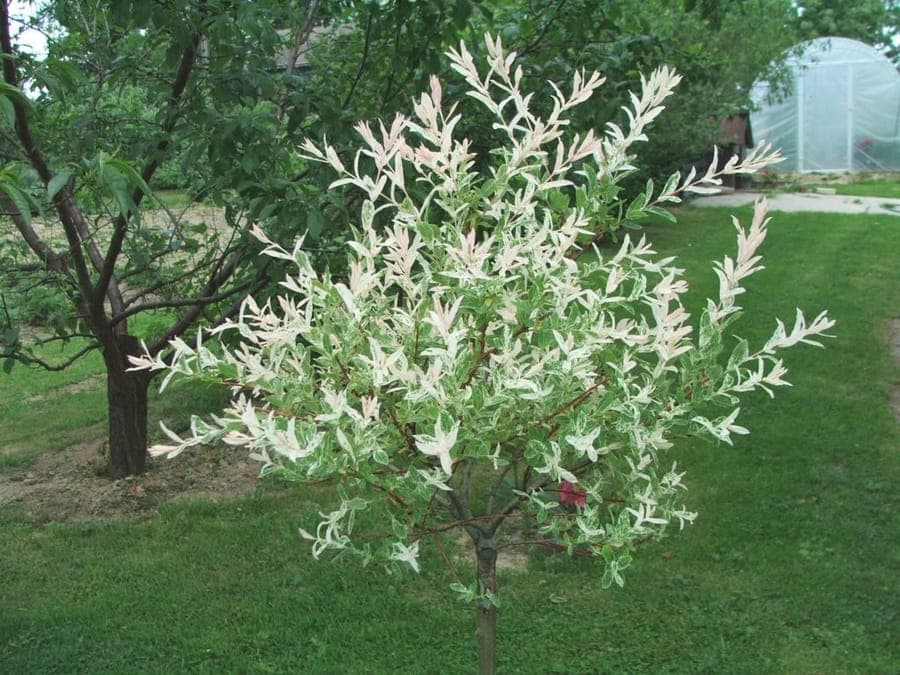
Opioła Jerzy (Poland) / CC BY 2.5, via Wikimedia Commons
Dappled willow (Salix integra): complete guide
Salix integra
Want to see Dappled willow (Salix integra): complete guide in your garden?
Full design in HD: €7.99
Look after your Dappled willow with the GardenWorld app
Identify plants with your camera and get a care calendar with reminders for this plant.


Overview
Salix integra is a graceful willow from Japan, Korea and north-eastern China. In the wild it is a fairly plain green shrub of riverbanks and damp hollows, but in gardens almost everyone knows it through the variegated cultivar 'Hakuro-nishiki', usually sold as dappled willow or Japanese dappled willow. It has become one of the most popular small trees for front gardens, patios and large containers. New shoots open in shades of pink, cream and white, so from a distance the plant looks as if it is in flower.
Garden centres generally offer Salix integra in two forms: a loose, multi-stemmed shrub, or a plant grafted onto a straight stem of 80 to 150 cm topped with a rounded head. Both stay surprisingly manageable, as long as you prune every year. On gardenworld.app you can create a garden design that puts a standard in exactly the right spot, for instance as a focal point beside the front door or repeated along a path.
The plant belongs to the willow family (Salicaceae) and shares the vigour and thirst of its relatives. That is the single most important thing to understand: this willow wants moisture, light and a firm hand with the secateurs, and repays all three generously.
Appearance and bloom cycle
Grown as a shrub, Salix integra reaches 2 to 3 metres in height and about the same across. A standard keeps a head of 1 to 1.5 metres in diameter, depending on how hard you cut it. The slender twigs turn red to reddish brown in winter, adding a warm note to a bare garden.
Unusually for a willow, the leaves are often arranged almost opposite one another and have hardly any stalk. They are oblong, smooth-edged and roughly 3 to 7 cm long. On 'Hakuro-nishiki' the young foliage is salmon pink in April and May, then marbled white and green. As summer goes on, the leaves gradually turn greener. A trim in June brings a second flush of colourful shoots.
Flowering is modest. In March and April, just before or as the leaves emerge, small catkins with a purplish tint appear. They are a welcome early food source for solitary bees and bumblebees, but the real ornamental value lies in the foliage. Heat and drought can scorch the white leaves, leaving brown edges by July.
Ideal location
Give Salix integra full sun or light shade. Colour is strongest in sun, yet on a very hot, dry spot against a south-facing wall the variegated leaves scorch more readily. An open position with morning sun and some shelter from the fiercest afternoon heat is ideal. In deep shade the leaves revert to green and growth becomes thin and floppy.
The plant copes reasonably well with wind, though a grafted standard needs a sturdy stake for its first few years. Keep the roots in mind: like all willows, this species actively seeks out water. Plant it at least 3 to 4 metres from drains, sewer pipes and foundations. In a container of 40 litres or more, a standard grows happily on a patio provided you water faithfully.
Soil requirements
A moisture-retentive, humus-rich and fertile soil is perfect. Light clay, loam and humus-rich sand all suit it. Soil pH matters little: anything from slightly acidic to mildly alkaline works. On poor, free-draining sand, dig in plenty of garden compost or well-rotted manure at planting time so the ground holds moisture better.
Occasional waterlogging does a willow no harm, but standing water for weeks in winter is less welcome. Dig a planting hole twice as wide as the root ball, loosen the base and set the plant at the same depth it grew in its pot. A 5 cm mulch of bark chips or compost keeps the roots cool and damp.
Watering
Water is the key to success with Salix integra. In the first year, give 10 to 15 litres per plant each week during dry spells, and twice a week in hot weather. Established plants also need extra water in dry summers: a willow that goes short drops leaves and develops scorched, brown margins.
Container plants dry out quickly and often need watering daily in summer. Use a pot with drainage holes and do not leave the saucer full in cool weather. Water in the morning, at the base of the plant, so the foliage stays dry. That also helps prevent powdery mildew and rust.
Free preview
Want to see Dappled willow (Salix integra): complete guide in your garden? Make a free preview of your design.
Pruning
Left unpruned, this willow becomes a tangled shrub with mostly green leaves. The best colour appears on young shoots, so a hard cut every year is essential. Carry out the main pruning in late February or early March, before growth starts. Cut all of last year's stems back to two or three buds above the base of the head or the framework you want to keep. It looks drastic, but the plant responds with a dense mass of brightly coloured new growth.
A second, lighter trim in June or early July keeps the head compact and triggers another wave of pink and white leaves. Shorten roughly a third to a half of the shoots. Avoid pruning after mid-August so the new twigs can ripen before winter.
On grafted standards one extra point matters: remove every shoot that appears on the stem itself or from the ground. These come from the rootstock, often a green willow, and grow faster than the variegated head, eventually crowding it out.
Maintenance calendar
February-March: Main pruning before bud break. Check the stake and tie on standards. Scatter compost or an organic fertiliser around the base.
April-May: Pink and white leaves unfold. Apply mulch and water as soon as a dry week sets in. Watch for willow leaf beetles and aphids on the young tips.
June-July: Second, lighter trim for compactness and fresh colour. Water regularly, especially container plants. Rub off rootstock shoots.
August-September: No more pruning. Keep the soil moist during dry spells. Remove and dispose of leaves showing rust.
October-November: Leaves fall. A good time to plant new specimens. Clear fallen, diseased foliage.
December-January: Dormant season. Raise container plants on pot feet and move them against a sheltered wall so the root ball neither freezes solid nor sits in water.
Winter hardiness
Salix integra is fully hardy and tolerates temperatures down to about -25 °C in open ground. Across Britain and the Low Countries it overwinters without any protection. Late frosts in April may damage the first young leaves, but the plant simply produces new ones.
Container plants are more vulnerable because the root ball freezes faster. A large pot, some insulation with hessian or bubble wrap and a spot against the house solve this. The graft union on standards is slightly more sensitive in severe winters, so a wrap of hessian around the top of the stem is a sensible precaution.
As for health, rust, powdery mildew, aphids and willow leaf beetles all occur, usually without lasting damage. An open head maintained by annual pruning is the best prevention. Salix integra is not regarded as poisonous to people or pets, although willow bark contains salicin, so it is best not to let rabbits or dogs chew it extensively. The species is not known to be invasive anywhere in Europe.
Companion plants
The pink and white tones of 'Hakuro-nishiki' look their best against calm, dark green foliage. A backdrop of yew, a beech hedge or the purple leaves of ninebark (Physocarpus opulifolius) makes the variegated head glow. For winter structure, the red and yellow stems of Tatarian dogwood (Cornus alba) and Cornus sericea work beautifully, as they enjoy the same moist soil and the same spring pruning.
Beneath a standard, choose foliage plants that like some shade and moisture, such as blue-leaved hostas, lady's mantle or a low cranesbill. An ornamental grass such as Miscanthus sinensis adds movement and fine texture in late summer next to the rounded head. In a container, underplant the stem with low white summer bedding or trailing ivy so the display looks full in every season.
Final thoughts
Salix integra 'Hakuro-nishiki' is a rewarding shrub for anyone who wants colour without relying on flowers: from April to June it looks as if it is in bloom, and in winter the red twigs add a second season of interest. The rules are simple: moist soil, plenty of light and a hard prune every year. Stick to those three and the plant stays compact and colourful for many years.
Remember that it is still a true willow, with thirsty roots you do not want right next to pipes or foundations. When you plan your borders, the plant calendar on gardenworld.app lines up your pruning dates in February and June so you never miss that second flush of colour.
Frequently asked questions about Dappled willow
Is Dappled willow winter hardy?
Salix integra is fully hardy and tolerates temperatures down to about -25 °C in open ground. Across Britain and the Low Countries it overwinters without any protection.
When and how do you prune Dappled willow?
Left unpruned, this willow becomes a tangled shrub with mostly green leaves. The best colour appears on young shoots, so a hard cut every year is essential.
How much water does Dappled willow need?
Water is the key to success with Salix integra. In the first year, give 10 to 15 litres per plant each week during dry spells, and twice a week in hot weather.
Where does Dappled willow grow best?
Give Salix integra full sun or light shade. Colour is strongest in sun, yet on a very hot, dry spot against a south-facing wall the variegated leaves scorch more readily.
What soil does Dappled willow need?
A moisture-retentive, humus-rich and fertile soil is perfect. Light clay, loam and humus-rich sand all suit it.

See it in your garden
See Dappled willow in your garden
One photo of your garden and a few questions. You see the result in about a minute.
Try it with a photoIdentify this plant in your own garden. Identify a plant
Similar plants
Siberian Dogwood: complete guide
Cornus alba
Learn how to grow and care for Cornus alba (Siberian Dogwood) in your garden. Ideal conditions, pruning, winter color and companion plants explained.
Red-osier dogwood: complete guide
Cornus sericea
Everything you need to know about Cornus sericea: growth habits, care tips, winter hardiness and how to use this shrub in wet garden areas. A must for wildlife and winter interest.
Physocarpus opulifolius: complete guide
Physocarpus opulifolius
Elegant ornamental shrubs with distinctive foliage and snowy white flowers. Learn how to grow and care for this hardy North American shrub successfully.
