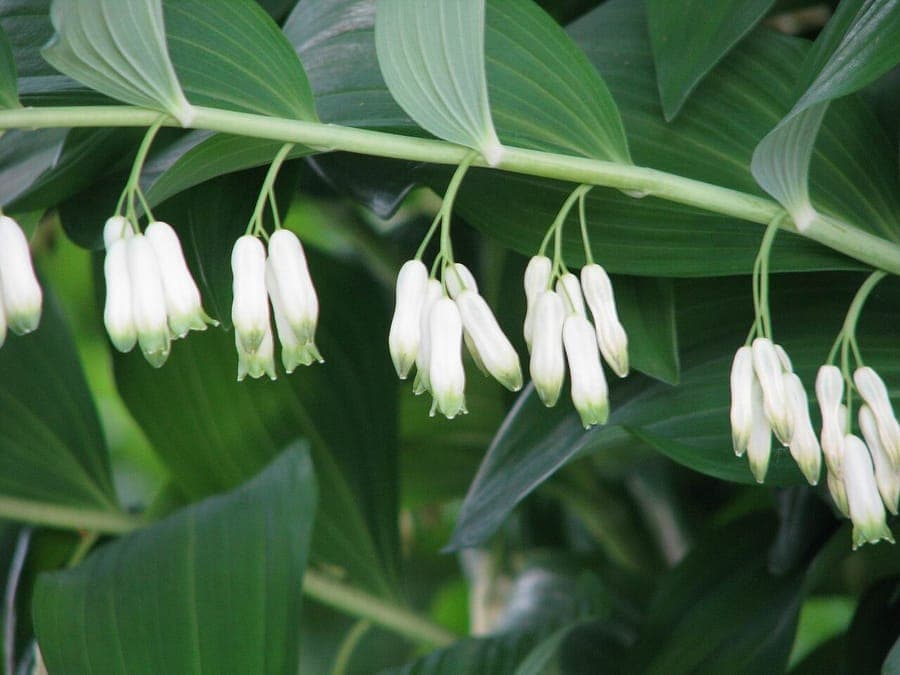
Borealis55 / CC0, via Wikimedia Commons
Solomon's Seal: complete guide
Polygonatum multiflorum
Want to see Solomon's Seal: complete guide in your garden?
Full design in HD: €7.99
Look after your Solomon's Seal with the GardenWorld app
Identify plants with your camera and get a care calendar with reminders for this plant.


Overview
Solomon's Seal (Polygonatum multiflorum), renowned for its graceful form and delicate pendant flowers, is a woodland classic spanning from Europe to the Caucasus. This member of the Asparagaceae family (formerly Liliaceae) is essential for shaded gardens. Named for the distinctive scars left on rhizomes resembling ancient seals, this plant brings architectural elegance to any shade garden.
This plant is essential for woodland gardens, natural plantings, and shaded borders. With its arching form reaching 40-60 centimeters, it adds drama and grace to shadowed spaces.
Appearance and Bloom
Solomon's Seal displays gracefully arching stems lined with alternate, ovate, glossy green leaves. Small, tubular white flowers dangle delicately from leaf axils during April-May. The light fragrance is barely perceptible. After bloom, green berries mature to blue-black.
The characteristic arching habit creates an architectural presence unmatched by other shade plants. Growth is upright initially, then gracefully bending under its own weight.
Ideal Location
This is a deep-shade plant. Position under trees, against north-facing walls, or in wooded corners. The plant tolerates some afternoon sun in northern climates but thrives in full shade. Adequate air circulation prevents fungal issues.
Grouped plantings under trees create enchanting shaded landscapes.
Free preview
Want to see Solomon's Seal: complete guide in your garden? Make a free preview of your design.
Soil
This plant requires fertile, humus-rich soil. Target pH 5.5-6.5 for optimal growth. Significant soil amendment is needed in poor soils. Excellent drainage is critical - Solomon's Seal abhors winter waterlogging.
Annual mulching with leaf litter maintains soil structure and moisture.
Watering
Regular watering during the growing season is essential. The plant enjoys well-moistured soil without waterlogging. In dry periods, water regularly, especially during the first season.
Woodland settings with high leaf litter well simulate natural conditions.
Pruning
Minimal pruning is needed. Remove dead stems in early spring. Carefully remove any diseased or damaged growth. The plant forms its own natural shape.
Maintenance Calendar
February-March: Remove dead growth. April-May: Monitor for bloom. June-July: Normal maintenance. August-September: Apply mulch. October-January: Minimal care.
Winter Hardiness
Fully hardy throughout Europe to zone 5 (-29°C). The plant tolerates severe winters without protection. Good drainage is critical in wet winters.
Companion Plants
Perfect partners include other shade plants: European hellebore, Astilbe, Hosta, ferns. Ivy forms beautiful underplanting. Hostas provide summer interest.
Groupings of 3-5 plants create spectacular displays.
Closing
Solomon's Seal is a must-have for shade gardeners. Its elegance, reliability, and architectural form make it indispensable. Discover today why this is a classic. Visit gardenworld.app for more inspiration!
gardenworld.app: your guide to shade gardens! gardenworld.app: where elegance meets nature!
Frequently asked questions about Solomon's Seal
Is Solomon's Seal winter hardy?
Fully hardy throughout Europe to zone 5 (-29°C). The plant tolerates severe winters without protection.
When and how do you prune Solomon's Seal?
Minimal pruning is needed. Remove dead stems in early spring.
How much water does Solomon's Seal need?
Regular watering during the growing season is essential. The plant enjoys well-moistured soil without waterlogging.
Where does Solomon's Seal grow best?
This is a deep-shade plant. Position under trees, against north-facing walls, or in wooded corners.
What soil does Solomon's Seal need?
This plant requires fertile, humus-rich soil. Target pH 5.5-6.5 for optimal growth.

See it in your garden
See Solomon's Seal in your garden
One photo of your garden and a few questions. You see the result in about a minute.
Try it with a photoIdentify this plant in your own garden. Identify a plant
Similar plants
Great camas (Camassia leichtlinii): planting and care
Camassia leichtlinii
Everything about great camas (Camassia leichtlinii): planting the bulbs, heavy wet soil, naturalising in grass, hardiness and the best partners for a flowering meadow.
Pineapple lily (Eucomis bicolor): planting, care and overwintering
Eucomis bicolor
Everything about the pineapple lily (Eucomis bicolor): planting the bulbs, watering and feeding, overwintering in pots or the ground, and the best border partners.
Pineapple lily (Eucomis comosa): growing and overwintering
Eucomis comosa
Eucomis comosa is the tallest and best-known pineapple lily, with creamy spikes topped by a leafy tuft in late summer. Planting, overwintering and leaf cuttings.
