
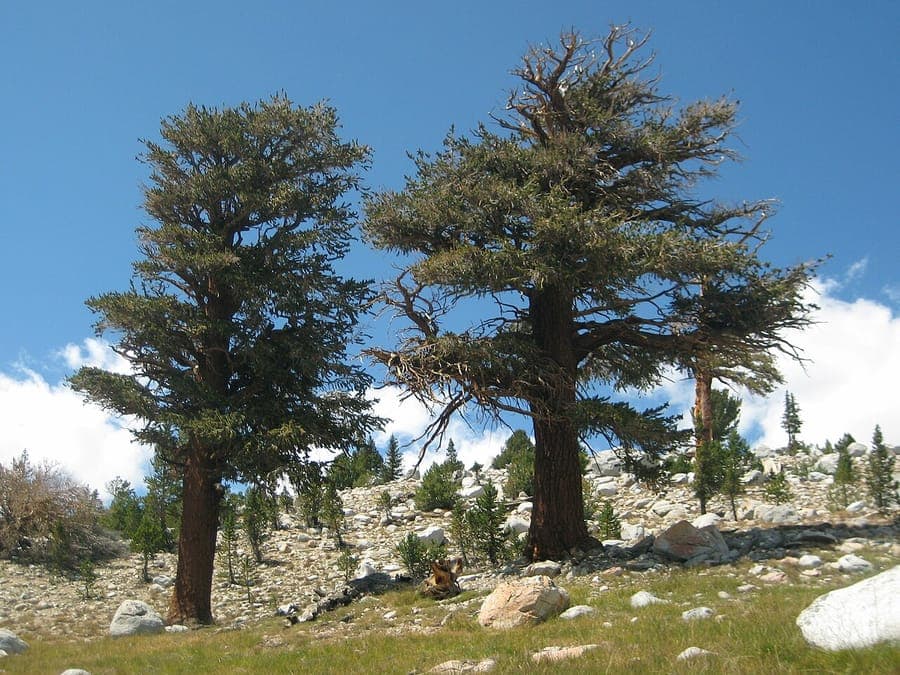
Mat Honan from San Francisco, CA, USA / CC BY 2.0, via Wikimedia Commons
Foxtail pine: complete guide
Pinus balfouriana
Want to see Foxtail pine: complete guide in your garden?
1 minute, no credit card
Overview
The Foxtail pine (Pinus balfouriana) is a rare coniferous tree native to the mountain regions of California, primarily found in the Klamath Mountains and Sierra Nevada. This small, compact tree reaches heights of 5 to 10 meters and is famous for its extremely tightly packed needles that resemble a fox's tail.
Belonging to the Pinaceae family, this tree is very limited in wild occurrence. It is a prized find for collectors and alpine garden enthusiasts.
Appearance and growth
The Foxtail pine grows as a compact, regularly pyramidally formed tree. Mature specimens typically reach 5 to 10 meters, though in ideal conditions may grow somewhat larger.
The needles are very short, tightly clustered green spikes, each approximately 1 to 4 centimeters long. This dense needle arrangement gives the branches a remarkably full, dense appearance. The needles are bundled in groups of five, typical of pine family members.
The bark is thickened and grayish-brown. Young bark is more purplish.
The cones are small to medium-sized, approximately 5 to 10 centimeters long. They appear in purple tones when young, gradually turning brown.
Ideal location
The Foxtail pine grows best in alpine or subalpine environments. Plant in a location with full sun and good air circulation.
This tree does not thrive in warm, dry lowland climates. It suits hardiness zones 4 to 6, possibly even zone 3 under ideal conditions.
Choose a location sheltered from extreme, desiccating winds but with good air moisture.
Soil type
The Foxtail pine prefers well-draining, slightly acidic soil. The pH should range between 5.5 and 6.5.
If your soil is poor or heavily compacted, add sand, perlite, and compost. This tree cannot tolerate dense, clayish soil or water stagnation.
Mulch carefully at the tree's base with small gravel or bark to support drainage.
Free design
Want to see Foxtail pine: complete guide in your garden? Make a free design now.
Watering
During the first growing year, the Foxtail pine requires regular watering. Water when the top 5 centimeters of soil feel dry.
Provide the tree with approximately 2.5 centimeters of water weekly. Avoid heavy watering - this tree prefers drier conditions.
Once established (after 2-3 years), the tree needs little water and can tolerate considerable drought.
Avoid overhead watering of the needle foliage.
Pruning
Minimal pruning is needed for this tree. Remove only dead or diseased branches.
This tree grows naturally in an attractive, compact form. No drastic pruning is needed or desired.
Hand branches can be carefully removed if they obstruct the silhouette.
Maintenance calendar
Spring (April-May): Inspect for winter damage. Add thin mulch layer if needed.
Early summer (June-July): Water regularly as needed. Monitor for pests.
Mid summer (July-August): Minimal intervention. Tree grows slowly.
Autumn (September-October): Add autumn mulch. Prepare for winter.
Winter (November-March): Brush heavy snow loads from young specimens to prevent bending.
Winter hardiness
The Foxtail pine is extremely cold-hardy, suitable for zones 4 to 6. It can survive temperatures down to -30 degrees Celsius.
In very cold alpine areas, the tree may actually thrive better, as this approaches its natural climate.
Young trees may need extra protection during the first or second season.
Companion plants
The Foxtail pine pairs well with:
- Other alpine conifers like dwarf spruces
- Low-growing alpine plants like Sedum
- Rocky ground covers
- Other mountain plants that prefer dry soil
Closing thoughts
The Foxtail pine is a beautiful choice for serious collectors and alpine garden enthusiasts. With its unique fox-tail-like branches and compact form, it is truly a treasure.
This rare tree can only be obtained from specialized alpine tree nurseries. We recommend contacting specialized growers.
Visit gardenworld.app/en for more garden advice about alpine plants. See also gardenworld.app/nl for tips in Dutch.
Want to see Foxtail pine: complete guide in your garden? Make a free design now.
Upload a photo, pick a style, and get a photorealistic design with plant list in under a minute.
10,000+ gardens designed already
No credit card required


Similar plants
Abies delavayi: complete guide
Abies delavayi
Delavayi fir is an elegant, medium-sized coniferous tree from the Pinaceae family with dark green needles. This Asian evergreen is perfect for alpine gardens and large landscapes.
Taiwan fir: complete guide
Abies kawakamii
Discover the magnificent Taiwan fir, a rare evergreen conifer from Taiwan's mountain regions. Learn growth requirements, care tips, and why this beautiful tree is perfect for collectors of unique garden specimens.
Farges fir: complete guide
Abies fargesii
Discover the majestic Farges fir, an impressive conifer from China's mountains with elegant foliage and columnar form. Ideal for large gardens.