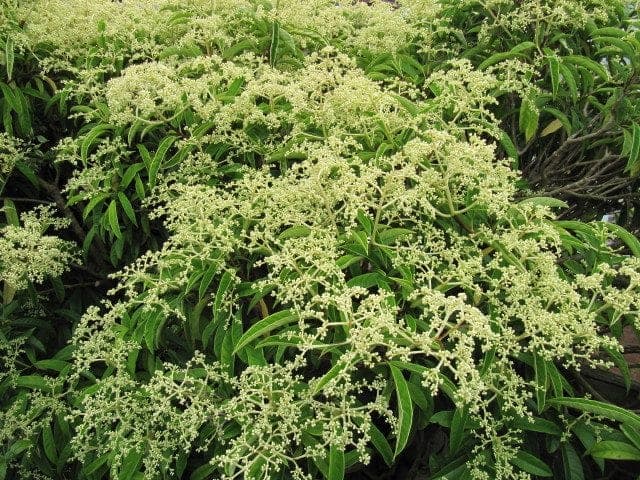
Leonora Enking from West Sussex, England / CC BY-SA 2.0, via Wikimedia Commons
Evergreen climbing hydrangea (Pileostegia viburnoides): complete guide
Pileostegia viburnoides
Want to see Evergreen climbing hydrangea (Pileostegia viburnoides): complete guide in your garden?
Full design in HD: €7.99
Look after your Evergreen climbing hydrangea with the GardenWorld app
Identify plants with your camera and get a care calendar with reminders for this plant.


Overview
Pileostegia viburnoides is an evergreen climber from the forests of China, Taiwan and southern Japan. It is often sold as the evergreen climbing hydrangea, and that says a lot: it belongs to the hydrangea family and, like the climbing hydrangea, clings to walls and trunks with aerial roots. The big difference is that it keeps its leaves all year. Where an ordinary climbing hydrangea leaves a bare wall in winter, this plant stays dark green.
It grows slowly, especially in the first few years, and eventually reaches 4 to 8 metres. That makes it ideal where a thug such as ivy would be too much: a wall beside the front door, a shady courtyard or a pergola post. It flowers late, from August to October, when most climbers have long finished.
Pileostegia viburnoides is not yet an everyday garden plant, but specialist nurseries offer it more and more.
Appearance and bloom cycle
The leaves are leathery, narrowly oval to lance-shaped and 6 to 15 cm long. They are dark green and slightly glossy above, with clearly impressed veins. The leaves sit in opposite pairs and give the plant a firm, rather neat look. Young shoots are often bronze.
In late summer, broad, fluffy panicles of 10 to 15 cm appear at the tips of the shoots. They consist of hundreds of tiny creamy white flowers with long stamens, giving a foamy effect. Unlike true hydrangeas there are no large, showy outer florets. The flowers are lightly sweet-scented and attract bees, bumblebees and butterflies late in the season. Brown seed heads remain afterwards.
There are no known reports of toxicity to people or animals. Because related hydrangeas do contain substances that can upset the stomach and irritate skin, it is sensible to stop children and pets eating it and to wear gloves when pruning.
Ideal location
This climber is a true shade plant. A north- or east-facing wall, the shady side of a fence or the trunk of a large tree are ideal. It even flowers in deep shade, although a little morning or evening sun makes the display richer. In full midday sun on a south wall the leaves can yellow and scorch, especially if the soil is dry.
Choose a spot out of cold, drying winds. Evergreen leaves lose water in winter too, and a harsh easterly over frozen ground causes brown leaf edges. A courtyard or a corner between two walls is perfect. Plant 30 to 40 cm away from the wall so the roots are clear of the dry strip along the house.
Providing support
Pileostegia viburnoides climbs with aerial roots and on rough brick, stone or bark it eventually needs no help at all. Young plants, however, are slow to grip. At planting, lean a few canes against the wall and tie the shoots along them so they touch the surface along their whole length. After one or two seasons the stems will have attached themselves and you can remove the ties.
On a smooth or painted wall, a timber fence, or if you want to keep the masonry unmarked, fix sturdy wires or mesh 5 cm from the surface and tie the shoots to that. Without any support the plant becomes a loose, sprawling shrub. That works too, for instance as evergreen ground cover on a shady bank.
Soil requirements
The plant likes humus-rich, moisture-retentive, well-drained soil. Slightly acid to neutral is ideal, but mildly alkaline soil is tolerated. When planting, mix plenty of leaf mould or well-rotted compost into the excavated soil. On heavy clay, add some grit to avoid waterlogging.
A 5 cm mulch of leaf mould or bark keeps the roots cool and moist. Feeding is hardly necessary: a handful of organic fertiliser in March is enough.
Plant in autumn or early spring. Soak the rootball in a bucket of water first and set the plant at the same depth as it was in its pot. New plants can be raised from semi-ripe cuttings in late summer or by layering a low shoot.
Free preview
Want to see Evergreen climbing hydrangea (Pileostegia viburnoides): complete guide in your garden? Make a free preview of your design.
Watering
For the first two years, regular watering is the most important thing you can do. In dry spells give 10 litres a week, in spring too, as less rain reaches the foot of a wall than you might think. An established plant is fairly drought-tolerant, but in long dry summers and just before flowering an extra soak helps. Remember dry, sunny frosty spells as well: water on a mild day so the evergreen leaves do not dry out.
Pruning
Pruning is hardly needed, and that is one of this climber's strengths. Flowers form at the tips of the current season's shoots, so a light trim in spring does no harm to flowering. In April, remove shoots growing away from the wall, take out dead or frost-damaged wood and shorten overlong stems.
Keep the plant out of gutters, windows and roof tiles. You can leave faded flower heads over winter or cut them off in spring. Hard renovation is rarely needed and the plant does not love it, so spread it over several years.
Maintenance calendar
March: Scatter some organic fertiliser and top up the mulch.
April: Light prune. Tie in young shoots and remove frost damage.
May–July: Growth period. Water in dry weather, especially young plants.
August–October: Flowering with creamy panicles. Keep the soil moist.
November: A good time to plant, as long as the ground is not frozen.
December–February: Evergreen rest. Water on frost-free days during long dry frosty spells.
The plant calendar on gardenworld.app lists these jobs month by month, together with what the other plants in your garden need at the same time.
Winter hardiness
Pileostegia viburnoides is hardy in most of Britain. The RHS rates it H5, which means frost down to about -15 °C. An established plant in a sheltered spot copes well with that. In harder frost or biting winds some leaves may brown, but the plant usually reshoots in spring. Protect young plants in their first winter with leaf mould around the base and, if needed, fleece over the shoots.
Companion plants
In a shady spot the plant shines next to other evergreens. Fatsia japonica, with large hand-shaped leaves, contrasts well with the climber's narrow foliage. Skimmia japonica and Camellia japonica bring flowers and berries in winter and spring while the climber rests. At its feet, Japanese spurge (Pachysandra terminalis) forms a green carpet, and hart's-tongue fern (Asplenium scolopendrium) adds glossy, strap-shaped fronds. Together they make a shady corner that looks green and tidy all year.
Final thoughts
Pileostegia viburnoides is the climber for anyone who wants to fill a dark wall with leaves that stay and flowers that arrive when the rest of the garden is thinking of autumn. It asks for patience at first, a moist root run and a little help to cling. After that it is one of the least demanding climbers there is.
Want to know which wall or fence suits it best, and what to plant beneath it? On gardenworld.app you can create a garden design that takes shade, soil and evergreen structure into account. Plant it this autumn and give it time: within a few years you will have a green wall that never goes bare.
Frequently asked questions about Evergreen climbing hydrangea
Is Evergreen climbing hydrangea winter hardy?
Pileostegia viburnoides is hardy in most of Britain. The RHS rates it H5, which means frost down to about -15 °C.
When and how do you prune Evergreen climbing hydrangea?
Pruning is hardly needed, and that is one of this climber's strengths. Flowers form at the tips of the current season's shoots, so a light trim in spring does no harm to flowering.
How much water does Evergreen climbing hydrangea need?
For the first two years, regular watering is the most important thing you can do. In dry spells give 10 litres a week, in spring too, as less rain reaches the foot of a wall than you might think.
Where does Evergreen climbing hydrangea grow best?
This climber is a true shade plant. A north- or east-facing wall, the shady side of a fence or the trunk of a large tree are ideal.
What soil does Evergreen climbing hydrangea need?
The plant likes humus-rich, moisture-retentive, well-drained soil. Slightly acid to neutral is ideal, but mildly alkaline soil is tolerated.

See it in your garden
See Evergreen climbing hydrangea in your garden
One photo of your garden and a few questions. You see the result in about a minute.
Try it with a photoIdentify this plant in your own garden. Identify a plant
Similar plants
Japanese fatsia: complete guide
Fatsia japonica
Discover the Japanese fatsia, a tropical houseplant with large, hand-shaped leaves. This guide covers cultivation, care, and creating a tropical atmosphere.
Skimmia japonica: complete guide
Skimmia japonica
Evergreen shrub with red berries and fragrant leaves that remain visible long. Winter hardy to -10C, perfect for shade.
Hart's-tongue fern: complete guide
Asplenium scolopendrium
Learn how to grow Asplenium scolopendrium successfully in your garden. Ideal location, soil, watering needs, and care tips for this elegant evergreen fern.
