
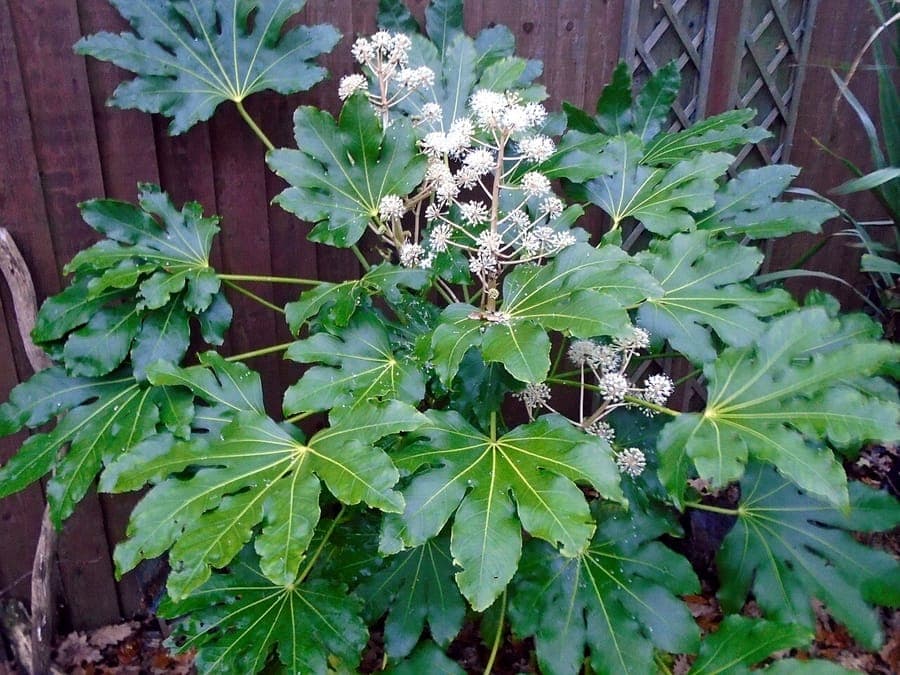
Orengi Harvey / CC BY-SA 4.0, via Wikimedia Commons
Japanese fatsia: complete guide
Fatsia japonica
Want to see Japanese fatsia: complete guide in your garden?
1 minute, no credit card
Overview
The Japanese fatsia (Fatsia japonica), also known as Japanese aralia or glossy-leaf paperplant, is an impressive foliage plant from Japan and Korea. This member of the Araliaceae family is known for its large, glossy, hand-shaped leaves that can reach 30 cm or larger. Thanks to its elegant appearance, it is ideal for creating a tropical atmosphere in interiors, gardens, and conservatories in temperate climates.
This plant is highly valued by gardeners and professionals for its versatile properties.## Appearance & bloom
The plant forms a dense shrub with thick, dark green, opposite leaves. The leaves are deeply lobed, resembling a human hand with spread fingers, which explains the popular name "finger plant." In autumn and early winter, small white flowers appear in large, spherical clusters (umbels). These are followed by small, black berries. The plant reaches 1.5-2.5 meters tall under favorable conditions.
Ideal location
Choose bright, indirect light for optimal leaf growth. The plant also tolerates moderate shade but forms more compact growth. Place away from direct sunlight in south and west-facing areas, as this can cause leaf scorch. For outdoors, choose partial shade to moderate shade in warm regions. Indoors, place it near a window but away from direct rays.
Soil
Use nutrient-rich, well-draining potting mix for potted plants. A good mix is garden soil, peat moss, and perlite. For outdoor planting in temperate climates, use moderately nutrient-rich, well-drained garden soil. A pH between 6.0-7.0 is ideal. Avoid heavy clay soils without drainage.
Free design
Want to see Japanese fatsia: complete guide in your garden? Make a free design now.
Watering
Keep the soil moderately moist, not wet. Water when the top 2-3 cm of soil feels dry. Water less in winter. For potted plants, ensure drainage and empty the saucer after watering. Mist the leaves regularly for shine and health. Increase humidity in dry environments.
Pruning
Prune regularly to maintain compact, bushy form. Remove yellowed or damaged leaves. Pinch young growth for more branching. In spring, you can prune back heavily to correct form. Pruning waste can be used for propagation via cuttings.
Maintenance calendar
Spring: Begin growing, moderate watering, prune heavy growth. Summer: Water regularly, maintain high humidity. Autumn/Winter: Bloom appears, less water, slightly lower temperature.
Winter hardiness
The Japanese fatsia is hardy to about -5 to -10 degrees Celsius. In cold regions, it should be kept as a houseplant or conservatory plant. In temperate climates (USDA zones 8-10), it can overwinter outdoors with protection. Young plants should always be protected.
Companion plants (indoors)
Combine with smaller foliage plants like philodendron or dieffenbachia. Low plants like Pothos can grow underneath. For outdoor plantings, combine with shade-tolerant plants like hosta or ferns.
Closing
The Japanese fatsia brings instant tropical atmosphere to any space. With its spectacular foliage and easy-care nature, it is ideal for both houseplant beginners and experienced gardeners. Follow this guide for years of enjoyment from this beautiful plant.
Available at leading garden centers. Visit gardenworld.app/en for tips on incorporating this exotic plant into your interior or garden.
Want to see Japanese fatsia: complete guide in your garden? Make a free design now.
Upload a photo, pick a style, and get a photorealistic design with plant list in under a minute.
No credit card required


Similar plants
American marsh pennywort: complete guide
Hydrocotyle americana
Everything about Hydrocotyle americana: location, soil, moisture and winter care. A delicate groundcover for shaded pond edges and boggy garden borders.
Devil's club: complete guide
Oplopanax horridus
Full guide to growing Oplopanax horridus: ideal site, soil, watering, and care for this dramatic spiny woodland shrub.
Water pennywort: complete guide
Hydrocotyle umbellata
Everything about Hydrocotyle umbellata: ideal location, soil, watering, winter care and pond planting. A versatile aquatic plant for garden ponds and boggy spots.