
Gillfoto / CC BY-SA 4.0, via Wikimedia Commons
Devil's club: complete guide
Oplopanax horridus
Want to see Devil's club: complete guide in your garden?
1 minute, no credit card
Overview
Oplopanax horridus, commonly called devil's club or devil's walking-stick, is a bold, spiny shrub in the Araliaceae family - the same plant family as English ivy and Japanese aralia. The species epithet horridus is Latin for 'bristling' or 'dreadful', a clear reference to the formidable yellow spines that densely cover the stems, leaf stalks, and even the undersides of the leaf veins. Few plants in North American woodland are as immediately recognisable - or as memorable to anyone who has blundered into a dense stand.
Native to the humid coastal forests of the Pacific Northwest, its range extends from Alaska and the Yukon through British Columbia, Alberta, Washington, Oregon, Idaho, and Montana. An isolated population also occurs near Lake Superior in Ontario, suggesting that the species once had a broader distribution that contracted during past climate shifts. Oplopanax horridus typically grows in moist forest ravines, along streambanks, and in shaded mountain valleys from sea level to around 1,800 metres.
The plant holds deep cultural significance for many Indigenous peoples of the Pacific coast, who used preparations from the roots and bark for medicinal purposes. Today it is increasingly valued by adventurous gardeners as a dramatic specimen for sheltered shade gardens, wild woodland designs, and naturalistic plantings where sheer presence and ecological value are prized over conventional beauty. Explore how to incorporate this remarkable plant into a planting design at gardenworld.app.
Appearance & bloom cycle
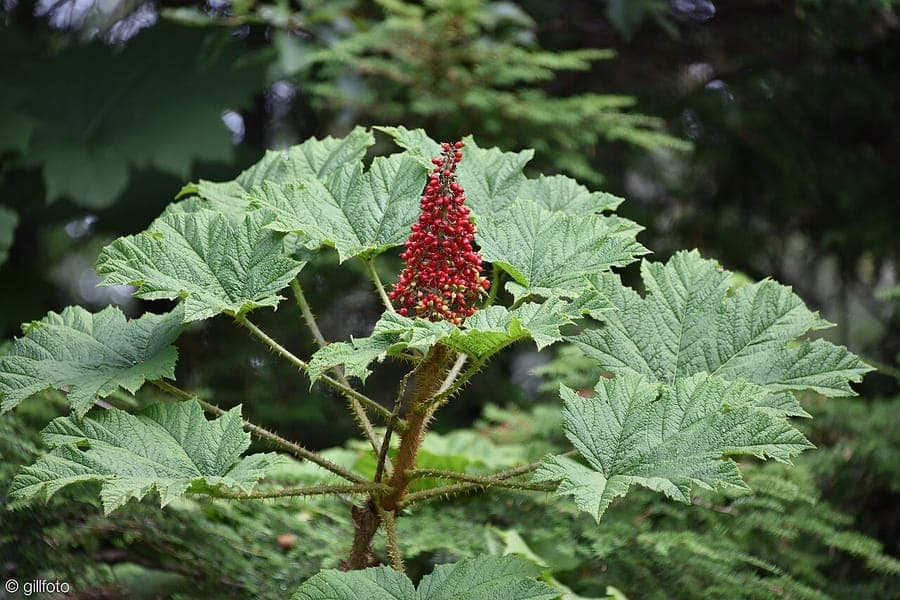
Oplopanax horridus is immediately distinctive in any landscape. It forms a multi-stemmed, upright shrub typically reaching 1 to 3 metres in height, occasionally to 4 metres in ideal conditions. The stems are stout, hollow, and almost entirely covered in sharp, pale yellow spines 5-15 mm long. The same spines arm the leaf stalks and run along the undersides of the main leaf veins.
The leaves are the plant's most impressive feature during the growing season. They are large, palmately lobed - reminiscent of maple or Japanese aralia leaves but considerably bigger - reaching 30-40 cm across on vigorous stems. Each leaf has seven to nine pointed lobes. The upper surface is glossy, bright green; the underside is paler and armed with spines along the veins. In autumn the foliage turns bright yellow before falling, creating a striking seasonal display.
Flowers appear in June and July: small, creamy-yellow to greenish blooms gathered in erect, cylindrical clusters 10-20 cm long above the leaf canopy. The flowers are pollinated by flies, beetles, and small wasps, and are not showy in themselves. After flowering, clusters of vivid red berries 6-10 mm across ripen from August through October. These red drupes are toxic to humans but are eaten eagerly by bears, birds, and other mammals, making the plant a genuinely valuable wildlife resource. The bright berry clusters are often the most striking ornamental feature of the plant in late summer and early autumn.
Ideal location
Devil's club is a true woodland plant and must be grown in partial to deep shade. In its native habitat it occupies the understorey beneath tall canopy trees - alders, maples, cottonwoods, conifers - on permanently moist forest soils. In the garden, replicate these conditions as closely as possible: a sheltered position under or behind large deciduous or evergreen trees, on the shaded north or east side of a building, wall, or tall hedge.
The plant tolerates full shade better than most ornamental shrubs. Some dappled light or gentle morning sun encourages flowering and fruiting, but direct afternoon sun causes leaf scorch and rapid wilting. In the relatively mild, moist climate of the Netherlands and Belgium, a north- or east-facing position under a tree canopy provides near-ideal conditions.
Given the formidable spines, siting is critical from a safety perspective. Do not plant devil's club along frequently used paths, near children's play areas, or in locations where people or pets might brush against it accidentally. A sheltered back corner, a slope rarely visited, or a dense boundary planting where access is not required are all appropriate positions. The plant's impenetrability also makes it an effective security barrier along a garden boundary.
Soil requirements
Oplopanax horridus requires deep, moist, humus-rich soil. In nature it grows on thick layers of decomposed leaf litter along streambanks and in forested ravines. The ideal garden soil is a deep, well-structured woodland loam with a pH between 5.0 and 7.0 - from slightly acid to neutral.
The plant does not tolerate dry, lean, or sandy soils. On soils low in organic matter, the large leaves yellow rapidly and the plant remains stunted. Amend dry or sandy ground by incorporating large quantities of well-rotted leaf mould or mature compost to a depth of at least 20-30 cm across the entire planting zone. Apply a thick mulch (8-12 cm) of shredded leaves or fine wood chips around the plant to retain soil moisture and keep the roots cool.
Heavy clay must be lightened with coarse sand and organic matter. Once well-amended, clay soils can support good growth, provided winter waterlogging is avoided. While devil's club loves moisture, it does not tolerate stagnant water sitting around the roots for extended periods. A gentle drainage gradient - as found naturally along a stream or on a gently sloping bank - is ideal.
Free design
Want to see Devil's club: complete guide in your garden? Make a free design now.
Watering
As a forest plant, Oplopanax horridus is accustomed to consistent moisture throughout the growing season. In the variable summers of the Low Countries, supplemental watering during dry spells is essential for healthy growth. The plant should never dry out completely: when prolonged drought exceeds two weeks, the large leaves begin to wilt and curl.
Water thoroughly but not excessively: allow the top 5-7 cm of soil to dry slightly between waterings while keeping the deeper root zone consistently moist. A good mulch layer greatly helps retain soil moisture and reduces the need for frequent irrigation. In the first year after planting, weekly watering during dry weather is almost always necessary to establish the root system.
On a site near a permanent water feature, pond, or stream, the plant thrives with minimal supplemental care. On slopes, a slightly sunken planting pocket or a ring of stones around the base can help retain water around the roots. Avoid overhead watering during hot weather, as wet foliage combined with heat can encourage fungal issues on the large leaf surfaces.
Pruning
Oplopanax horridus needs very little pruning. Left to its own devices it develops into a dense, upright shrub without any intervention. Remove dead or damaged stems when they occur, but exercise extreme caution: wear heavy-duty thorn-proof gloves, a thick jacket, and protective eyewear given the numerous sharp spines. Use long-handled pruning loppers rather than hand pruners to maintain safe working distance from the stems.
If the plant outgrows its allotted space, individual stems can be removed at the base in early spring. Avoid heavy pruning: the plant recovers slowly from severe cutting back and may lag behind in growth for several years. Most gardeners prefer to plant devil's club where it has room to reach its natural size and simply let it grow.
In early spring, before new leaves unfurl, clear away any dead material from the previous year - dried flower clusters and dead leaf stalks. The bright red berry clusters often persist through winter, providing food for birds; leave them in place until they are consumed or drop naturally.
Maintenance calendar
January - February: Check that the site is not waterlogged. Mark any dead stems for removal in spring. No pruning or feeding.
March: Carefully remove dead stems before new leaves emerge. Apply a thick layer of well-rotted leaf mould or compost around the plant - this is the ideal time for feeding. Plant out container-grown specimens once hard frosts are past.
April: New leaves unfurl rapidly and are particularly dramatic. Maintain the mulch layer. Begin watering if the soil starts to dry.
May - June: Full leaf development. Flowers visible in late May and June. Keep plant well-watered in dry weather. Weed carefully around the spiny base.
July - August: Fruit development after flowering. Continue watering in dry spells. Bird activity increases as red berries begin to ripen.
September - October: Berries ripen to vivid red. Foliage begins to turn yellow before falling. Collect fallen leaves to use as mulch around the base.
November - December: Plant dormant. Minimal care needed. Check drainage. Leave ripe berries for birds.
Winter hardiness
Oplopanax horridus is remarkably cold hardy despite its Pacific coastal origins. The species survives reliably in USDA zones 4 to 7, meaning it overwinters without difficulty across the Netherlands and Belgium and throughout most of Germany. In its native Alaskan habitat, it withstands temperatures down to -40 °C.
In the Low Countries, hard winters pose no serious threat to established plants, provided they are on a sheltered, well-drained site. Young plants in their first season are more vulnerable to late spring frosts when the large new leaves are just emerging. Protect first-year plants with a light fleece if late frost is forecast after budbreak.
No snow cover is needed for protection. A mulch layer of 8-10 cm around the roots provides sufficient winter insulation on most sites. On alkaline soils, the plant is less reliable long-term; a slightly acidic, humus-rich soil is strongly preferred. Find more inspiration for shade gardening and woodland plantings at gardenworld.app.
Companion plants
Oplopanax horridus's size and spines keep most plants at a distance, but several excellent companions suit the same moist, shaded conditions:
- Dryopteris wallichiana (Wallich's wood fern) - one of the most impressive ferns for moist shade, with large upright fronds in attractive yellow-green. The bold texture pairs well with the large leaves of Oplopanax.
- Actaea simplex (Bugbane) - tall, elegant flower spikes in autumn above dark, divided foliage; thrives in the same moist, rich woodland soil.
- Rodgersia pinnata - large, chestnut-like compound leaves and pink plume flowers; excels in the same moist, humus-rich shade conditions.
- Aruncus dioicus (Goat's beard) - tall, feathery white plumes in summer on large compound leaves; excellent for big, moist shade borders.
- Ligularia dentata 'Desdemona' - dark purple-red, rounded leaves and orange flowers provide vivid colour contrast next to Oplopanax's green.
- Trillium grandiflorum - elegant three-petalled white flowers of this woodland native bloom early in the season before Oplopanax closes its canopy overhead.
Allow ample space: a mature devil's club specimen needs at least 2 by 2 metres. Plant companions no closer than 1.5 metres from the spiny stems to allow safe access for maintenance. Available from specialist woodland nurseries and some larger garden centres.
Closing thoughts
Oplopanax horridus is not the most obvious choice for a garden, but it is undoubtedly one of the most memorable. The combination of enormous leaves, dramatic spines, modest but ecologically valuable flowers, and vivid red berry clusters makes it a truly spectacular presence in any woodland or shade garden. For sheltered corners, naturalistic wild gardens, and gardeners who value the genuinely extraordinary, devil's club is a plant that rewards patience and careful siting with a display unlike anything else.
Want to see Devil's club: complete guide in your garden? Make a free design now.
Upload a photo, pick a style, and get a photorealistic design with plant list in under a minute.
10,000+ gardens designed already
No credit card required


Similar plants
American marsh pennywort: complete guide
Hydrocotyle americana
Everything about Hydrocotyle americana: location, soil, moisture and winter care. A delicate groundcover for shaded pond edges and boggy garden borders.
Water pennywort: complete guide
Hydrocotyle umbellata
Everything about Hydrocotyle umbellata: ideal location, soil, watering, winter care and pond planting. A versatile aquatic plant for garden ponds and boggy spots.
Aralia hispida: complete guide
Aralia hispida
Bristly sarsaparilla: native North American shrub with white flowers and black berries. Shade specialist.