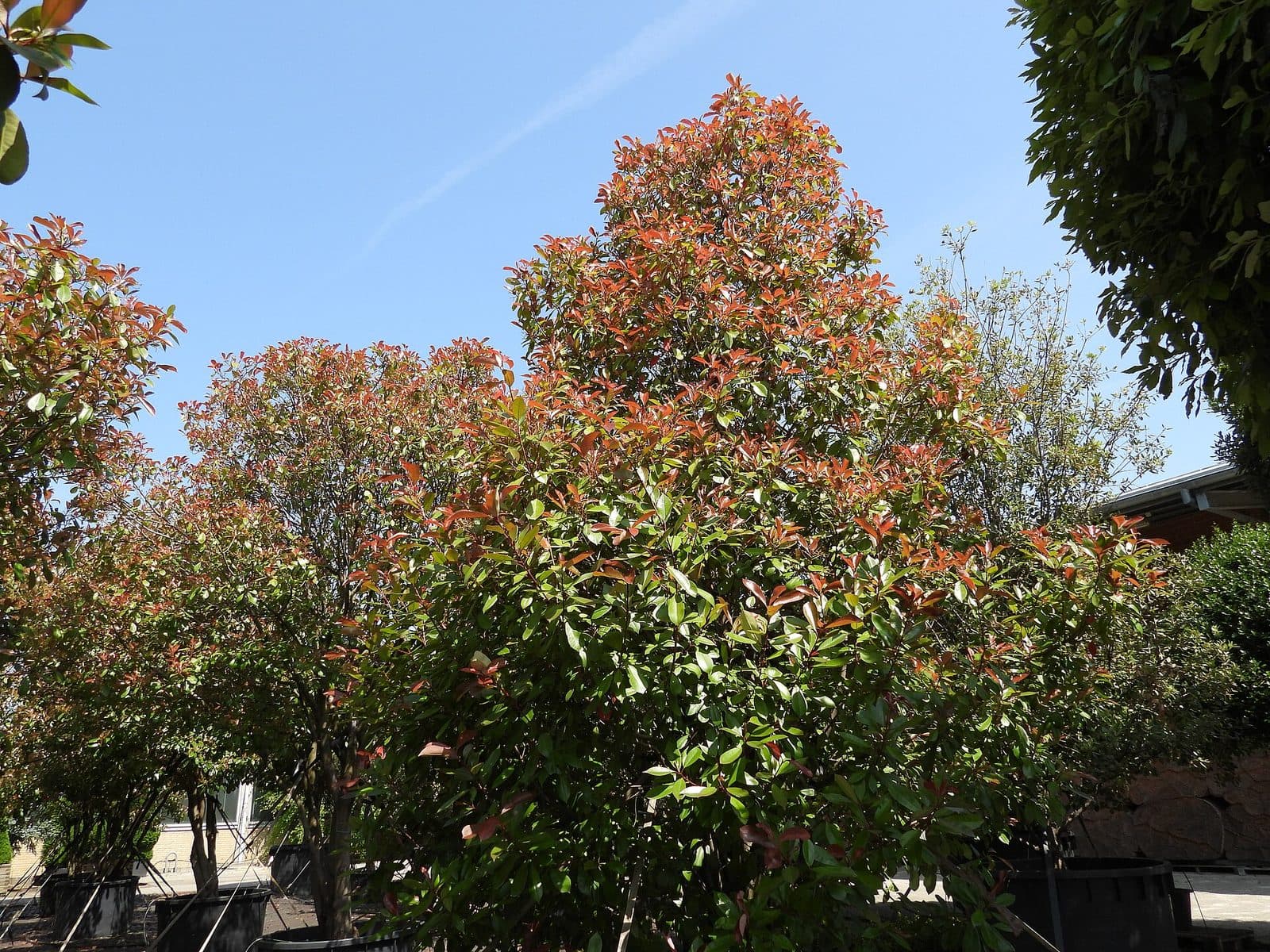
Homoarborea / CC0, via Wikimedia Commons
Red tip photinia: complete guide
Photinia × fraseri
Want to see Red tip photinia: complete guide in your garden?
Full design in HD: €7.99
Look after your Red tip photinia with the GardenWorld app
Identify plants with your camera and get a care calendar with reminders for this plant.


Overview
Red tip photinia (Photinia × fraseri) has become one of the most widely planted hedging shrubs in Britain, almost entirely thanks to one cultivar: 'Red Robin'. Each spring, and after every trim, this evergreen pushes out glossy, brilliant red young leaves that fade through bronze to deep green over a few weeks. The result is a hedge that stays dense and green all year and flushes vivid red several times a season. The plant is a hybrid of Photinia glabra and Photinia serratifolia that arose in the 1940s at Fraser Nurseries in Alabama, while 'Red Robin' itself was selected later in New Zealand. It belongs to the rose family (Rosaceae), alongside hawthorn and apple, and 'Red Robin' holds the RHS Award of Garden Merit.
Left unpruned, Photinia × fraseri grows into a large shrub or small tree 3 to 5 metres tall and 3 to 4 metres wide. As a hedge it is easily kept at 1.2 to 2.5 metres. Garden centres stock 'Red Robin' alongside compact forms such as 'Little Red Robin', at around 1 to 1.5 metres, and 'Carré Rouge', plus variegated selections like 'Louise' and 'Pink Marble'. At gardenworld.app you can create a garden design that shows how a red photinia hedge or a single specimen would sit next to your house and patio.
Appearance and bloom
The leaves are elliptic, leathery and very glossy, 7 to 15 cm long with finely toothed edges. Young shoots are bright red; after two to four weeks they turn coppery bronze and then a deep, shiny green. Because every trim triggers a new red flush, you decide how often the hedge colours up.
In April and May, an unpruned or lightly pruned shrub carries flat white heads of tiny flowers 10 to 15 cm across. Bees visit them, though many people find the scent unpleasant, somewhere between sweet and musty. A tightly clipped hedge shows few flowers, as the buds are usually trimmed off. Red berries rarely form in the British climate.
Ideal location
For the best red colour, plant in full sun. Photinia also grows well in partial shade, but the new leaves are then more bronze than scarlet and growth is a little slower. Avoid deep shade, where the hedge becomes thin and bare at the base.
Choose a spot sheltered from cold easterly winds. Harsh winter wind and late frosts in April can blacken the soft red growth and brown the leaves. Photinia copes well in towns and in many coastal gardens, though it is only moderately tolerant of direct salt spray. Allow a mature hedge a depth of 60 to 80 cm.
Soil
Photinia grows on most garden soils provided they drain well. It prefers fertile, humus-rich ground with a pH of 5.5 to 7.5. On heavy clay that stays wet in winter, root rot sets in quickly, so open the soil with compost and grit or plant on a slight mound. On very chalky soils, leaves may turn yellow between green veins, a sign of iron deficiency.
Plant a hedge at two to three plants per metre. For 60 to 80 cm plants, two per metre is enough; for a hedge that closes quickly, use three in a slightly staggered row. Dig a trench 40 cm wide and deep, mix the excavated soil with compost and plant at the same depth as in the pot. The best planting times are October and November, or March and April.
Watering
A newly planted hedge needs regular watering for its first two summers: about 10 litres per plant per week in dry spells, given in one go so the water reaches deep. A soaker hose laid along the hedge is ideal. A 5 cm mulch of bark or compost helps hold moisture.
An established photinia is fairly drought tolerant but dislikes waterlogged roots. Always water the soil, not the foliage, as wet leaves encourage leaf spot, the main problem with this plant. Feed in March with an organic shrub fertiliser and give a second, lighter feed after the first trim in June.
Free preview
Want to see Red tip photinia: complete guide in your garden? Make a free preview of your design.
Pruning
With photinia, pruning shapes both the form and the colour. The rule of thumb: prune after the first flush. Wait until the red spring growth of April and May starts turning green, usually in late May or June, and trim the hedge to shape. The fresh growth that follows comes through red again. For another red flush, trim a second time in late July or August. Do not prune later than the end of August: soft growth that appears in September cannot harden before winter and will be frosted.
For a single specimen shrub, shorten the longest shoots in June to just above a leaf to keep it compact and full. An old, leggy photinia can be cut hard back to 30 to 50 cm above ground in April; it regrows from old wood. Prune in dry weather and clear away the clippings, as wet cuts and young leaves are prone to fungal infection.
Leaf spot. The fungus Entomosporium mespili causes small red to purple spots that grow into grey or brown patches with a purple margin. Badly affected leaves drop and the hedge thins out. It strikes hardest in wet springs, on young red foliage and in dense hedges where leaves stay damp for long. Remove infected leaves and fallen debris, avoid overhead watering, keep air moving through the plants and do not trim in wet spells. A well-fed plant usually grows out of it.
Maintenance calendar
- January and February: check for frost damage; no pruning.
- March: feed and mulch; plant in mild weather.
- April: new red growth; cover with fleece if late frost threatens. Hard renovation pruning if needed.
- May: flowers on unclipped shrubs; watch for leaf spot in wet weather.
- June: first trim as soon as red growth turns green; second feed.
- July: water young hedges during dry spells.
- August: second and final trim, by the end of the month at the latest.
- September: no more pruning, so new growth can harden off.
- October and November: good planting time; rake up fallen diseased leaves.
- December: rest; shield young plants in exposed spots from cold wind.
Winter hardiness
Photinia × fraseri is hardy in USDA zones 7 to 9, which means frost down to about -15 °C. Across most of Britain and Ireland it overwinters well. In colder inland areas and on exposed sites, the leaves can brown or drop in a severe winter, but the plant usually reshoots in spring.
Protect young plants in their first winter with a windbreak or fleece during hard frosts. Late frost in April is more dangerous than winter cold, as the soft red growth is damaged at just a few degrees below zero. Leave frosted shoots in place until the risk of frost has passed, then cut them back.
Companion plants
Photinia sits well among other evergreen shrubs. Heavenly bamboo echoes the red theme with its autumn and winter colour, and laurustinus flowers white from November to April, just when photinia has least to show. Choisya ternata adds scented white flowers and fresh green leaves in May.
In a mixed hedge, photinia pairs nicely with Pittosporum tenuifolium, whose small wavy leaves give a finer texture. At its feet, Euonymus fortunei fills the gap as a low evergreen ground cover. Mixing species along a long hedge also slows the spread of leaf spot.
Closing
Red tip photinia is a hedging and specimen shrub that stays green all year and flushes bright red several times a season. Give it sun and well-drained soil, prune after the first flush and again in August if you like, and keep the leaves dry to stay ahead of leaf spot. You will have a dense, lively hedge for many years. On gardenworld.app you can see how Photinia × fraseri 'Red Robin' would look as a hedge or a single shrub in your garden, with the right partners alongside.
Frequently asked questions about Red tip photinia
Is Red tip photinia winter hardy?
Photinia × fraseri is hardy in USDA zones 7 to 9, which means frost down to about -15 °C. Across most of Britain and Ireland it overwinters well.
When and how do you prune Red tip photinia?
With photinia, pruning shapes both the form and the colour. The rule of thumb: prune after the first flush.
How much water does Red tip photinia need?
A newly planted hedge needs regular watering for its first two summers: about 10 litres per plant per week in dry spells, given in one go so the water reaches deep. A soaker hose laid along the hedge is ideal.
Where does Red tip photinia grow best?
For the best red colour, plant in full sun. Photinia also grows well in partial shade, but the new leaves are then more bronze than scarlet and growth is a little slower.
What soil does Red tip photinia need?
Photinia grows on most garden soils provided they drain well. It prefers fertile, humus-rich ground with a pH of 5.5 to 7.5.

See it in your garden
See Red tip photinia in your garden
One photo of your garden and a few questions. You see the result in about a minute.
Try it with a photoIdentify this plant in your own garden. Identify a plant
Similar plants
Heavenly bamboo: complete guide
Nandina domestica
Everything about heavenly bamboo (Nandina domestica): planting, pruning, hardiness, and colour impact. Note: berries are toxic to birds and pets.
Laurustinus: complete guide
Viburnum tinus
Everything about Laurustinus (Viburnum tinus): planting, care, pruning and winter flowering. Expert tips for this evergreen winter-blooming shrub.
Choisya ternata: complete guide
Choisya ternata
Mexican orange: fragrant blooming shrub for warm spots. Elegant foliage and white flowers. Mediterranean character for gardens.
