
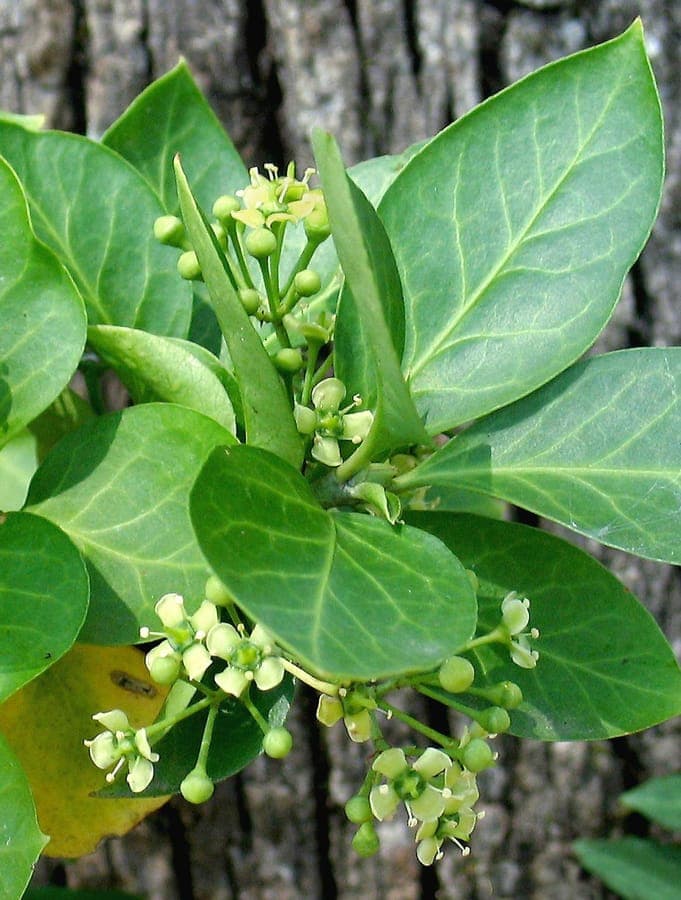
James H. Miller, USDA Forest Service, Bugwood.org / CC BY 3.0, via Wikimedia Commons
Climbing euonymus: complete guide
Euonymus fortunei
Want to see Climbing euonymus: complete guide in your garden?
1 minute, no credit card
Overview
Euonymus fortunei, commonly known as climbing euonymus, is a tough, evergreen shrub that's earned its place in UK and North American gardens for its adaptability and resilience. Native to eastern Asia-from Japan and Korea to southern China and Assam-it thrives in urban settings, woodland edges, and challenging corners where other plants struggle. It grows either as a climber using aerial rootlets to cling to walls, fences, and tree trunks, or as a groundcover, forming a dense mat up to 50 cm high. In milder climates, it remains fully evergreen, though in colder zones it may drop some leaves during harsh winters.
This plant is a go-to for gardeners dealing with deep shade or dry soil under trees. On gardenworld.app, you can design a shade garden layout that incorporates Euonymus fortunei as a vertical green backbone, especially along north-facing walls.
Appearance & bloom cycle
The foliage is small, oval, and glossy green, arranged oppositely along the stems. Leaves typically measure 2–5 cm long and create a tight, lush canopy. In autumn, especially after cool nights, the leaves may turn bronze or reddish-purple, adding seasonal interest. The plant flowers in late spring to early summer (May–July), producing small, unassuming greenish-yellow flowers that aren't particularly showy. These are followed by striking fruit capsules in autumn: bright orange pods that split open to reveal vivid red seeds. However, fruiting is rare in cooler climates and on non-self-fertile cultivars.
As a climber, Euonymus fortunei can reach 8–10 m with support; as a groundcover, it spreads 1–2 m wide while staying under 0.5 m tall. Growth rate is moderate-roughly 20–30 cm per year-slower in poor soil or full shade.
Ideal location
This euonymus prefers partial to full shade, making it ideal for north-facing walls, beneath tree canopies, or in narrow urban gaps. It tolerates morning sun but may scorch in hot afternoon sun, especially if the soil dries out. When planting as a climber, ensure the wall or structure is sound-its aerial roots can penetrate weak mortar over time. Young plants benefit from light tying with garden twine until rootlets establish.
For groundcover use, clear weeds first and plant at 60 cm intervals for full coverage in 2–3 years. Avoid planting near invasive species or vigorous groundcovers that could outcompete it.
Soil requirements
Euonymus fortunei is adaptable to most soil types: sandy, loamy, or clay, as long as drainage is decent. It prefers a pH between 5.0 and 7.5-slightly acidic to neutral. Avoid waterlogged soils, which can lead to root rot. When planting, dig a hole twice the width of the root ball (minimum 40x40x40 cm) and mix in compost or well-rotted manure to boost establishment.
In heavy clay, add grit or horticultural sand to improve drainage. On very alkaline soils (pH over 7.5), watch for signs of iron deficiency-yellowing between leaf veins-which can be treated with chelated iron.
Free design
Want to see Climbing euonymus: complete guide in your garden? Make a free design now.
Watering
Water regularly during the first growing season, especially in dry spells. Aim for deep watering once or twice a week rather than daily sprinkles. Once established, it's fairly drought-tolerant, though climbers may need supplemental watering during extended dry periods due to exposed root systems.
Use rainwater when possible-this plant is sensitive to high calcium levels in tap water, which can cause leaf chlorosis. Mulching with bark or compost in spring helps retain moisture and suppress weeds.
Pruning
Pruning is optional but useful for shaping, rejuvenating, or controlling spread. The best time is late winter or early spring (February–March), before new growth starts. Cut back stems by up to half their length without harming the plant. For climbers, trim stray shoots and thin out dense areas to encourage airflow.
Use sharp, clean secateurs and disinfect between cuts if disease is suspected. Avoid heavy pruning in late summer, as it may encourage tender growth vulnerable to frost.
Maintenance calendar
- Jan: Inspect for winter damage, remove dead wood
- Feb–Mar: Light pruning, shape as needed
- Apr: Apply slow-release fertilizer, check for aphids
- May: Growth accelerates, monitor for water stress
- Jun–Jul: Flowers appear, no action required
- Aug: Watch for drought stress in hot weather
- Sep: Last feed with low-nitrogen fertilizer
- Oct: Fruit capsules may open, leaves may colour
- Nov: Leave leaf litter around groundcover forms for insulation
- Dec: Check root attachment on climbers, secure loose stems
Winter hardiness
Euonymus fortunei is hardy to USDA zones 6a–9b (-15°C to -1°C). In most of the UK and northern US, it survives winter with minimal protection. In exposed sites or colder zones, foliage may bronze or scorch, but the plant usually recovers in spring. Young plants benefit from hessian wrap during extreme cold snaps.
Avoid planting in frost pockets or windy, open areas where desiccation can occur.
Companion plants
Pair with shade-loving perennials like hellebores, ferns, or hostas. Under trees, combine with epimedium, barrenwort, or spring bulbs like snowdrops. Avoid aggressive spreaders like ivy or periwinkle that can overwhelm it.
Use gardenworld.app to visualise companion planting schemes and create maintenance-friendly borders.
Closing
Climbing euonymus is a dependable, low-fuss plant for tough spots. It handles shade, dry soil, and urban pollution with ease. While generally well-behaved, it can spread in mild, moist climates-monitor groundcover forms. Stick to the species form for natural gardens; avoid variegated cultivars if seeking subtle elegance. Available at most garden centres, often in 3-litre pots or trained on small trellises.
Want to see Climbing euonymus: complete guide in your garden? Make a free design now.
Upload a photo, pick a style, and get a photorealistic design with plant list in under a minute.
No credit card required


Similar plants
Fringed grass of Parnassus: complete guide
Parnassia fimbriata
Everything about Fringed grass of Parnassus (Parnassia fimbriata): growing, soil, watering and care. A delicate mountain perennial with white fringed flowers.
Euonymus cornutus: complete guide
Euonymus cornutus
Horned spindle is an intriguing shrub from central China with distinctive winged seed capsules. Learn how to grow this unique plant.
Large-Winged Spindle: complete guide to this Far Eastern shrub
Euonymus macropterus Rupr.
Discover Large-Winged Spindle (Euonymus macropterus), an elegant Japanese shrub prized for spectacular winged fruits. Perfect for Asian gardens and woodland plantings.