
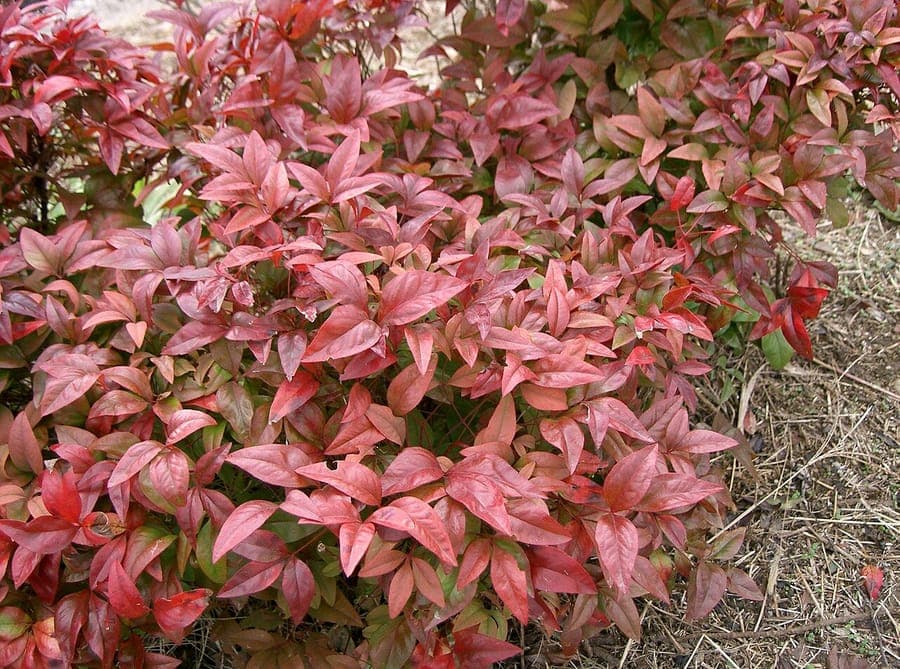
KENPEI / CC BY-SA 3.0, via Wikimedia Commons
Heavenly bamboo: complete guide
Nandina domestica
Want to see Heavenly bamboo: complete guide in your garden?
1 minute, no credit card
Overview
Heavenly bamboo (Nandina domestica) is one of the most rewarding ornamental shrubs for gardeners in temperate and mild climates. Despite its common name, it has no botanical connection to bamboo whatsoever. The name refers to the plant's feathery, bamboo-like leaf structure and the slender, upright canes that call bamboo to mind. Nandina belongs to the Berberidaceae family - the same family as barberry and mahonia - and originates from China, Japan, and India, where it has been cultivated in gardens for centuries.
In gardens across Western Europe, North America, and Australia, Nandina has become a staple of planting schemes because it earns its space across three seasons: striking bronze-red new foliage in spring, airy white flower plumes in summer, and vivid scarlet or crimson leaves paired with clusters of glossy red berries in autumn and winter. The upright, loosely branching habit - typically 100 to 200 cm tall and 60 to 100 cm wide - gives the plant a light, transparent quality in the border that heavier shrubs simply cannot match.
An important warning for all gardeners: the red berries of Nandina domestica contain cyanogenic glycosides and are toxic to humans, pets, and birds. In the United States, documented cases of mass mortality in Cedar Waxwings have been directly linked to Nandina berry consumption. In Europe, similar risks exist for waxwings, thrushes, and other fruit-eating birds. If your garden hosts significant bird activity, carefully consider whether to plant berry-producing forms, and choose fruitless or low-berry cultivars when in doubt. On gardenworld.app you can design a garden that balances ornamental impact with wildlife safety.
Appearance and bloom cycle
The foliage of Nandina domestica is twice to three times pinnate, with lance-shaped leaflets 3 to 7 cm long. Young growth in spring emerges in warm shades of copper, bronze, and soft red before maturing to mid- or deep green through summer. In autumn, as temperatures drop and day length shortens, the foliage reverses course and colours up brilliantly in shades of scarlet, flame red, and orange-red. The intensity of this colour is greatest in full sun and cold autumn nights - in sheltered mild gardens the colouring can be modest, while in open, continental positions the effect is genuinely dramatic.
Flowering takes place in June and July. The plant carries erect, pyramidal panicles 20 to 40 cm long, made up of small six-petalled white flowers with conspicuous yellow stamens. The individual flower is not large, but a shrub in full bloom, with creamy white plumes rising above the delicate foliage, is airy and graceful. After flowering, small green berries develop through late summer and ripen from September onward to a vivid, glossy red. The berry clusters persist on the plant well into winter, often until February or March, providing sustained ornamental interest in the coldest months.
Compact cultivars widely available include 'Firepower' (50 to 70 cm, intense winter-red colouring), 'Gulf Stream' (80 to 100 cm, dependable and tough), and 'Obsessed' (a newer selection with deep purple-red winter colour). Most garden centres in the UK and Northern Europe stock at least two or three named selections.
Ideal location
Nandina domestica performs best in a position that receives at least four to six hours of direct sun per day. Full sun maximises autumn and winter colour intensity and encourages heavier berry production. Partial shade is tolerated and the plant remains vigorous and healthy, but the leaf colouring in autumn will be less spectacular. Deep shade is unsuitable - the plant becomes drawn, grows poorly, and produces little colour or fruit.
In the cooler regions of the Netherlands, Belgium, and northern Germany, plant Nandina against a sheltered east- or south-facing wall, where reflected warmth and shelter from cold winds reduce frost risk. In milder coastal regions, it can stand freely in the open border without wall protection. The plant adapts well to urban microclimates and tolerates a degree of air pollution, making it a practical choice for courtyard and patio plantings in city gardens.
Nandina is widely planted in the south-eastern United States, parts of California, and coastal Australia, where it has naturalised and is classified as invasive in several states. Always check local regulations before planting in regions where it may spread into native vegetation.
Soil requirements
Nandina grows well in a range of soils but performs best in light, humus-rich, moist but free-draining ground with a slightly acid to neutral pH of 5.5 to 6.5. It tolerates clay soils if drainage is adequate, but on waterlogged heavy clay it will suffer root rot and decline. On thin, very free-draining sandy soils, it dries out too quickly and may struggle in summer.
When planting, dig a hole at least twice as wide as the rootball. Mix the excavated soil with generous amounts of well-rotted garden compost or planting compost. On heavy clay, add coarse horticultural grit to improve drainage. Plant at the same depth as the pot, water in thoroughly, then mulch the root zone with 5 to 8 cm of composted bark or wood chips. This retains moisture, moderates soil temperature, and protects the shallow root system from frost. On chalky or alkaline soils with a pH above 7, the foliage may show inter-veinal yellowing - treat with sequestered iron chelate and an acidifying fertiliser.
Free design
Want to see Heavenly bamboo: complete guide in your garden? Make a free design now.
Watering
Nandina is moderately drought-tolerant once established, but grows and colours best with consistent moisture availability, particularly during its first year in the ground. Newly planted specimens need watering every one to two weeks during dry spells, with enough water to penetrate 20 to 30 cm into the soil. A thorough, infrequent soaking is always better than a shallow daily sprinkle.
Established shrubs cope well with short dry spells but can shed leaves and slow their growth under prolonged drought in summer. In extended dry periods of two weeks or more, water deeply - 10 to 15 litres per plant - to maintain healthy growth. Avoid overwatering: Nandina does not tolerate standing water around its roots and will develop root rot if the soil stays waterlogged. Before watering, check soil moisture by pressing a finger 5 cm into the ground; if the soil still feels damp, hold off. In containers, good drainage holes are essential - choose large, sturdy pots and water regularly during summer but more sparingly in winter.
Pruning
Nandina requires only minimal pruning and responds poorly to hard cutting back. The plant's naturally open, upright form is part of its appeal, and pruning should be aimed at renewal and light tidying rather than shaping. Prune in early spring, in March or early April, before the new season's growth begins.
The most effective technique is renewal pruning: cut one to three of the oldest, barest canes right down to ground level each year. This encourages vigorous new growth from the base and keeps the shrub youthful and well-furnished at all heights. At the same time, remove damaged, dead, or congested stems. Deadhead spent flower panicles by cutting back to just above a side bud or leaf joint. Avoid cutting stems off at an arbitrary height mid-cane - the cane will die back to the next node and look ungainly. Compact cultivars like 'Firepower' and 'Gulf Stream' are naturally tidy and need almost no intervention beyond removing dead wood.
Maintenance calendar
January-February: Admire the winter red colouring. Add extra mulch around the base if hard frost is forecast. In exposed positions, a temporary fleece wrap helps during prolonged freezing spells.
March-April: Main pruning session: remove one to three old bare canes at ground level. Cut out winter damage. Apply a balanced slow-release fertiliser around the root zone. Plant new specimens after the last hard frost.
May-June: New bronzy-red growth emerges. Monitor soil moisture as temperatures rise. Flower buds form in early June.
June-July: Flowering season. Enjoy the white plumes. Water deeply during dry spells. No other action needed.
August-September: Berries developing and swelling on the plant. Apply a potassium-rich autumn fertiliser to strengthen overwintering capacity and improve foliage colour.
October-November: Peak autumn-winter foliage display. Berries ripen to red. Note the bird-toxicity risk if waxwings or thrushes visit your garden.
December: Plant in dormancy. Protect from hard frost as needed with fleece or extra mulch at the base.
Winter hardiness
Nandina domestica is rated USDA zones 6 to 9. In practice, this means it is fully reliable in mild maritime climates - much of England, coastal Belgium, the Netherlands west of the central ridge - but borderline in colder inland or northern regions where temperatures regularly fall below -15 to -20 degrees Celsius. In these colder zones, the plant may lose most of its foliage in hard winters and can be cut to the ground by severe frost, but it typically regrows from the root zone in spring.
The species and the compact green cultivars are generally the toughest. Strongly coloured red selections like 'Firepower' are typically slightly more tender. Wall protection is the single most effective measure in borderline climates: planting against a sheltered south- or west-facing wall can extend reliable hardiness by one full hardiness zone. A thick mulch of composted bark over the root zone in November provides additional insurance. Remove the mulch gradually in March rather than all at once, to avoid sudden exposure to late frosts.
In mild winters, Nandina is effectively semi-evergreen to fully evergreen. In cold winters it may appear bare but reshoot reliably once conditions improve. Established plants recover faster than recently planted specimens.
Companion plants
Nandina pairs naturally with other plants that contribute winter structure and colour. Ornamental grasses such as Pennisetum alopecuroides 'Hameln' and Calamagrostis x acutiflora 'Karl Foerster' make ideal companions, their tawny plumes echoing the red-orange tones of Nandina's winter foliage. Berberis thunbergii 'Atropurpurea' offers a complementary purple-red contrast in a mixed border, while Photinia x fraseri 'Red Robin' gives a similar red new-growth effect on a larger scale.
For a contemporary, minimal planting, Nandina works well beside Carex morrowii 'Ice Dance' as low ground cover, Helleborus x hybridus for late-winter flowers, and Epimedium x warleyense for a tough, drought-tolerant underplanting. In a Japanese-inspired garden scheme, combine Nandina with Camellia japonica, bamboos (non-invasive clumping types), and moss to create a year-round composition rich in texture and seasonal change. Visit gardenworld.app to build a personalised planting plan that positions Nandina alongside the right companions for your specific garden.
Closing
Heavenly bamboo is a shrub that earns its place in the garden across three full seasons: bronze-red new growth in spring, elegant white flower spires in summer, and a vivid display of scarlet or crimson foliage paired with glossy red berries from autumn through to late winter. Its light, upright habit suits it equally as a specimen plant, in group plantings, or as a low informal hedge.
Give Nandina a sunny to partly shaded position, improve the soil with compost, prune sparingly in early spring, and protect the roots in hard winters. Always bear in mind the toxicity of the berries to birds and pets, and choose a fruitless cultivar if your garden is a regular stopping point for waxwings or other fruit-eating birds. Meet those few requirements and heavenly bamboo will reward you year after year with one of the finest three-season displays of any garden shrub.
Want to see Heavenly bamboo: complete guide in your garden? Make a free design now.
Upload a photo, pick a style, and get a photorealistic design with plant list in under a minute.
10,000+ gardens designed already
No credit card required


Similar plants
Thunberg's barberry: complete guide
Berberis thunbergii
Everything you need to know about Thunberg's barberry: planting, care, pruning, and ideal garden uses. Hardy, low-maintenance shrub with vibrant autumn colour.
Mahonia aquifolium: complete gids
Mahonia aquifolium
Leer alles over mahonia aquifolium, een veelzijdige struik met glanzende bladeren en gele bloemen. Perfecte keuze voor haagwerk en borders.