
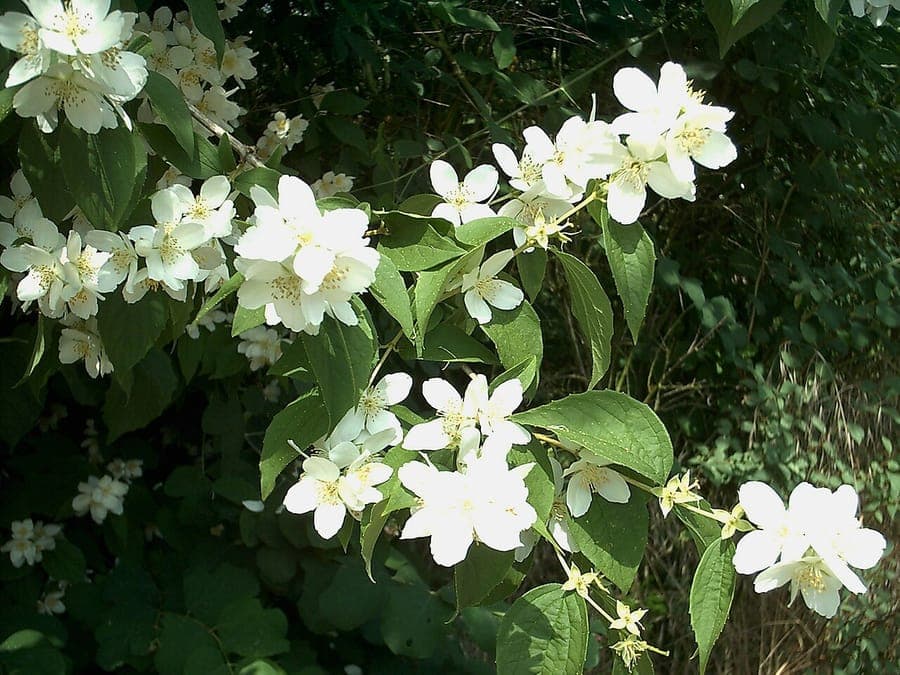
No machine-readable author provided. Rainer Bielefeld assumed (based on copyright claims). / Public domain, via Wikimedia Commons
Mock Orange: complete guide
Philadelphus coronarius
Want to see Mock Orange: complete guide in your garden?
1 minute, no credit card
Overview
Mock Orange (Philadelphus coronarius) is one of the most treasured ornamental shrubs in the European garden tradition. Anyone who has walked past a blooming mock orange in June will never forget the experience - the intoxicatingly sweet fragrance, reminiscent of orange blossom and jasmine, carries dozens of metres and for many people forms the ultimate scent memory of summer. This deciduous shrub has been in cultivation since the sixteenth century and has graced countless gardens and parks ever since.
Mock Orange grows to a height of 2 to 3 metres and forms a broad, upright shrub with elegantly arching branches. On gardenworld.app you can create a garden design where mock orange serves as a fragrant focal point - as a specimen plant, in a mixed border, or as an informal hedge. The plant belongs to the family Hydrangeaceae and originates from southern Europe and Asia Minor. Popular cultivars include 'Virginal' (double flowers, exceptionally fragrant), 'Belle Etoile' (single flowers with a purple blotch at the base), and 'Manteau d'Hermine' (compact, reaching only 80 cm, ideal for small gardens).
Appearance and bloom cycle
Mock Orange flowers profusely in June over a period of three to four weeks. The blooms are pure white, 2 to 4 cm across, with four petals and a cluster of golden stamens at the centre. They appear in short racemes of 5 to 9 flowers at the tips of lateral shoots. The fragrance is overwhelming: intensely sweet, with notes of orange blossom, honey, and a hint of lemon. Few other garden plants can rival this scent.
The leaves are oval, 4 to 8 cm long, light green, and slightly hairy on the undersides. In autumn the foliage turns yellow before falling. The bark of older branches is chestnut-brown and peels away in thin strips, providing a subtle winter detail. The shrub has a graceful, slightly pendulous growth habit that looks particularly elegant when the branches are laden with flowers.
Ideal location
Mock Orange is surprisingly unfussy regarding location. It performs best in full sun to partial shade. In full sun, flowering is most prolific and the fragrance strongest; in partial shade the shrub still blooms well but somewhat less abundantly. Avoid deep shade - there the plant will grow lanky and barely flower.
Plant mock orange in a spot you pass regularly or sit near, so you can enjoy the fragrance to the fullest. Beside a patio, along a garden path, or near a seating area are ideal locations. The shrub tolerates wind without difficulty and is also suited to urban gardens with some air pollution. Allow for a spread of 1.5 to 2.5 metres on a mature specimen - give it space to develop its graceful form.
Soil requirements
Mock Orange is remarkably tolerant regarding soil. It grows in clay, loam, sand, and even chalky ground. The ideal soil is moisture-retentive yet well-drained, moderately fertile, with a pH of 6.0 to 8.0. On very dry, poor sandy soil, growth will be somewhat slower, but the plant survives without difficulty.
When planting, it is advisable to dig the planting hole generously (twice as wide as the root ball) and mix the excavated soil with a spadeful of compost. This improves soil structure and gives the young roots a good start. On heavy clay, adding a handful of coarse grit to the planting hole improves drainage.
Watering
Mock Orange is fairly drought-tolerant after its first growing season. During the first year after planting, water weekly in dry weather - roughly 8 to 10 litres per session. Water at the base of the plant and avoid wetting the foliage and flowers. From the second year onward, supplementary watering is only necessary during prolonged drought exceeding two weeks.
Container-grown mock orange requires more frequent watering: check every two to three days and do not let the root ball dry out completely. Ensure pots have ample drainage holes. A 5 cm layer of mulch around the base helps retain moisture and suppress weeds. Avoid waterlogging: persistently wet feet lead to root rot and a declining plant.
Pruning
Correct pruning is the secret to annual abundant flowering in mock orange. The shrub blooms on the previous year's wood, which means you should never prune in early spring - you would be removing the flower buds. Prune immediately after flowering, in July, when the last blooms have faded.
During the summer prune, cut the flowered shoots back to a strong, young lateral shoot lower on the branch. Also remove dead, crossing, and overcrowded branches to allow light and air into the heart of the shrub. Each year, remove a quarter to a third of the oldest, thickest stems at the base - this stimulates the formation of young, flower-bearing wood. A neglected, overgrown mock orange can be rejuvenated drastically by cutting it back to 30 cm above ground in late winter. It will recover fully in two to three seasons, but will not flower in the first year after such treatment.
Free design
Want to see Mock Orange: complete guide in your garden? Make a free design now.
Propagation
Mock Orange is easily propagated from cuttings. In June or July, take semi-ripe cuttings 10 to 15 cm long: cut just below a leaf node, remove the lower leaves, and insert the cuttings into a mix of peat and perlite. Keep them moist and sheltered - after six to eight weeks most cuttings will have rooted. Overwinter the young plants in their first winter in a cold frame or sheltered spot and plant them out the following spring.
Alternatively, take hardwood cuttings of 20 to 25 cm in autumn and insert them directly into the ground in a sheltered spot. This method is simpler but the success rate is slightly lower. Both methods produce plants identical to the parent.
Maintenance calendar
March–April: The shrub breaks bud. Check for frost damage and remove any dead twigs. Apply a thin layer of compost around the base.
May: Flower buds become visible. The shrub needs adequate moisture now for a good display - water in dry weather.
June: Flowering. Enjoy the fragrance and cut branches for the vase if desired - they last 5 to 7 days indoors.
July: Prune immediately after flowering. Remove flowered shoots and thin, weak growth.
August–September: New shoots develop and form the flower buds for next year.
October–November: Leaf fall. Clear fallen foliage from borders.
December–February: Dormancy. No pruning - the flower buds for the coming season are already set.
Winter hardiness
Philadelphus coronarius is fully winter-hardy across the British Isles, the Netherlands, Belgium, and most of continental Europe, tolerating temperatures down to approximately -25 °C (USDA zones 4 to 8). The shrub requires no winter protection, even in severe winters. All popular cultivars - 'Virginal', 'Belle Etoile', and 'Manteau d'Hermine' - are as hardy as the species.
Young container-grown plants are slightly more vulnerable: place them in a sheltered position for their first winter or wrap the pot in bubble wrap. Planted-out specimens overwinter without difficulty. Late spring frosts can occasionally damage flower buds, but this is rare and has no lasting effect on the plant's health.
Pests and diseases
Mock Orange is remarkably healthy and suffers from few pests or diseases. Aphids may occasionally appear on young shoots in spring, but these rarely cause serious damage and are typically controlled by natural predators. In wet summers, powdery mildew may occur - ensure adequate air circulation by pruning the shrub open and avoid overhead watering.
Honey fungus (Armillaria) can in rare cases attack older plants. Symptoms include sudden wilting of part of the shrub and white fungal threads beneath the bark. Remove affected parts generously and improve drainage. On the whole, mock orange is one of the most trouble-free ornamental shrubs in existence.
Companion plants
Mock Orange combines beautifully with other shrubs and perennials. The classic partner is lilac (Syringa vulgaris): flowering together in May-June, they form a fragrant double act. Plant mock orange behind lavender, catmint (Nepeta), or sage (Salvia nemorosa) for a colourful foreground. Hydrangea (Hydrangea macrophylla) is an excellent neighbour - both thrive in similar conditions.
For a mixed shrub border, combine mock orange with butterfly bush (Buddleja davidii), weigela (Weigela florida), and deutzia (Deutzia gracilis). The white blooms of mock orange provide a calming contrast to the purple, pink, and red tones of these partners. In a romantic garden style, mock orange is indispensable alongside climbing roses and clematis.
Final thoughts
Mock Orange is a shrub that perfumes the entire garden in June and offers a reliable green backdrop for the rest of the year. It demands little care, grows in virtually any soil, tolerates sun and partial shade, and rewards a simple annual prune with a profusion of fragrant flowers.
Choose 'Virginal' for the richest scent, 'Belle Etoile' for the prettiest individual flowers, or 'Manteau d'Hermine' for a compact specimen. On gardenworld.app you can create a garden design that combines mock orange with the right partners for your specific garden. Plant this shrub where you sit on summer evenings and let yourself be surprised anew each year by that unforgettable fragrance.
Want to see Mock Orange: complete guide in your garden? Make a free design now.
Upload a photo, pick a style, and get a photorealistic design with plant list in under a minute.
No credit card required


Similar plants
Common Lilac: complete guide
Syringa vulgaris
Everything about Common Lilac (Syringa vulgaris): planting, pruning, care and propagation. Practical tips for abundant, fragrant May blooms.
Butterfly Bush: complete guide
Buddleja davidii
Everything about the Butterfly Bush (Buddleja davidii): planting, pruning, care and attracting butterflies. Practical tips for a blooming butterfly garden.
Bigleaf Hydrangea: complete guide
Hydrangea macrophylla
Everything about the Bigleaf Hydrangea (Hydrangea macrophylla): planting, pruning, flower colour control and winter protection. Practical tips for lush blooms.