Wikimedia Commons / CC BY-SA 3.0, via Wikimedia Commons
Himalayan bistort (Persicaria affinis): complete guide
Persicaria affinis
Want to see Himalayan bistort (Persicaria affinis): complete guide in your garden?
Full design in HD: €7.99
Look after your Himalayan bistort with the GardenWorld app
Identify plants with your camera and get a care calendar with reminders for this plant.


Overview
Persicaria affinis, often sold as Himalayan bistort or simply as dwarf knotweed, is a low, mat-forming perennial from the high Himalaya. In the wild it grows on damp rocky slopes and alpine meadows at roughly 3,000 to 4,800 metres, and that mountain origin explains a great deal about how it behaves in the garden: it is tough, cold-hardy and happiest where the soil stays reliably moist. You may still see it labelled under older names such as Polygonum affine or Bistorta affinis, but most nurseries now list it as Persicaria affinis followed by a cultivar name.
Its appeal lies in three qualities that rarely come together in one plant. It flowers for a very long time, it knits into a dense weed-suppressing carpet, and it puts on a genuine autumn display when the leaves turn bronze and russet. Even in winter the dead foliage and spent flower spikes stay on the plant, so the ground never looks bare. Expect a height of 15 to 25 cm, with each plant spreading to 50 or 60 cm across, and wider over time, through creeping stems that root as they go.
Popular selections include 'Superba', which opens pale pink and ages to crimson, 'Darjeeling Red' with deeper rose-red spikes, and 'Donald Lowndes', a compact form with salmon-pink flowers. If you would like to see where this groundcover fits best among your other perennials, on gardenworld.app you can create a garden design that takes your aspect and soil into account.
Appearance and bloom cycle
The leaves are lance-shaped to narrowly elliptic, 5 to 10 cm long, glossy dark green and fairly leathery. They sit closely along short, prostrate stems that root at the nodes, building a tight mat that keeps most weeds down once established, though it spreads at a steady pace rather than at a gallop.
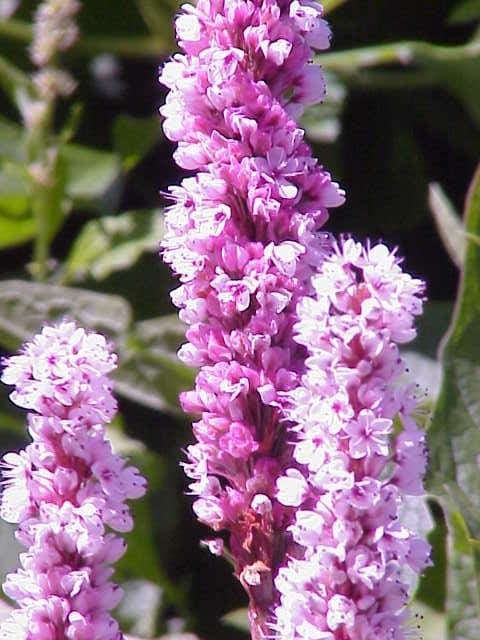
Flowering normally starts in July and carries on until October, sometimes later in a mild autumn. The spikes are short and plump, around 5 to 8 cm long, held on upright stalks just above the foliage. Each one is packed with dozens of tiny bell-shaped flowers with protruding stamens. The characteristic two-tone effect comes from the way the flowers age: fresh blooms are pale pink, older ones darken to deep pink and red. At any moment you see spikes in several shades, which gives the planting a lively, speckled look.
Bees, bumblebees and hoverflies visit the flowers freely, which is particularly useful in late summer when many gardens have little left to offer. In autumn the foliage turns bronze and rusty red, and much of it hangs on through winter, adding warmth to the border and protecting the crown at the same time.
Ideal location
In a temperate climate Persicaria affinis does best in full sun to light shade. Full sun gives the most flowers and the most compact carpet, provided the soil never dries out completely. In dappled shade, at the edge of a shrub border or beneath high-canopied trees, it still grows well but produces fewer spikes.
Use it at the front of a border, along a path, at the edge of a patio or as groundcover between taller perennials. It also suits a bank or a large rock garden with a little extra moisture. Because it stays low and spreads widely, it can replace lawn in small, awkward spots that are a nuisance to mow. Plant five to seven per square metre if you want the ground covered quickly.
Avoid places that become bone dry in summer, such as a narrow strip against a south-facing wall or soil full of tree roots. There the leaves scorch and the mat tends to open up in the middle.
Soil requirements
This knotweed is not especially fussy, but it wants soil that stays moist without becoming waterlogged. A humus-rich, crumbly loam is ideal. It also copes with clay, as long as the ground is not saturated for long spells in winter. On light sandy soil, dig in plenty of compost or leaf mould at planting time so the ground holds more water.
Soil pH matters little; slightly acidic to slightly alkaline conditions are all tolerated. A thin mulch of compost in spring keeps the soil life active and helps the plant through dry spells. Heavy feeding is unnecessary and tends to produce soft, floppy growth.
Free preview
Want to see Himalayan bistort (Persicaria affinis): complete guide in your garden? Make a free preview of your design.
Watering
Water regularly for the first few weeks after planting until the roots have taken hold. After that the plant usually looks after itself in ordinary garden soil. During long, hot and dry spells in summer, give a thorough soak about once a week; one generous watering is better than a daily sprinkle, because it encourages the roots to go deeper.
Brown, curling leaf edges in midsummer are almost always a sign of drought. In pots and troughs the compost dries out much faster, so check two or three times a week in summer whether it still feels moist.
Pruning
Very little pruning is needed. Leave the spent flower spikes in place; they turn a handsome rusty brown and are part of the plant's winter character. Clear away the old foliage in late February or March, just before new leaves appear, using secateurs or shears, and take care not to cut into the growing points at the base.
If the mat becomes too wide after a few years, simply slice off the outer sections with a spade in spring. When the centre of a clump starts to look thin, dividing in March or April is the best remedy. Replant the young, vigorous pieces from the edge in improved soil.
Maintenance calendar
- March: cut back old foliage and spent spikes, spread a layer of compost.
- April: the best time to plant or divide.
- May - June: new foliage closes the carpet; weed between young plants.
- July - October: flowering season; water deeply during drought.
- October - November: leaves turn russet, leave everything standing.
- December - February: the plant rests and the old foliage protects the crown.
To keep these tasks on track, use the planting calendar on gardenworld.app, which shows you month by month what needs doing in your garden.
Winter hardiness
Persicaria affinis is extremely hardy. As a Himalayan mountain plant it withstands temperatures down to around -25 °C and below in free-draining soil, and it overwinters without protection throughout Britain, Ireland and the Low Countries. Hard frost kills off much of the top growth, but the plant reliably reshoots in spring from its creeping stems.
The real winter threat is not cold but wet feet. Soil that sits waterlogged for months can rot the stems, so improve drainage on heavy clay. Plants in containers are more vulnerable: in a severe winter, move the pot against a wall and raise it on pot feet so excess water can escape.
Little is recorded about toxicity, and this species is not known to be dangerous to people or pets. As with many members of the knotweed family, the leaves may contain oxalic acid, so it is sensible to stop children, dogs and cats from chewing them. The plant is not regarded as invasive in Europe, although it spreads freely in a moist garden.
Companion plants
Its low, dense habit makes Persicaria affinis a natural front-of-border plant. Pair it with lady's mantle (Alchemilla mollis), whose lime-green froth sets off the pink spikes beautifully. Scented Geranium macrorrhizum is another robust partner that tolerates shade and needs a similar level of care.
In partial shade, hostas such as Hosta sieboldiana add bold structure with their large, blue-green leaves. In sunny, moist borders, ornamental grasses like purple moor grass (Molinia caerulea) make a fine backdrop, especially in autumn when grass and knotweed turn gold and red together. For a more natural look, plant the taller common bistort (Persicaria bistorta) behind it; this relative flowers earlier in the season and extends the display.
Final thoughts
Persicaria affinis is a dependable, low-growing groundcover for anyone who wants long-lasting colour for very little effort. It flowers for months, takes on warm autumn tints, smothers weeds and asks for little more than soil that does not dry out and a single tidy-up in spring. Plant it at the front of a border or along a path, give it some attention in its first summer, and it will form a colourful carpet for years, feeding bees and bumblebees well into October.
Frequently asked questions about Himalayan bistort
Is Himalayan bistort winter hardy?
Persicaria affinis is extremely hardy. As a Himalayan mountain plant it withstands temperatures down to around -25 °C and below in free-draining soil, and it overwinters without protection throughout Britain, Ireland and the Low Countries.
When and how do you prune Himalayan bistort?
Very little pruning is needed. Leave the spent flower spikes in place; they turn a handsome rusty brown and are part of the plant's winter character.
How much water does Himalayan bistort need?
Water regularly for the first few weeks after planting until the roots have taken hold. After that the plant usually looks after itself in ordinary garden soil.
Where does Himalayan bistort grow best?
In a temperate climate Persicaria affinis does best in full sun to light shade. Full sun gives the most flowers and the most compact carpet, provided the soil never dries out completely.
What soil does Himalayan bistort need?
This knotweed is not especially fussy, but it wants soil that stays moist without becoming waterlogged. A humus-rich, crumbly loam is ideal.

See it in your garden
See Himalayan bistort in your garden
One photo of your garden and a few questions. You see the result in about a minute.
Try it with a photoIdentify this plant in your own garden. Identify a plant
Similar plants
Garden lady's-mantle: complete guide
Alchemilla mollis
Alchemilla mollis, or garden lady's-mantle, is a graceful perennial perfect for borders, shade gardens, and low-maintenance landscapes. Grows 15–30 cm tall, blooms June–August.
Rock crane's-bill: complete guide
Geranium macrorrhizum
Rock crane's-bill (Geranium macrorrhizum) is a tough groundcover thriving in sun or partial shade. Great for rock gardens and dry spots. Grows 20-30 cm tall.
Hosta sieboldiana: complete guide
Hosta sieboldiana
Hosta sieboldiana growing guide: large blue-green shade plant from Japan. Complete care tips, placement and maintenance for shady gardens and woodland areas.
