
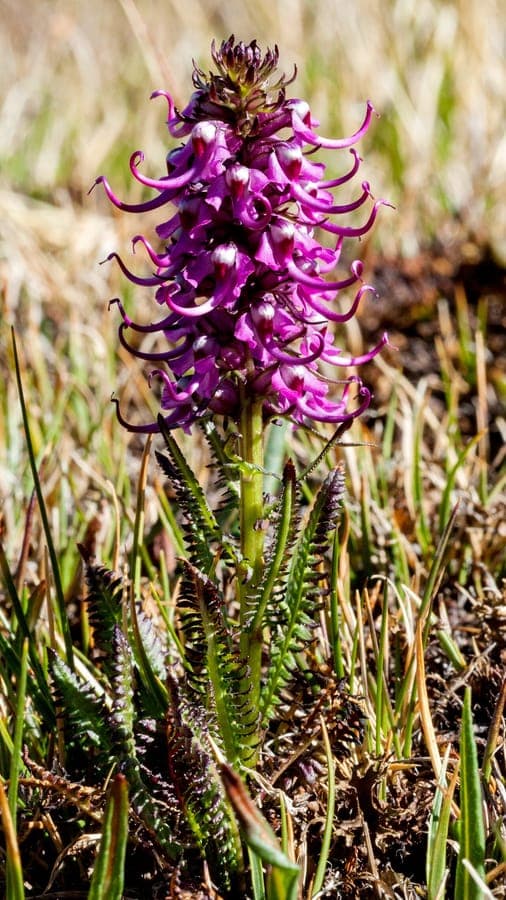
Patrick Alexander from Las Cruces, NM / CC0, via Wikimedia Commons
Elephant's-head: complete guide
Pedicularis groenlandica
Want to see Elephant's-head: complete guide in your garden?
1 minute, no credit card
Overview
Elephant's-head (Pedicularis groenlandica), also called elephant's-head lousewort, pink-elephants, or little red elephants, is one of the most visually distinctive native wildflowers of North America. A member of the family Orobanchaceae (broomrape family), it occurs naturally across an enormous range: from Greenland and subarctic Canada (including Alaska, Yukon, Manitoba, and Nunavut) southward through the Rocky Mountains to Colorado, New Mexico, and California. Its habitats are wet alpine meadows, streambanks, fens, and bog margins at elevations between 1,500 and 4,000 metres above sea level.
The common name elephant's-head perfectly describes the flowers, which bear an uncanny resemblance to elephant heads with upturned trunks. Each individual flower has a strongly arched and elongated upper lip that curves upward like a trunk, while the two-lobed lower lip represents the ears and face. An entire flower spike in bloom thus looks like a row of tiny pink elephants - an impression so vivid that the plant has independently acquired this comparison across multiple languages and cultures.
Botanically, Pedicularis groenlandica is a hemiparasite, meaning it partially parasitises the roots of neighbouring plants - particularly sedges, grasses, and other meadow species - to supplement its mineral nutrition, while retaining the capacity for independent photosynthesis. This partial parasitism makes the species difficult to cultivate outside its natural or semi-natural habitat and essentially impossible in a conventional container setting without suitable host plants.
The species was formerly placed in the genus Elephantella (as Elephantella groenlandica) and several botanical synonyms exist, including Pedicularis surrecta and various forms such as Pedicularis groenlandica f. pallida. The accepted species name groenlandica reflects its occurrence in Greenland, one of the northern extremities of its range. Plant height reaches 20 to 50 cm in flower.
Appearance & bloom cycle
The foliage of Pedicularis groenlandica is among the most attractive of any alpine perennial. The leaves are deeply cut, pinnate to bipinnate in structure with fine, fern-like texture, 5 to 15 cm long, and borne both in a basal rosette and alternately along the stem. The leaf colour is mid-green, occasionally with reddish tinges at the base of petioles.
Flower spikes rise in June and July to 20 to 50 cm, forming dense cylindrical racemes 10 to 20 cm long. Each individual flower is 1 to 1.5 cm long, consisting of a deeply two-lipped corolla. The upper lip (the galea) is strongly elongated and arched upward, representing the trunk, while the lower lip is three-lobed. Flower colour ranges from pale rose-pink to vivid magenta-purple. The subspecies Pedicularis groenlandica var. surrecta has a more upright galea orientation.
Flowering progresses from the base of the spike to the tip over three to four weeks. Across a naturalistic planting or meadow, the combined bloom period extends from June through August depending on elevation and local conditions. After pollination by bumblebees, small seed capsules develop and rupture at maturity to disperse fine, lightweight seeds by wind and water.
The plant behaves as a short-lived perennial to biennial in cultivation, with individual plants sometimes dying after seed set. Natural regeneration from self-sown seeds alongside appropriate host plants can maintain a colony over time.
Ideal location
Pedicularis groenlandica has exacting site requirements shaped by its hemiparasitic lifestyle and alpine origins. It must have: permanent soil moisture, suitable host plants nearby, open to partial shade, and cool growing conditions. In garden cultivation this combination points clearly toward pond margins, stream edges, bog gardens, and alpine water features rather than conventional herbaceous borders.
Full sun is acceptable where soil moisture is guaranteed. Partial shade is preferable in warmer lowland gardens. The plant performs best in the company of sedges (Carex species), rushes (Juncus), and other meadow plants that serve as hosts. Plant 20 to 30 cm from suitable host species such as Carex nigra or Carex rostrata for the best establishment results.
Avoid positions with dry or freely draining soils, heavy shade, or exposure to hot desiccating winds. Cool, humid conditions with mean summer temperatures below 20 degrees Celsius are strongly preferred. In lowland European gardens, a position alongside a garden pond with reed zone plantings comes closest to replicating the natural habitat.
Soil requirements
The soil pH range for Pedicularis groenlandica is 5.8 to 7.2, spanning slightly acidic to neutral. The plant thrives in moist to wet, moderately fertile mineral soil with a fine to medium texture. Rich, heavily fertilised soils are counterproductive, as they encourage vigorous competing plants while offering little benefit to a hemiparasite that obtains some nutrients from its hosts.
A practical planting medium for a bog garden or pond margin consists of equal parts loam and sharp grit, with a small addition of well-rotted compost. Avoid pure peat composts or ericaceous mixes. In containers, use a well-draining mix and stand the pot in a saucer kept constantly filled with water. Annual top-dressing with a thin layer of compost maintains baseline soil fertility without over-enrichment.
The presence of appropriate host plants in the root zone is at least as important as soil chemistry. Establish the host sedges or rushes three to six months before planting Pedicularis to allow them to root well.
Free design
Want to see Elephant's-head: complete guide in your garden? Make a free design now.
Watering
Permanent soil moisture is non-negotiable for Pedicularis groenlandica. In its natural habitat along alpine streams and in fens, the soil is never truly dry. In garden settings, the most reliable approach is to site the plant where natural moisture is continuously available: a pond margin, a constructed bog bed, or a position with a permanently high water table.
Where additional watering is necessary, daily applications during warm, dry periods are essential. The soil should never be allowed to dry out completely for more than one to two days during the growing season from April through September. Water at the base of the plant rather than overhead. Drip irrigation or capillary watering via a submerged reservoir in a bog bed are the most efficient methods.
In winter, moisture requirements are lower but the soil should not desiccate completely during prolonged frost. A 5 cm mulch of leaf litter applied before the first frosts protects the root zone and retains residual moisture through cold periods. In the event of more than seven to ten days of drought during the growing season, the plant will show wilting and leaf roll, recovering once moisture is restored but potentially losing that season's bloom.
Pruning
Pedicularis groenlandica requires minimal pruning. The plant's naturally compact, upright habit needs no cutting back or shaping. After flowering, leave the seed spikes to ripen if natural spread by seed is desired, or remove them at the base once they turn brown if you wish to prevent self-seeding.
In early spring, remove dead stems and any winter-damaged leaves to freshen the rosette. This is a light task given the plant's modest size. Division for propagation is possible but delicate, as the hemiparasitic roots may be intertwined with those of adjacent host plants. Use a narrow spade to carefully separate sections in early autumn, replanting immediately alongside suitable host sedges in moist soil and watering generously.
Maintenance calendar
March: Remove dead winter stems and damaged leaves. Check soil moisture. Verify that host sedges (Carex) are thriving around the plant.
April: New leaf rosettes emerge. Water regularly if rainfall is insufficient. Remove competing weeds.
May: Vegetative growth. Maintain constant soil moisture. Flower spikes begin forming at the base of stems.
June: Flowering begins from the base of the spike. Observe the remarkable pink blooms and watch for bumblebee visitors.
July and August: Peak bloom period. Pollination by bumblebees. Decide whether to allow seed capsules to ripen for dispersal.
September: End of flowering. Optional division and replanting alongside fresh host plants. Apply a thin compost top-dressing.
October and November: Reduce watering as temperatures drop. Apply 5 cm of leaf mulch for winter root protection.
December to February: Minimal care. Check periodically that soil does not dry out during extended frost periods.
Winter hardiness
Pedicularis groenlandica is exceptionally cold-hardy, native to Greenland and subarctic Canada where temperatures regularly fall below -30 °C. In garden cultivation across Europe it spans USDA zones 3 to 5, meaning the Benelux, Germany, France, and the United Kingdom present no overwintering challenge under normal conditions.
The greatest winter risk is not cold but frost-drought: if the soil desiccates severely during a prolonged winter frost without snow cover, root damage may result. A 5 cm mulch of dry leaf litter applied before the first frosts provides adequate protection against this risk while retaining residual soil moisture. On sites with poor winter drainage, a slightly raised planting position helps prevent crown rot during wet winters.
Newly planted autumn specimens benefit from more generous mulching to prevent frost heaving before they are fully rooted. Established plants in well-suited positions require no special attention through winter.
Companion plants
For Pedicularis groenlandica, companion planting is both an aesthetic and functional matter: the best companions double as host plants, supporting the hemiparasite's nutritional needs while creating a coherent naturalistic composition:
- Carex nigra (black sedge): An excellent host plant for Pedicularis and a decorative native sedge for wet, slightly acidic soil with fine dark plumes.
- Carex rostrata (bottle sedge): A robust wetland sedge that serves well as a host and naturalises beautifully at pond margins and stream edges.
- Caltha palustris (marsh marigold): Golden-yellow flowers in April in the same wet conditions, providing colour contrast before the Pedicularis bloom begins.
- Eriophorum angustifolium (common cottongrass): Ornamental plant for wet, acidic soils with white fluffy seed heads in summer that complement the pink Pedicularis flowers.
- Juncus effusus (soft rush): A robust marginal plant for wet soils that can serve as a host and gives the composition a naturalistic character.
At gardenworld.app you can design a bog garden or pond margin planting that incorporates Pedicularis groenlandica alongside these ideal companion and host plants. For detailed profiles of moisture-loving and alpine perennials and design templates for naturalistic water gardens, visit gardenworld.app.
Conclusion
Elephant's-head (Pedicularis groenlandica) is a botanical treasure of extraordinary visual appeal. Its pink flowers, with their unmistakable resemblance to elephant heads, its fascinating hemiparasitic lifestyle, and its subarctic alpine origins make it one of the most singular plants a specialist gardener can cultivate. It demands specific conditions - permanent moisture, suitable host plants, cool temperatures, and neutral to slightly acidic soil with a pH of 5.8 to 7.2 - but rewards the committed grower with one of the most distinctive and conversation-starting flower displays in any garden from June through August.
For the naturalistic pond garden, alpine water feature, or specialist bog planting, Pedicularis groenlandica planted alongside Carex nigra, Caltha palustris, and Eriophorum makes a botanically rich and ecologically valuable composition that attracts bumblebees and captivates every visitor who sees the elephant-shaped blooms for the first time. Seek it at specialist wildflower nurseries or botanical garden plant sales.
Want to see Elephant's-head: complete guide in your garden? Make a free design now.
Upload a photo, pick a style, and get a photorealistic design with plant list in under a minute.
10,000+ gardens designed already
No credit card required


Similar plants
Northwestern Indian paintbrush: complete guide
Castilleja angustifolia
All about Castilleja angustifolia, the northwestern Indian paintbrush from dry western US steppes. Growing, care, and companion plant advice.
Wavyleaf Indian paintbrush: complete guide
Castilleja applegatei
Everything about Castilleja applegatei, the wavyleaf paintbrush from Oregon and California. Host plants, care, location, and garden use covered.
Bushy bird's-beak: complete guide
Cordylanthus ramosus
Complete guide to Cordylanthus ramosus, the hemiparasitic annual of western US steppes: ecology, host plants, cultivation and uses.