
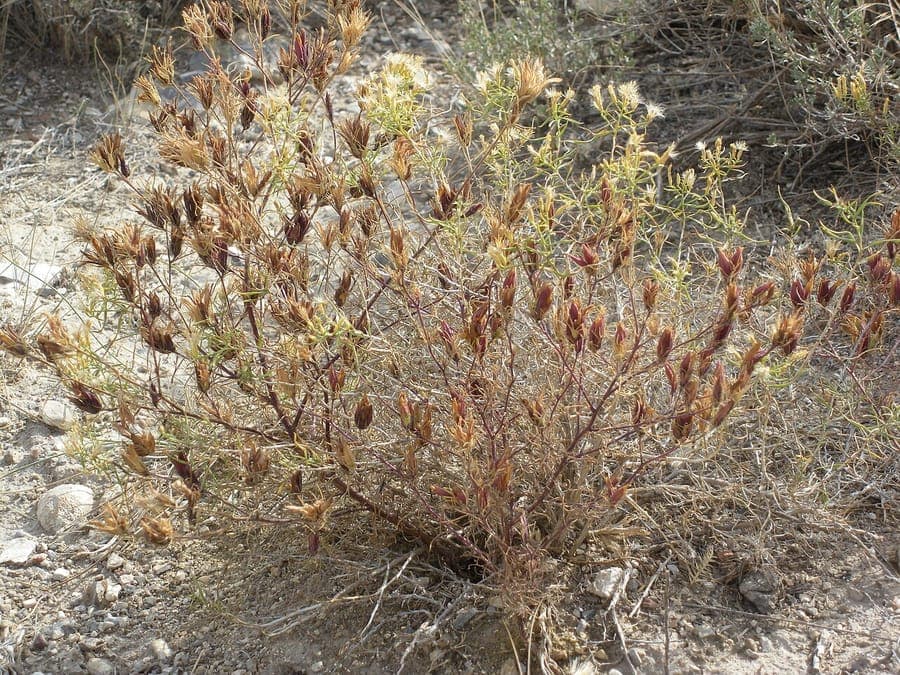
Matt Lavin from Bozeman, Montana, USA / CC BY-SA 2.0, via Wikimedia Commons
Bushy bird's-beak: complete guide
Cordylanthus ramosus
Want to see Bushy bird's-beak: complete guide in your garden?
1 minute, no credit card
Overview
Cordylanthus ramosus, commonly called bushy bird's-beak or much-branched bird's-beak, is a hemiparasitic annual herb in the family Orobanchaceae - the same family as broomrapes. Described by Thomas Nuttall and published by George Bentham in 1846, it is native to the western United States, occurring in California, Oregon, Idaho, Nevada, Utah, Colorado, Montana and Wyoming. The species grows on open, dry ground: sagebrush steppe, mountain grasslands and rocky slopes at low to middle elevations.
The species name 'ramosus' is Latin for 'much-branched', perfectly describing the plant's habit. Instead of a single stem it produces a rounded, densely forking mass of stems resembling a small subshrub, though it is entirely herbaceous. The common name 'bird's-beak' refers to the characteristic tubular, two-lipped flowers whose hooded upper lip curves forward like a bird's beak.
What makes Cordylanthus ramosus genuinely remarkable in botanical terms is its hemiparasitic lifestyle. Unlike full parasites it retains green leaves and carries out photosynthesis, but it supplements its water and mineral intake by attaching haustoria - specialised root organs - to the roots of neighbouring plants, most often grasses and other herbs of the sagebrush community. This dependence on host plants makes it a challenging and unusual species to grow in cultivation. For advice on incorporating ecologically interesting or native plants into a designed garden, gardenworld.app offers planning resources and plant combination ideas.
Appearance and bloom cycle
Cordylanthus ramosus grows 20 to 60 cm tall, forming a compact, densely branched mound. Stems are round, grey-green and covered with glandular hairs that give the entire plant a slightly sticky texture. Leaves are narrow and lance-shaped, often with small teeth or lobes along the margins, and are arranged alternately along the stems. The overall impression is of a bushy, finely textured annual with a greyish-green cast that blends well with the dry grassland communities it inhabits.
Flowers appear at the tips of the many branching stems from late summer into autumn - typically August to October. Each flower is small and tubular, two-lipped, with the upper lip forming a closed beak-like hood over the lower lip and stamens. Flower colour ranges from yellowish-white to pale lavender, often with fine purple spotting. While individually the flowers are modest in size, the sheer density of the branching means a mature plant carries dozens of flowers at once.
After flowering, small capsule fruits develop containing a limited number of hard seeds. Since the plant is annual, seed production is its only means of perpetuation; the parent plant dies completely after seed ripening in autumn.
Ideal location
In its native range, Cordylanthus ramosus occupies open, sun-drenched habitats where competition from taller vegetation is low. Sagebrush (Artemisia tridentata) communities, open bunchgrass prairies, gravelly hillsides and roadside embankments in the intermountain west are typical. The species absolutely requires full sun and will not thrive - or even survive - in even partial shade.
Critically, it must grow in the presence of suitable host plants. In nature these are primarily native grasses of the sagebrush community such as bluebunch wheatgrass (Pseudoroegneria spicata), needlegrasses (Stipa spp.) and other bunchgrasses. Without a host root system to parasitise, seedlings may germinate but fail to establish and flower.
In European gardens this species is extremely rarely cultivated and is not commercially available in most countries. It is of interest primarily to botanical garden collections and to enthusiasts recreating western North American plant communities. Dry gardens, gravel gardens and steppe-style plantings provide the most suitable context. Visit gardenworld.app to explore more accessible alternatives for dry, sunny garden spaces.
Soil
Cordylanthus ramosus prefers lean to moderately fertile soils with a pH between 6.0 and 7.8, tolerating both slightly acidic and mildly alkaline conditions. In its native habitat it grows on rocky loams, sandy-gravelly soils and mineral-rich substrates with minimal organic matter. Good drainage is non-negotiable: water-retentive, humus-rich soils cause root rot and disrupt the fine haustorial connections with host roots.
For cultivation attempts, mix sharp sand or grit with a small proportion of lean garden soil or loam. Avoid peat, bark compost or any moisture-retentive amendments. A raised bed or rock garden setting with free-draining substrate and full sun exposure is optimal. Container cultivation requires a pot with large drainage holes and a gritty, free-draining mix.
The haustorial connections work best in dry to moderately dry conditions where the host root system is concentrated in the upper soil profile. Overly rich, moist soils disrupt this relationship and weaken the parasite.
Free design
Want to see Bushy bird's-beak: complete guide in your garden? Make a free design now.
Watering
Cordylanthus ramosus is adapted to summer-dry conditions typical of the intermountain west, where most precipitation falls in winter and spring and summers are long and dry. Once established, the plant draws supplemental water from its host through haustoria, which partially offsets its own modest moisture needs.
In garden cultivation, water sparingly. After initial establishment watering to help seeds germinate, reduce frequency sharply. Allow the soil to dry out to at least 5 cm depth between waterings. Overwatering is the single most common failure when attempting to cultivate this species: wet roots combined with summer heat lead quickly to fungal root diseases. In container culture over winter (in a cool greenhouse or conservatory), watering is barely needed - just enough to prevent the substrate from becoming bone dry.
Pruning
As an annual, Cordylanthus ramosus requires no seasonal pruning. Spent or dried branches can be removed for appearance if desired, but the plant manages its own structure through branching. When flowers begin to fade in September and October, allow the seed capsules to ripen fully on the plant before collecting them - they split when ripe and seeds scatter quickly. Collect capsules into a paper bag and dry them indoors before extracting and storing seeds in a cool, dry place until spring sowing.
Once the first autumn frosts kill the top growth, the entire plant can be cut and composted. There is no living root system to protect over winter.
Maintenance calendar
February to March: sow seed indoors in a lean, gritty mix at 15 to 20 degrees Celsius. Include a small amount of growing media from a container where native grasses have been growing, to introduce potential host-root contact. Germination is often slow and erratic.
April to May: harden off seedlings gradually; transplant to the outdoor site after the last frost, ensuring host grasses are present in the immediate surroundings. Water moderately at transplanting, then reduce.
June to July: established plants grow rapidly in warm, dry conditions. No watering unless in extreme drought.
August to October: flowering period. Collect ripe seed capsules as needed. The plant requires minimal attention.
October to November: plants die after first hard frost. Remove and compost the above-ground material. Store collected seeds dry and cool.
December to January: dormant period; check stored seeds are not damp.
Winter hardiness
Because Cordylanthus ramosus is an annual, traditional winter hardiness ratings do not apply. The plant completes its entire life cycle - from germination in spring to seed set and death in autumn - within a single growing season. Only the seeds overwinter, and they are tolerant of cold dry conditions (the dormant seeds of many western North American annuals are adapted to survive buried under snow for months).
In its native range, the species occurs from California coastal foothills to Rocky Mountain elevations corresponding to USDA zones 5 through 9 depending on altitude. In European gardens, the annual character means cold hardiness is irrelevant; what matters instead is whether the growing season is long and warm enough to complete the life cycle before autumn frosts arrive. In most of western and central Europe this should be achievable with early indoor sowing.
For information on winter-hardy perennial alternatives for dry, sunny spots, see the planting resources at gardenworld.app.
Companion plants
In nature, Cordylanthus ramosus grows intermingled with its host plants and other inhabitants of the sagebrush steppe community. Suitable companion plants for a western North American-themed planting include big sagebrush (Artemisia tridentata) as a backdrop shrub, bluebunch wheatgrass (Pseudoroegneria spicata) and Idaho fescue (Festuca idahoensis) as host grasses, and forbs such as golden aster (Heterotheca villosa) and blanket flower (Gaillardia aristata) for additional flower colour.
In a European dryland or steppe garden, analogous companions would be ornamental fescues, feather grasses (Stipa or Nassella), lavender (Lavandula spp.) and hardy stonecrops (Sedum spp.), which create a similar open, dry-textured matrix. Avoid aggressive ground-covers or vigorous border perennials that would shade or outcompete the delicate annual.
Specialist nurseries focusing on native North American flora and botanical garden plant sales are the most likely sources for seed or young plants. General garden centres in Europe rarely stock Cordylanthus species.
Closing
Cordylanthus ramosus is not a mainstream garden plant and is unlikely to become one given its specific cultural requirements. Its value lies in its botanical fascination: a hemiparasitic annual of the American West, perfectly adapted to lean, dry, sunlit habitats and dependent on root-to-root connections with neighbours for part of its sustenance. For naturalists, ecologists and botanical enthusiasts it represents a compelling study piece in a specialised dry garden or naturalistic prairie planting.
For gardeners seeking the aesthetic of western American dry grassland with more achievable plants, gardenworld.app provides design tools and plant palettes suited to various garden styles, including dry and gravel gardens. Specialist native plant nurseries and botanical garden seed exchanges are the best sources for Cordylanthus ramosus if you wish to attempt cultivation.
Want to see Bushy bird's-beak: complete guide in your garden? Make a free design now.
Upload a photo, pick a style, and get a photorealistic design with plant list in under a minute.
10,000+ gardens designed already
No credit card required


Similar plants
Northwestern Indian paintbrush: complete guide
Castilleja angustifolia
All about Castilleja angustifolia, the northwestern Indian paintbrush from dry western US steppes. Growing, care, and companion plant advice.
Wavyleaf Indian paintbrush: complete guide
Castilleja applegatei
Everything about Castilleja applegatei, the wavyleaf paintbrush from Oregon and California. Host plants, care, location, and garden use covered.
Euphrasia hirtella: complete guide
Euphrasia hirtella
Full guide to Euphrasia hirtella, a bristly eyebright: hemiparasite of meadows, white flowers, bloom time and cultivation tips.