
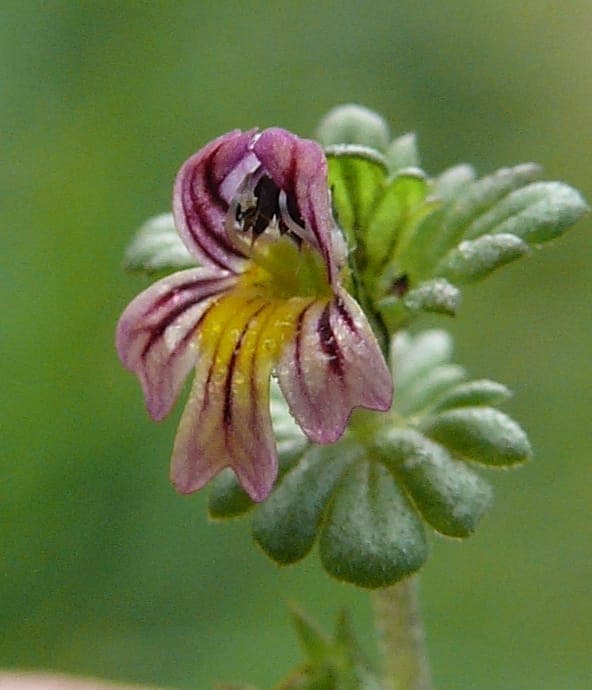
BerndH / CC BY-SA 3.0, via Wikimedia Commons
Euphrasia hirtella: complete guide
Euphrasia hirtella
Want to see Euphrasia hirtella: complete guide in your garden?
1 minute, no credit card
Overview
Euphrasia hirtella, commonly called the bristly eyebright or hairy eyebright, is a small annual plant belonging to the broomrape family Orobanchaceae. The species name 'hirtella' refers to the dense covering of glandular hairs on its stems and leaves, a diagnostic feature that separates it from the many other eyebright species in the large genus Euphrasia. This diminutive plant, typically reaching between 5 and 25 cm in height, has a remarkable survival strategy: it is a facultative hemiparasite, meaning it can attach its roots to neighbouring grasses and herbs to extract water and some nutrients. This makes Euphrasia hirtella an ecologically unique plant that thrives only where species-rich grassland communities provide suitable host plants. The species is native across an extraordinarily broad range, from Europe through Central Asia to North Korea and the western Himalaya, demonstrating a robustness that belies its delicate appearance. At gardenworld.app we highlight plants like this because they bring genuine ecological depth to naturalistic garden designs.
Appearance and bloom cycle
The plant forms an erect or somewhat branched stem covered with small, opposite leaves. The leaves are ovate to lanceolate with toothed margins, and like the stem they are clothed in fine glandular hairs that give the plant a slightly sticky feel when touched. The flowers are two-lipped (bilabiate), white with fine purple veining on the upper lip and a distinct yellow spot on the lower lip - a precise landing guide for small pollinators such as bees and hoverflies. The corolla is small, typically 5-8 mm long, but produced in great numbers along the stem from June through to September, peaking in July and August. After pollination, small capsules ripen and split to release the seeds. The overall flowering period of roughly four months makes this an important late-season nectar source in species-rich meadows.
Ideal location
Euphrasia hirtella grows naturally on sunny to lightly shaded, nutrient-poor grasslands, alpine meadows, road verges, and calcareous slopes. Its native range spans Albania, Austria, France, Germany, Switzerland, Spain, Portugal, Italy, Greece, and extends through Russia, Kazakhstan, Mongolia, Korea, and into the West Himalaya - a testament to its adaptability across a wide range of climates. In the garden context, this plant is best suited to a wildflower meadow strip, an unimproved lawn area, or a naturalistic planting that includes a range of host grasses and forbs. It needs at least six hours of direct sunlight daily. Shaded or densely planted borders are not appropriate.
Soil
Nutrient-poor, well-drained soils are essential for Euphrasia hirtella. On fertile, nitrogen-rich soils, vigorous competing grasses and herbs quickly shade out the small eyebright. A light, sandy or loamy soil with a neutral to slightly alkaline pH (around 6.5-7.5) is ideal. If your garden soil is too rich, you can incorporate a layer of horticultural grit or sharp sand into the top 10-15 cm to reduce fertility. Heavy clay soils are unsuitable due to poor drainage. Calcareous (chalky) soils are especially favoured, reflecting the plant's preference for limestone grasslands in its native range.
Watering
As a hemiparasite, Euphrasia hirtella draws some moisture from its host plants through haustorial connections. Nevertheless, the soil must not be allowed to dry out completely during dry spells, particularly while seedlings are establishing. In most temperate climates rainfall is sufficient, but during prolonged summer droughts it is worth giving the planting a gentle watering every two to three weeks. Avoid waterlogging at all costs: standing water quickly causes root rot and kills the plant. Check the soil at 5 cm depth - if it still feels slightly moist, no additional water is needed. Garden centres sometimes stock related eyebright species in wildflower mixes if you want to experiment with the hemiparasite concept.
Free design
Want to see Euphrasia hirtella: complete guide in your garden? Make a free design now.
Pruning
As an annual, Euphrasia hirtella does not require pruning in the conventional sense. After the flowers fade, the seed capsules ripen and the plant completes its life cycle. If you want self-seeding to occur, simply leave the stems in place until the capsules turn brown and begin to split. You can also collect the ripened capsules and shake the seeds onto a prepared, nutrient-poor seed bed elsewhere in the garden. In autumn, cut back the dead stems or leave them standing as shelter for overwintering insects. There is no need to deadhead individual flowers, as this serves no purpose for an annual with hemiparasitic habits.
Maintenance calendar
Euphrasia hirtella demands little routine maintenance once established, but timing matters.
March - April: Look for emerging seedlings at the base of grasses and weeds. Remove any aggressively competitive plants that might overshadow seedlings. Ensure host plants such as red fescue, plantain, and buttercups are present.
May: Young plants extend their haustorium roots toward host plant roots. Avoid heavy trampling or fertilising at this stage.
June - September: Full flowering period. Do not mow the meadow strip. Allow bees, hoverflies, and other pollinators to visit freely.
October: After seed set, remove or leave stems as winter habitat.
November - February: Dormant period. Seeds overwinter in the soil. No action required.
Winter hardiness
Euphrasia hirtella is an annual that survives winter exclusively as seeds in the soil. The seeds are notably frost-tolerant, consistent with the plant's natural range extending into Siberia, Mongolia, and the Himalayan foothills. Germination typically begins in March once soil temperatures rise above about 8 degrees Celsius. USDA hardiness zones 4 to 8 cover the typical cultivation range. The seeds may remain viable in the soil for two to three years, providing some insurance against years when conditions are unfavourable for seedling establishment. No winter protection is needed for the seeds.
Companion plants
Because Euphrasia hirtella is a hemiparasite, companion plants serve a double purpose: they provide aesthetic context and act as potential host plants. Red fescue (Festuca rubra), ribwort plantain (Plantago lanceolata), meadow buttercup (Ranunculus acris), and sweet vernal grass (Anthoxanthum odoratum) are all excellent companions. In a wildflower meadow setting, ragged robin (Silene flos-cuculi), oxeye daisy (Leucanthemum vulgare), and self-heal (Prunella vulgaris) complement the eyebright beautifully. Avoid dominant, tall grasses like cock's-foot (Dactylis glomerata) in large quantities, as these will smother the small annual. Garden centres across the UK and Europe now stock many of these native wildflower species, making it straightforward to assemble a suitable companion planting. At gardenworld.app you can design a complete naturalistic front garden that incorporates wildflower strips like this.
Closing
Euphrasia hirtella is not a plant for the conventional bedding display, but for the gardener curious about ecological complexity and native plant communities, it is a rewarding species to grow. Its white flowers with purple veining and yellow lip markings are genuinely beautiful at close range, and its hemiparasitic lifestyle offers a fascinating window into the hidden interactions that underpin healthy grassland ecosystems. Establishing it requires patience, the right lean soil, and a community of host plants - but once settled, it will self-seed and return year after year with minimal intervention. Whether you are creating a wildflower lawn, a naturalistic border, or simply want to support native pollinators, this eyebright deserves a place on your list.
Want to see Euphrasia hirtella: complete guide in your garden? Make a free design now.
Upload a photo, pick a style, and get a photorealistic design with plant list in under a minute.
10,000+ gardens designed already
No credit card required


Similar plants
Northwestern Indian paintbrush: complete guide
Castilleja angustifolia
All about Castilleja angustifolia, the northwestern Indian paintbrush from dry western US steppes. Growing, care, and companion plant advice.
Wavyleaf Indian paintbrush: complete guide
Castilleja applegatei
Everything about Castilleja applegatei, the wavyleaf paintbrush from Oregon and California. Host plants, care, location, and garden use covered.
Bushy bird's-beak: complete guide
Cordylanthus ramosus
Complete guide to Cordylanthus ramosus, the hemiparasitic annual of western US steppes: ecology, host plants, cultivation and uses.