
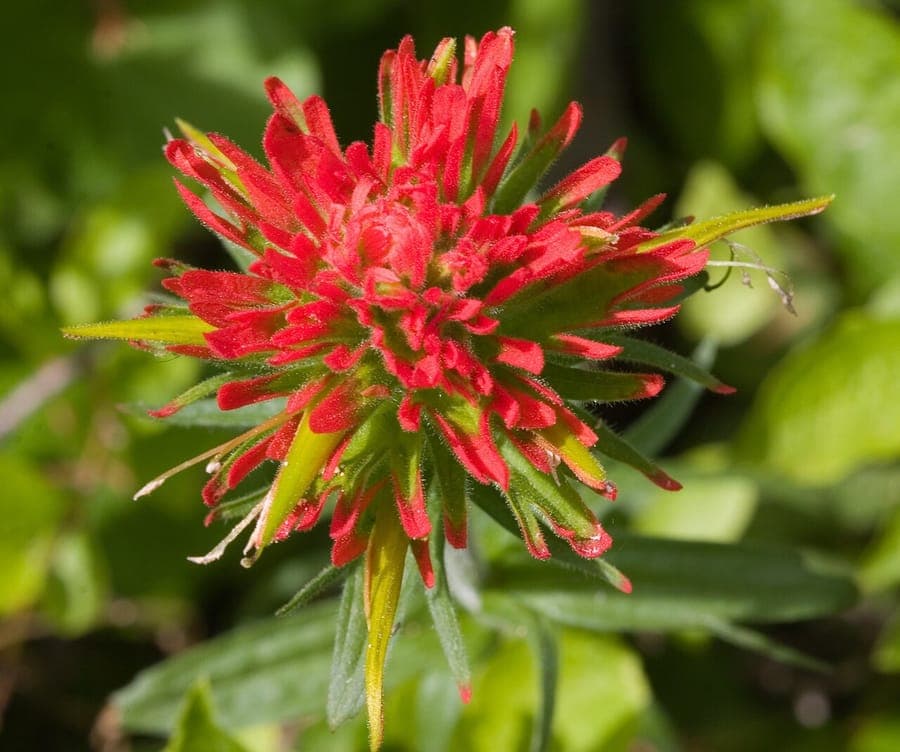
Cacophony / CC BY-SA 3.0, via Wikimedia Commons
Wavyleaf Indian paintbrush: complete guide
Castilleja applegatei
Want to see Wavyleaf Indian paintbrush: complete guide in your garden?
1 minute, no credit card
Overview
Castilleja applegatei, the wavyleaf Indian paintbrush or wavy-leaf paintbrush, is one of the most vivid wildflowers of the Pacific Coast and Great Basin ranges. A member of the Orobanchaceae family, it grows natively in south-central Oregon, California, Idaho, Nevada, Utah, and Wyoming, occupying dry, open slopes, rocky outcrops, and open conifer woodlands. Like all Castilleja species, it is a hemiparasite: it carries out photosynthesis independently but also extracts water and mineral nutrients from the roots of neighbouring host plants. Without suitable host plants in close proximity the species will not establish successfully. First described in 1898 by Fernald, it is named after Elmer Ivan Applegate, a prominent Pacific Northwest botanist. Slow-growing but genuinely rewarding, this plant brings a wild, authentic energy to dry rock gardens and prairie-style plantings that few other species can match. At gardenworld.app you will find design ideas that integrate native wildflowers like this one into cohesive, ecologically grounded garden schemes.
Appearance and bloom cycle
Castilleja applegatei earns its common name from the distinctly wavy or lobed margins of its lance-shaped leaves - a characteristic that sets it apart from related paintbrush species when examined up close. Leaf texture is medium and the overall foliage colour is green. The stems are erect, rising from a basal rosette. As with other paintbrush species, the true flowers are small and greenish-white; the spectacle comes entirely from the scarlet to red-orange bracts (modified leaves) that surround the flowers, giving the plant the appearance of having been stroked with a brush loaded with vivid pigment. Bloom time begins as early as April at lower elevations and extends to August at higher mountain locations. The flowers are highly attractive to hummingbirds, native bees, and certain butterfly species, making this plant a genuine contributor to garden biodiversity.
Ideal location
Castilleja applegatei demands a fully sunny, open position - at least six hours of direct sunlight per day is non-negotiable for healthy growth and good flowering. In nature the plant grows on dry to moderately moist slopes, often alongside open pine forests and on rocky ledges, always on well-drained, lean substrates. Because of its hemiparasitic lifestyle, siting near suitable host plants is essential. It works well alongside native bunchgrasses such as Festuca and Elymus, and with drought-tolerant perennials like Penstemon and Artemisia. Rich, fertile garden soil is actively counterproductive: it promotes competing vegetation and disrupts the plant's relationship with its hosts. Choose a lean, dry site with minimal nutrient load and good natural water runoff, including in winter.
Soil
The soil for Castilleja applegatei must be free-draining and low in nutrients. The preferred pH is between 6.3 and 7.8 - slightly acid to slightly alkaline - making it somewhat more lime-tolerant than the closely related Castilleja angustifolia. It is well suited to sandy and stony substrates that warm quickly in spring. In heavier clay soils, incorporate generous amounts of coarse grit or perlite before planting to ensure adequate drainage. Fresh compost and nitrogen-rich fertilisers are counterproductive: they encourage competing plants and can unbalance the delicate relationship between the paintbrush and its host roots. A lean, open, fast-draining substrate mix consistently gives the best long-term results.
Watering
Castilleja applegatei is highly drought-tolerant once established and requires very little supplementary watering. Overwatering is genuinely damaging - it promotes root rot and can harm the host plants on which the paintbrush depends. Water new plants moderately during the first growing season to aid establishment, then transition to a predominantly dry regime. Rainfall alone satisfies the moisture needs of established plants in most years. During exceptionally dry summers a light, occasional soak is acceptable, but consistently moist conditions must be avoided. Bark-based mulches are not recommended around this species; use coarse gravel instead as ground cover to help shed surface water rapidly and prevent splash-back onto the crown.
Free design
Want to see Wavyleaf Indian paintbrush: complete guide in your garden? Make a free design now.
Pruning
Castilleja applegatei needs no structural pruning. After flowering, spent stems can be left standing for birds and natural seed dispersal, or cut back carefully to stem height. Trimming stems back to just above the basal rosette after bloom encourages the plant to store energy for the following year. Remove dead foliage and stems from the previous season in early spring to give emerging shoots plenty of room. Avoid drastic cutting: this species is a slow grower and recovers poorly from heavy pruning. Follow the plant's own seasonal rhythm and limit your interventions to the strictly necessary.
Maintenance calendar
March: remove dead foliage and stems from the previous season; check the condition of surrounding host plants; replant host species if any have failed. April: new shoots emerge; first colourful bracts appear; light moisture monitoring during dry spring spells. May-June: peak flowering period; hummingbirds and native bees visit frequently; keep the planting area weed-free without disturbing the root zone. July: flowering gradually fades at lower elevations but continues at higher sites; seed capsules begin forming. August: allow seed capsules to ripen for collection or natural self-seeding. September: reduce any supplementary watering to zero; the plant enters a quieter phase. October-November: top growth may die back; this is normal and expected; roots overwinter safely. December-February: full dormancy; no active maintenance needed.
Winter hardiness
Castilleja applegatei tolerates cold considerably better than its delicate appearance might suggest. It is hardy to approximately USDA zones 5 to 6, meaning minimum temperatures of around -26 to -18 degrees Celsius. In the Netherlands, Belgium, and much of northern Europe - typically USDA zone 7 to 8 - winter temperatures are rarely a serious threat. The critical risk factor, as with all Castilleja species, is winter-wet soil rather than frost: roots sitting in cold, waterlogged conditions through the dormant period are far more likely to cause plant loss than low temperatures alone. Provide impeccable drainage and consider placing a layer of coarse gravel or stone chips around the stem base to shed excess rain rapidly. On a well-drained site, the plant routinely survives an average European winter without issue.
Companion plants
Selecting companion plants for Castilleja applegatei is a matter of biological necessity as much as aesthetics. Host plants are required for long-term success. Proven compatible hosts include Festuca idahoensis, Bouteloua curtipendula, Penstemon speciosus, and other drought-tolerant native prairie or mountain species with wide-ranging but non-aggressive root systems. Artemisia tridentata and Elymus elymoides have also been reported as suitable hosts in naturalistic planting projects. Avoid vigorous spreading species that could smother host plant root zones or exhaust the lean soil nutrients on which the whole community depends. Visit gardenworld.app for planting combinations designed around dry prairie and rock garden communities that accommodate hemiparasitic wildflowers alongside their required hosts.
Closing
Castilleja applegatei is a plant for the gardener willing to go beyond the standard nursery catalogue. Its biological complexity as a hemiparasite calls for thoughtful planting design and real knowledge of its needs. For those who invest that effort, the return is exceptional: gracefully wavy leaves, blazing scarlet flower bracts that draw hummingbirds and native bees, and an authentic connection to the dramatic mountain landscapes of the American West. Get the host plants right, give it a lean and dry site, and this wavyleaf paintbrush will reward you with years of spectacular, wildlife-friendly flowering.
Want to see Wavyleaf Indian paintbrush: complete guide in your garden? Make a free design now.
Upload a photo, pick a style, and get a photorealistic design with plant list in under a minute.
10,000+ gardens designed already
No credit card required


Similar plants
Northwestern Indian paintbrush: complete guide
Castilleja angustifolia
All about Castilleja angustifolia, the northwestern Indian paintbrush from dry western US steppes. Growing, care, and companion plant advice.
Festuca idahoensis: complete guide
Festuca idahoensis
Discover Idaho fescue: cultivation, drought tolerance, maintenance and full care guide for this stunning North American grass.