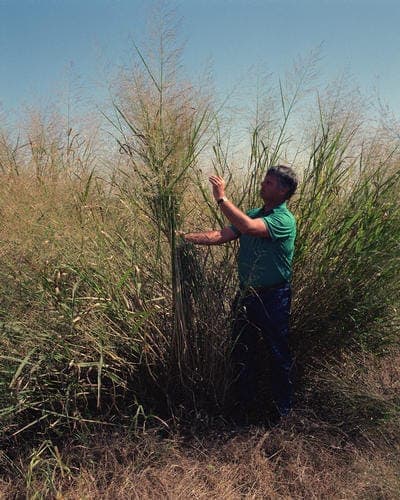
Warren Gretz, DOE/NREL / Public domain, via Wikimedia Commons
Switchgrass: complete guide
Panicum virgatum
Want to see Switchgrass: complete guide in your garden?
Full design in HD: €7.99
Look after your Switchgrass with the GardenWorld app
Identify plants with your camera and get a care calendar with reminders for this plant.


Overview
Switchgrass (Panicum virgatum) is a stylish ornamental grass native to North America from Canada to Mexico. This trendy ornamental grass has gained popularity in modern garden design for its elegant growth habit, fine texture, and spectacular autumn coloring. It is a sustainable, low-maintenance grass.
Panicum virgatum belongs to the Family Poaceae and forms an important part of contemporary and modern garden designs. The grass is very easy to grow and requires minimal care.
Appearance and Bloom
The plant reaches 1 to 1.5 meters tall, sometimes taller in rich soils. The leaves are fine, needle-thin structures that bend gracefully in wind. During summer, delicate, fine flower panicles rise upward displaying yellowish-pink colors.
The blooming period lasts July to October. The panicles sway elegantly in breezes and attract considerable attention. In autumn, the leaves change from green to yellow, orange, red to purple, depending on variety and temperature.
In winter the dried foliage remains intact providing attractive silhouette. This is a caespitose (clump-forming) grass maintaining compact growth habit.
Ideal Location
Panicum virgatum thrives best in full sun locations. The plant demands at least 6 hours direct sunlight daily. The plant also grows in partial shade but becomes less compact and flowers poorly.
The plant is very tough and tolerates windy terrain well. Plant in open, windier locations. The plant tolerates urban environments and polluted air well.
On gardenworld.app we suggest using this grass in contemporary garden designs as a single specimen or in groups.
Soil
Panicum virgatum grows on virtually all soils but prefers sandy, well-draining ground. The plant tolerates poor soil and actually prefers poorer soils. The plant is very drought-tolerant.
The pH range can vary from 5.0 to 8.0. The plant prefers neutral to slightly alkaline conditions. Extra fertilizer is not needed; actually the plant grows too exuberantly on rich soils.
When planting in containers, use well-draining soil mix with added sand. The plant tolerates very dry terrain.
Free preview
Want to see Switchgrass: complete guide in your garden? Make a free preview of your design.
Watering
Panicum virgatum is very drought-tolerant and requires water during first growing season only. Once established, almost no watering needed. The plant tolerates extremely dry conditions.
Water only during severe drought. The plant prefers dry to normal moist conditions. Excessive watering can cause fungal problems.
On gardenworld.app we recommend this plant for dry, low-water gardens.
Pruning
Panicum virgatum needs no pruning during growing season. Most gardeners leave the grass standing during winter for attractive silhouette. In March you can cut the grass close to 10 centimeters height.
Use shears or a mulching mower for cutting. This stimulates new growth in spring. Do not prune late in summer to prevent new growth stimulation.
Maintenance Calendar
January-March: Cut in March. Remove winter foliage. April-May: Growth begins rapidly. Monitor for dryness. June-October: Blooming and growth. No maintenance needed. November-December: Enjoy autumn color and winter silhouette.
Winter Hardiness
Panicum virgatum is very hardy to -30 degrees Celsius. In virtually all European climates it can stay outside. The plant dies back in winter but roots survive.
The plant needs no special winter protection. The dried foliage helps insulate and protects root crowns against frost. In very wet, soggy winters ensure good drainage.
Companion Plants
Combine Panicum virgatum with other grasses and herbaceous plants. Good companions are Miscanthus, Stipa, Rudbeckia, Echinacea, and aster species. These combinations create beautiful structural textures.
On gardenworld.app we recommend planting this grass in groups or large drifts for dramatic effects. Plant at least 3 to 5 together at 1 meter spacing.
Closing
Switchgrass is a wonderful, easy-to-grow ornamental grass for modern gardens. Although it demands space, it grows practically maintenance-free. With proper placement and minimal care you will enjoy elegant movement and autumn splendor.
Find this plant through specialist nurseries. Start creating your grass garden on gardenworld.app today!
Frequently asked questions about Switchgrass
Is Switchgrass winter hardy?
Panicum virgatum is very hardy to -30 degrees Celsius. In virtually all European climates it can stay outside.
When and how do you prune Switchgrass?
Panicum virgatum needs no pruning during growing season. Most gardeners leave the grass standing during winter for attractive silhouette.
How much water does Switchgrass need?
Panicum virgatum is very drought-tolerant and requires water during first growing season only. Once established, almost no watering needed.
Where does Switchgrass grow best?
Panicum virgatum thrives best in full sun locations. The plant demands at least 6 hours direct sunlight daily.
What soil does Switchgrass need?
Panicum virgatum grows on virtually all soils but prefers sandy, well-draining ground. The plant tolerates poor soil and actually prefers poorer soils.

See it in your garden
See Switchgrass in your garden
One photo of your garden and a few questions. You see the result in about a minute.
Try it with a photoIdentify this plant in your own garden. Identify a plant
Similar plants
Pheasant's tail grass (Anemanthele lessoniana): a guide
Anemanthele lessoniana
Pheasant's tail grass (Anemanthele lessoniana) is an evergreen New Zealand grass with orange-streaked leaves and airy summer flower heads. Siting, soil, care and hardiness.
Korean feather reed grass (Calamagrostis brachytricha): guide
Calamagrostis brachytricha
Everything about Korean feather reed grass (Calamagrostis brachytricha): position, soil, cutting back and planting partners for its glistening autumn plumes.
Northern sea oats (Chasmanthium latifolium): growing guide
Chasmanthium latifolium
Northern sea oats (Chasmanthium latifolium) carries flat, dangling spikelets and thrives in part shade. Learn how to site, water, cut back and partner it.
