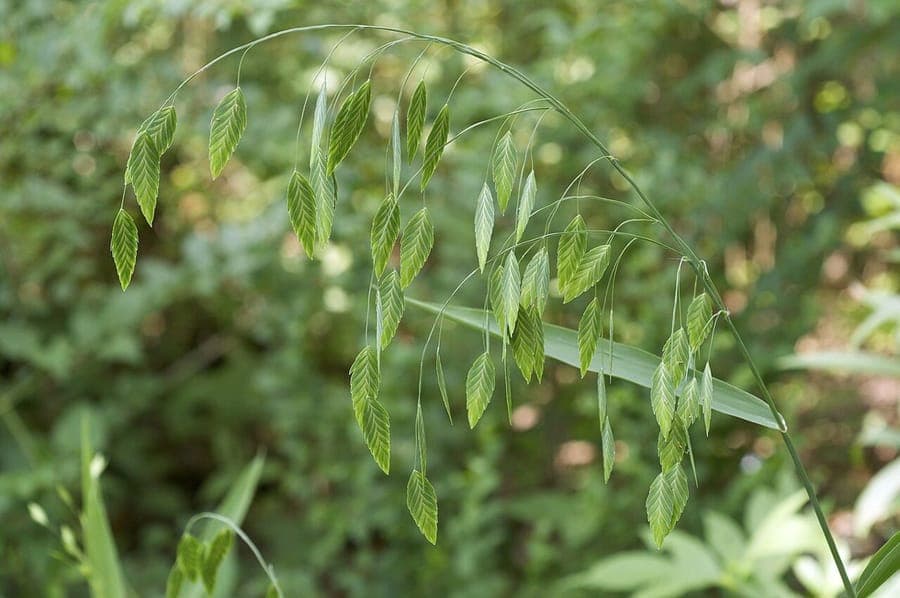
Eric in SF / CC BY-SA 3.0, via Wikimedia Commons
Northern sea oats (Chasmanthium latifolium): growing guide
Chasmanthium latifolium
Want to see Northern sea oats (Chasmanthium latifolium): growing guide in your garden?
Full design in HD: €7.99
Look after your Northern sea oats with the GardenWorld app
Identify plants with your camera and get a care calendar with reminders for this plant.


Overview
Northern sea oats (Chasmanthium latifolium) is the ornamental grass that visitors always ask about. Instead of fluffy plumes, it carries flat, oat-like spikelets that dangle from thread-thin stalks and shiver at the slightest breath of wind. Another of its common names, spangle grass, describes the effect perfectly: by late summer the whole clump looks as if it has been hung with sequins.
The species is native to the eastern and central United States, where it grows along stream banks, on river terraces and in open woodland. That woodland origin is the key to its value in British and Irish gardens. Very few ornamental grasses are genuinely happy in part shade, and northern sea oats is one of them. It will brighten a border beneath deciduous trees, a bed on the east side of the house or the edge of a shrubbery where miscanthus and pennisetum would sulk.
Botanically it belongs to the grass family (Poaceae) and was once known as Uniola latifolia. It forms a slowly expanding clump around 80 to 120 cm tall in flower and 50 to 60 cm across. As a warm-season grass it wakes late, usually in May, and saves its best performance for late summer, autumn and winter.
Two cultivars are worth knowing. 'River Mist' has leaves striped with creamy white and stays slightly shorter, which makes it useful for lighting up a dull corner. 'Little Tickler' is a compact selection of around 60 cm. For sheer elegance, though, the straight species is hard to beat.
Appearance and flowering
Before the spikelets appear, the plant could almost pass for a small bamboo. Its leaves are broad for a grass, 1 to 2 cm wide and 10 to 20 cm long, bright green and held almost horizontally on upright stems.
From July the flowering stems rise above the foliage and arch over at the tips. Each one carries a loose, nodding panicle with six to fifteen spikelets, every spikelet 2 to 4 cm long and pressed flat like a little fish or a narrow diamond. They open a crisp apple green, exactly as in the photograph above. Through August and September they slowly turn coppery, then russet, and finally a pale straw colour, while the leaves go golden yellow in October before fading to buff. The spikelets cling on for months and often stay in place until you cut the plant back.
The true flowers are tiny and wind-pollinated, so the display relies entirely on shape, colour and movement. That makes the stems excellent for cutting. Pick them in August while the spikelets are still green and hang them upside down somewhere dark and dry: they keep a soft sage colour. Stems picked in October give you the bronze tones instead.
Ideal location
Northern sea oats is adaptable. In full sun it stays more compact and colours more richly in autumn, but only if the soil stays reliably moist. In partial shade it grows a little taller and looser and the foliage stays a deeper green for longer. What it will not tolerate well is deep, dry shade under dense evergreens or beech, where the stems flop and flowering is sparse.
The ideal spot gets morning sun and dappled shade in the afternoon. Think of a woodland edge, a border under a high-canopied birch, or a strip along an east-facing wall. Place it where low autumn sun can shine through the spikelets, or where they are seen against a dark hedge; the effect is magical.
Plant 50 to 60 cm apart. Groups of three to five plants work far better than a single clump, which can look a little lost in a large border.
Soil requirements
In the wild Chasmanthium latifolium grows on alluvial soils that are rich, moisture-retentive and reasonably fertile. In gardens it is not fussy. Loam, sandy loam and clay all suit it, provided the ground does not sit waterlogged for weeks. On thin, hungry sand it stays smaller and needs more shade.
When planting, fork a couple of spadefuls of well-rotted garden compost or leaf mould into the hole. That helps sandy soils hold water and opens up heavy clay. Soil pH is not critical; anything from mildly acidic to mildly alkaline is fine. Avoid rich feeding. A thin mulch of compost each spring is plenty, and too much nitrogen produces lush, soft stems that collapse after summer storms.
Free preview
Want to see Northern sea oats (Chasmanthium latifolium): growing guide in your garden? Make a free preview of your design.
Watering
Water new plants regularly during their first growing season. In dry spells give each one a thorough soak of 5 to 10 litres once a week rather than a daily sprinkle, which encourages roots to go deep.
Once established, the grass copes with normal rainfall across most of the UK and Ireland, particularly in partial shade. In full sun during a hot, dry spell the leaves may roll inwards or brown at the tips, a sign that it needs a drink. A mulch of leaf mould or composted bark keeps the root zone cool and moist. Container plants dry out fast and may need watering every two or three days in midsummer.
Pruning
Pruning could not be simpler. Leave the old stems and spikelets standing all winter: they look superb rimed with frost, they protect the crown, and they shelter overwintering insects. In late February or early March, before new shoots appear, cut everything down to about 10 cm. Leave it later and you risk snipping off the fresh growth.
There is one thing to watch. Northern sea oats self-seeds freely, especially into moist, open soil and gravel, and some gardeners find seedlings popping up all over their borders. If that bothers you, remove the flowering stems in late September before the seed drops, accepting the loss of winter structure. The species is not listed as invasive anywhere in Europe, but it is sensible not to plant it right beside a stream or nature reserve where seedlings could escape.
Older clumps sometimes die out in the centre. Lift and divide them in April with a sharp spade and replant the vigorous outer sections.
Maintenance calendar
January–February: Enjoy the bronze winter silhouettes. Cut back to 10 cm in late February.
March–April: Spread a thin layer of compost. April is the best time to plant new clumps or divide old ones. Hoe off stray seedlings.
May: New shoots finally appear. Do not worry if the plant looks dead until then; it is simply a late riser.
June–July: Rapid leafy growth. Water young plants in dry weather. The first spikelets show at the end of July.
August–September: Peak display, green spikelets ageing to copper. Cut stems for drying. To limit self-seeding, remove flowering stems by the end of September.
October–December: Golden autumn foliage turning buff. Leave everything standing. For a month-by-month overview of jobs across your whole garden, the planting calendar on gardenworld.app is a handy reference.
Winter hardiness
This is a thoroughly hardy grass. In North America it survives in USDA zones 4 and 5, which means winter lows of -25 °C to -30 °C, far colder than anything British or Irish gardens are likely to see. The top growth dies back in winter and the crown sits safely below ground.
It tolerates winter wet better than many ornamental grasses, though weeks of standing water will still rot the roots. Plants in pots are a little more vulnerable because the whole root ball can freeze solid; stand containers against a sheltered wall in a hard spell.
Northern sea oats is not known to be toxic to people, dogs or cats.
Companion plants
Because it handles both sun and part shade, northern sea oats fits a surprising range of planting schemes. In light shade it contrasts beautifully with bold foliage: try it beside Hosta sieboldiana, whose huge blue-grey leaves make the grass look even more delicate. Foamflower (Tiarella cordifolia) and Pennsylvania sedge (Carex pensylvanica) make a neat green carpet at its feet.
For late colour, pair it with white wood aster (Eurybia divaricata), whose clouds of starry white flowers on near-black stems echo the dangling spikelets. In damper soil, cardinal flower (Lobelia cardinalis) adds a shot of scarlet that glows against the green seed heads well into September.
In a sunnier border, use clumps of sea oats as a repeating rhythm between rudbeckias and purple coneflowers (Echinacea purpurea), as long as the soil stays moist.
Final thoughts
Northern sea oats is the grass to choose when you want something different from the usual feathery plumes. Its flat spikelets bring movement, a faint rustle and changing colour from July right through to March, and it thrives in exactly the places where most ornamental grasses struggle: partial shade and heavier soil.
Start with a group of three at the front of a shady border and watch how the light catches them. To see how Chasmanthium latifolium could sit within your wider planting, you can have a garden design created on gardenworld.app that takes your soil, sun and shade into account.
Frequently asked questions about Northern sea oats
Is Northern sea oats winter hardy?
This is a thoroughly hardy grass. In North America it survives in USDA zones 4 and 5, which means winter lows of -25 °C to -30 °C, far colder than anything British or Irish gardens are likely to see.
When and how do you prune Northern sea oats?
Pruning could not be simpler. Leave the old stems and spikelets standing all winter: they look superb rimed with frost, they protect the crown, and they shelter overwintering insects.
How much water does Northern sea oats need?
Water new plants regularly during their first growing season. In dry spells give each one a thorough soak of 5 to 10 litres once a week rather than a daily sprinkle, which encourages roots to go deep.
Where does Northern sea oats grow best?
Northern sea oats is adaptable. In full sun it stays more compact and colours more richly in autumn, but only if the soil stays reliably moist.
What soil does Northern sea oats need?
In the wild Chasmanthium latifolium grows on alluvial soils that are rich, moisture-retentive and reasonably fertile. In gardens it is not fussy.

See it in your garden
See Northern sea oats in your garden
One photo of your garden and a few questions. You see the result in about a minute.
Try it with a photoIdentify this plant in your own garden. Identify a plant
Similar plants
Hosta sieboldiana: complete guide
Hosta sieboldiana
Hosta sieboldiana growing guide: large blue-green shade plant from Japan. Complete care tips, placement and maintenance for shady gardens and woodland areas.
Eurybia divaricata: complete guide
Eurybia divaricata
White wood aster: an effortless native wildflower with white blossoms and heart-shaped leaves. Perfect for shady woodland gardens and part shade.
Tiarella cordifolia: complete guide
Tiarella cordifolia
Discover heart-leaf foamflower (Tiarella cordifolia), the elegant groundcover with distinctive heart-shaped leaves and frothy spring blooms. Care, placement, and growing tips.
