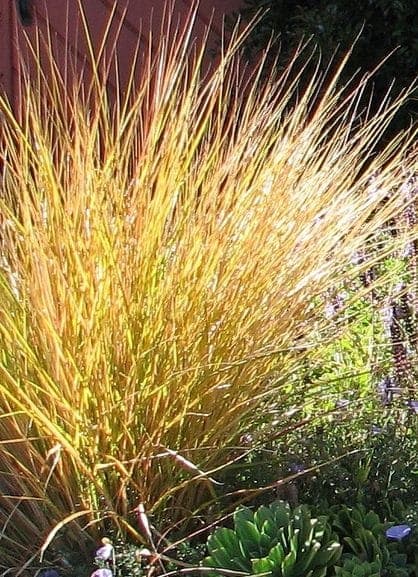
Photo by Flickr user hortulus; heavily cropped by Hesperian, so don't blame hortulus for the poor framing, okay? / CC BY 2.0, via Wikimedia Commons
Pheasant's tail grass (Anemanthele lessoniana): a guide
Anemanthele lessoniana
Want to see Pheasant's tail grass (Anemanthele lessoniana): a guide in your garden?
Full design in HD: €7.99
Look after your Pheasant's tail grass with the GardenWorld app
Identify plants with your camera and get a care calendar with reminders for this plant.


Overview
Pheasant's tail grass (Anemanthele lessoniana) is a New Zealand grass that seems to catch fire as summer turns to autumn. Its green leaves become streaked with orange, red and gold, and when low sun shines through the clump it looks like a slow-motion firework. Earlier in the season a haze of fine, purplish-brown flower heads hangs above it. Small wonder that British garden designers have relied on it for decades, and that it now turns up in borders across north-west Europe.
It is the only species in the genus Anemanthele and belongs to the grass family, Poaceae. Nurseries still often sell it under its old name, Stipa arundinacea, and occasionally as Oryzopsis lessoniana. Other English names include New Zealand wind grass and gossamer grass. In its homeland it grows along forest margins, in clearings in lowland forest and on slopes, where it gets both sun and light shade. It holds the RHS Award of Garden Merit.
Anemanthele lessoniana has a clear job in a planting: it brings movement, warm colour and a relaxed shape to schemes that might otherwise look stiff. If you are planning a new border, gardenworld.app can create a garden design for you in which this grass links perennials and shrubs, in sun or in part shade.
Appearance, foliage and flower heads
The plant forms a loose, arching clump 60 to 90 cm high and up to about 1.2 m wide. The leaves are narrow, around 3 to 5 mm across, and bow gracefully almost to the ground. In spring and early summer they are olive green. From August they colour gradually: first orange streaks appear, then red and golden tones, and by winter a plant in full sun can be almost entirely orange-brown. Most of the foliage stays on through winter, though a hard winter knocks some back, which is why it is described as evergreen to semi-evergreen.
From June to September the flower heads appear. They are extremely finely branched, purplish to reddish-brown, and drape over and above the foliage like a light veil. Up close you see hundreds of tiny spikelets on hair-thin stalks; from a distance the effect is a russet mist. After flowering, the heads persist well into autumn, catching dew and frost.
Pheasant's tail grass self-seeds readily, and the RHS notes that it can become a nuisance if left unmanaged. In most gardens that is easy to control by cutting the flower heads in good time, and young seedlings pull out easily. It is not on the EU list of invasive alien species. The grass is not known to be toxic to people or pets.
Ideal location
Anemanthele lessoniana is notably adaptable. In full sun the leaves colour most strongly, but it also does well in part shade, under a light tree canopy or against a wall that shades it in the afternoon. There the foliage stays greener with less autumn colour. Avoid deep, dry shade.
Use it as a loose accent in a border, in groups of three on a bank, beside a path where the leaves can spill over the edge, or as a single specimen in a large pot. Allow 80 cm to 1 m per plant, because a mature clump spreads wider than you expect at planting time. Place it where low light falls from behind or the side, and the colour and flower heads will look their best.
Soil requirements
This grass is not fussy. Ordinary garden soil, sandy soil and even heavy clay are fine, as long as water does not sit around the roots in winter. On wet clay, plant on a slight mound or mix coarse grit into the planting hole. pH makes little difference.
Feed sparingly. A handful of compost at planting is usually enough; very rich soil gives floppy foliage that falls open and colours less well. In a container, use good peat-free compost with about a fifth grit or gravel, in a generous pot at least 40 cm across.
Free preview
Want to see Pheasant's tail grass (Anemanthele lessoniana): a guide in your garden? Make a free preview of your design.
Watering
Once established, pheasant's tail grass is fairly drought tolerant. Water regularly during the first year, especially in a dry spring, and after that only in long summer droughts. If the leaves hang limply and start to roll, give a thorough soaking at the base.
Pots need more attention: in July and August you may need to water every other day. In winter keep the root ball on the dry side. Wet roots combined with frost are more dangerous for this grass than a few dry weeks.
Pruning
Do not cut this grass to the ground in spring as you would a Miscanthus. It keeps its leaves and new growth comes from the heart of the clump, so a hard cut weakens it. In March or April, comb out dead leaves with gloved fingers or a rake. Anything still brown or frost-damaged can then be trimmed back with shears.
After an exceptionally hard winter, when most of the foliage is dead, you can cut the plant back to about 15 cm; it usually regrows. To limit self-seeding, cut the flower heads as soon as they begin to turn brown in September, before the seed drops. If you prefer to keep them for winter interest, pull up unwanted seedlings in spring instead.
Pheasant's tail grass is fairly short-lived: after five to eight years old clumps often go bare. A well-placed seedling or a new plant is then the simplest replacement. Division is possible in April, but old clumps sometimes struggle to re-establish.
Maintenance calendar
January–February: The orange winter colour is at its best. Leave the clump standing.
March–April: Comb out dead leaves and trim frost damage. The best time to plant or move seedlings.
May: Fresh green leaves emerge from the centre. A handful of compost if needed.
June–September: Fine purplish-brown flower heads appear and stay attractive for weeks. Water in dry spells, particularly pots.
September–October: Cut off flower heads if you do not want seedlings. The leaves turn orange and red.
November–December: The grass holds its colour. Raise pots on feet and move them to shelter.
The planting calendar on gardenworld.app keeps these moments in view so you do not forget the spring tidy or the cutting of the seed heads.
Winter hardiness
According to the RHS, Anemanthele lessoniana tolerates temperatures down to around -10 °C for short periods. It comes through a typical British or Low Countries winter well, especially on well-drained soil in a sheltered spot. Long spells of harder frost kill part of the foliage, and in an exceptionally cold winter a plant may be lost. Because the grass self-seeds, a replacement is often already waiting.
A sheltered position near a wall, soil that stays dry in winter and no autumn cutting give the best chance of survival, as the leaves protect the crown. In December, move containers against a wall and wrap them in hessian during severe frost.
Companion plants
The orange tones of pheasant's tail grass are superb with late-summer flowers in warm colours. Rudbeckia fulgida, with golden petals and black centres, and Helenium autumnale in copper and red combine with the grass to make a glowing autumn border. Verbena bonariensis floats purple flower clusters through the scheme for contrast.
Stipa gigantea makes a fine big sister, its golden flower heads rising high above the clump. For a New Zealand theme, plant the grass at the foot of Pittosporum tenuifolium, an evergreen shrub with small, wavy leaves. Dark-leaved heucheras and the silvery foliage of Stachys byzantina also help the warm colours of the grass stand out.
Final thoughts
Pheasant's tail grass lights up the garden in the second half of the year: green in spring, a haze of flower heads in summer and a glow of orange and red through autumn and winter. It asks for soil that does not stay wet in winter, ideally some sun, and an annual comb-through. Keep an eye on self-seeding and replace old clumps in time, and this graceful New Zealand grass will give you years of pleasure.
Frequently asked questions about Pheasant's tail grass
Is Pheasant's tail grass winter hardy?
According to the RHS, Anemanthele lessoniana tolerates temperatures down to around -10 °C for short periods. It comes through a typical British or Low Countries winter well, especially on well-drained soil in a sheltered spot.
When and how do you prune Pheasant's tail grass?
Do not cut this grass to the ground in spring as you would a Miscanthus. It keeps its leaves and new growth comes from the heart of the clump, so a hard cut weakens it.
How much water does Pheasant's tail grass need?
Once established, pheasant's tail grass is fairly drought tolerant. Water regularly during the first year, especially in a dry spring, and after that only in long summer droughts.
Where does Pheasant's tail grass grow best?
Anemanthele lessoniana is notably adaptable. In full sun the leaves colour most strongly, but it also does well in part shade, under a light tree canopy or against a wall that shades it in the afternoon.
What soil does Pheasant's tail grass need?
This grass is not fussy. Ordinary garden soil, sandy soil and even heavy clay are fine, as long as water does not sit around the roots in winter.

See it in your garden
See Pheasant's tail grass in your garden
One photo of your garden and a few questions. You see the result in about a minute.
Try it with a photoIdentify this plant in your own garden. Identify a plant
Similar plants
Orange Coneflower: complete guide
Rudbeckia fulgida
Everything about Rudbeckia fulgida (orange coneflower): planting, care, combinations and bloom time. Practical tips for months of golden-yellow flowers.
Fall Sneezeweed (Helenium autumnale): complete guide
Helenium autumnale L.
Discover Fall Sneezeweed, a stunning late-season bloomer with red, yellow, and copper flowers. Hardy perennial for borders and late-season color.
Argentine vervain: complete guide
Verbena bonariensis
Discover how to grow Verbena bonariensis: ideal conditions, pruning tips, hardiness and plant partners. Perfect for wildlife gardens in USDA zones 7-11.
