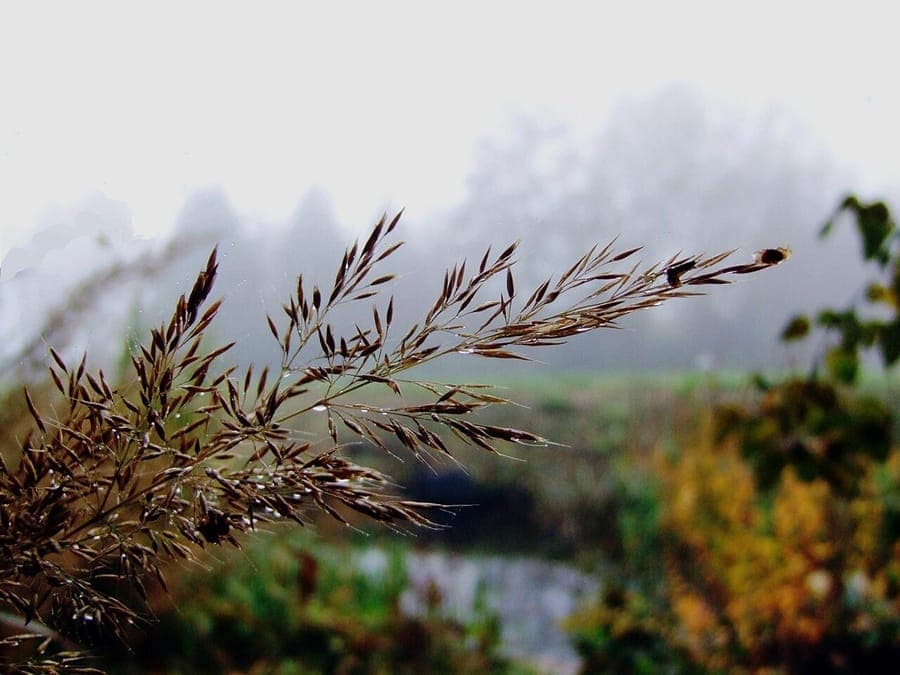
Dominicus Johannes Bergsma / CC BY-SA 3.0, via Wikimedia Commons
Korean feather reed grass (Calamagrostis brachytricha): guide
Calamagrostis brachytricha
Want to see Korean feather reed grass (Calamagrostis brachytricha): guide in your garden?
Full design in HD: €7.99
Look after your Korean feather reed grass with the GardenWorld app
Identify plants with your camera and get a care calendar with reminders for this plant.


Overview
Calamagrostis brachytricha, known as Korean feather reed grass, is a clump-forming ornamental grass from East Asia. It grows wild in Korea, Japan, China and the far east of Russia, along woodland edges, in clearings in mountain forests and in moist grassland. The flowering plumes are its glory: with morning dew on them or the low sun behind them, they sparkle as though set with tiny gems, which is why it is also sold as diamond grass. Older books and some labels still list it as Achnatherum brachytrichum or Stipa brachytricha.
In the garden it is valued above all as a late summer and autumn performer. Just when many perennials are past their best, feathery, pinkish-silver plumes rise above the green clump and stay standing well into winter. The grass forms a tidy, non-spreading clump and stays upright without any support.
An important difference from the familiar Calamagrostis × acutiflora 'Karl Foerster' lies in the timing and shape of the flowers. 'Karl Foerster' flowers as early as June and July with narrow, upright spikes and wants full sun. Korean feather reed grass does not flower until late August, has broader, airy plumes and copes with partial shade too. That makes it one of the few ornamental grasses that performs well under light trees or on the east side of a house. If you would like to see where this grass fits among your other border plants, you can have a garden design made on gardenworld.app with the right spacing and heights.
Appearance and flowering plumes
The leaves are fresh green, about 1 cm wide and gently arching. Together they form a dense, rounded clump 60 to 90 cm tall and roughly as wide. In autumn the foliage turns yellowish to straw-coloured, sometimes with a warm orange glow.
From late August or early September the flower stems shoot up to 100 to 140 cm. At the top appear plumes 20 to 30 cm long, at first dense and pointed, then opening wide and soft as feathers. As they open they have a pink to purplish-grey tint that turns silvery in the sun. During October they fade to pale beige and straw.
The plumes, like the dried stems, stay decorative for a long time. Frost and snow make the effect even stronger in winter. Only heavy snow or late autumn gales flatten them. For dried arrangements, cut the plumes once they are fully open; they keep their shape and some of their colour.
Ideal location
This grass flowers most freely in full sun, but does well in partial shade with three to five hours of sun a day. In deep shade the clump becomes looser and flowering is sparse. In hot, dry, fully sunny spots the leaves may develop brown tips in summer; a position with a little afternoon shade is better there.
It looks best in groups of three to seven plants, or repeated along a long border. It also works as a single specimen in a pot, provided the container holds at least 40 litres. Plant 60 to 80 cm apart so each clump can develop its natural arching shape. Ideally, place it where the low autumn sun falls behind or across it: that is when you see the sparkle that earned it its nickname.
Soil requirements
This grass likes a humus-rich, moisture-retentive soil that does not dry out in summer but does not stay waterlogged in winter either. Ordinary garden soil, loam and even light clay are suitable. On sandy soil, work in plenty of compost or well-rotted manure at planting time to help it hold moisture.
Soil pH is not critical: slightly acidic to neutral is ideal, and slightly alkaline is tolerated. A 2 to 3 cm layer of compost each spring is all the feeding it needs. Too much nitrogen makes the stems soft, so they lean after rain.
Free preview
Want to see Korean feather reed grass (Calamagrostis brachytricha): guide in your garden? Make a free preview of your design.
Watering
In the first year after planting, water regularly, especially during dry spells in spring and summer. About 10 litres per plant once a week is a good guide. Once the clump is well rooted, it copes on its own in a normal summer.
During long, hot droughts it struggles more than true steppe grasses. Water thoroughly every few days then. A mulch of compost or bark chips helps keep the soil cool and moist. Plants in pots need watering almost daily in summer. In winter the soil should ideally not be too wet, but in free-draining garden soil that is rarely a problem.
Cutting back
Do not cut back ornamental grasses such as Calamagrostis brachytricha in autumn. The plumes and dried leaves give structure to the winter garden, protect the heart of the clump from frost and offer shelter to insects.
In late February or March, cut the grass back in one go to 10 to 15 cm above the ground, before the new growth appears. Hedge shears are quicker than secateurs. Tie the clump together with string first and the clippings come away in one neat bundle. Wear gloves, as the leaf edges are rough and can cause small cuts.
After a few years the centre of the clump may thin out. Lift the plant in April, divide it with a spade and replant the young outer sections. In some gardens it self-seeds in moderation. If so, cut off the plumes in autumn before the seed drops, or weed out the seedlings in spring.
Maintenance calendar
February-March: Cut the clump back to 10 to 15 cm. Spread a thin layer of compost around the plant.
April: The best month to plant or divide. Water young plants regularly.
May-July: The clump grows into a fresh green mound. Water during dry spells, especially in the first year.
August-September: Flower stems appear and the plumes open pinkish-silver.
October-November: Plumes fade to beige. Cut a few for dried arrangements if you like.
December-January: Leave everything standing and enjoy frost and snow on the plumes.
If you do not want to miss the right moment to cut back, the plant calendar on gardenworld.app gives a monthly overview of every garden job.
Winter hardiness
Calamagrostis brachytricha is very hardy and tolerates temperatures down to roughly -30 °C. In Britain and the Low Countries it needs no protection anywhere. Leave the dried clump standing over winter; it shields the growing points at the heart of the plant from cold and wet.
In pots it is more vulnerable, because the root ball can freeze solid. In hard winters, move the pot against a wall and wrap it in hessian or bubble wrap if needed. Plants set out in autumn sometimes struggle in their first winter, so spring planting is preferable.
Toxicity
Korean feather reed grass is not poisonous to people, dogs, cats or other pets. Cats sometimes nibble grass blades; with this species that is harmless, although the rough leaf edges may mildly irritate their mouths. It is a safe choice for family gardens.
Companion plants
This grass is an ideal partner for late-flowering perennials. In sun, combine it with purple coneflower (Echinacea purpurea), black-eyed Susan (Rudbeckia fulgida) and ice plant (Hylotelephium spectabile). The soft plumes lighten the solid flower shapes of those plants. New England asters (Symphyotrichum novae-angliae) add purple and pink accents at the same height in September and October.
For a light, see-through effect, Verbena bonariensis works especially well, its purple heads floating among the plumes. In partial shade, place the grass beside Japanese anemones, hostas and ferns, whose broader leaves make a fine contrast. Avoid pairing it with invasive, running grasses, which will crowd out the clump.
Final thoughts
Calamagrostis brachytricha is one of the finest ornamental grasses for late summer and autumn. It stays neatly in its clump, tolerates more shade than most grasses and gives the garden structure well into winter with its glistening plumes. A single cut a year is the only maintenance it truly needs.
Plant it in small groups, somewhere the low light of September and October can shine through it. You will understand straight away where the name diamond grass comes from.
Frequently asked questions about Korean feather reed grass
Is Korean feather reed grass winter hardy?
Calamagrostis brachytricha is very hardy and tolerates temperatures down to roughly -30 °C. In Britain and the Low Countries it needs no protection anywhere.
How much water does Korean feather reed grass need?
In the first year after planting, water regularly, especially during dry spells in spring and summer. About 10 litres per plant once a week is a good guide.
Where does Korean feather reed grass grow best?
This grass flowers most freely in full sun, but does well in partial shade with three to five hours of sun a day. In deep shade the clump becomes looser and flowering is sparse.
What soil does Korean feather reed grass need?
This grass likes a humus-rich, moisture-retentive soil that does not dry out in summer but does not stay waterlogged in winter either. Ordinary garden soil, loam and even light clay are suitable.

See it in your garden
See Korean feather reed grass in your garden
One photo of your garden and a few questions. You see the result in about a minute.
Try it with a photoIdentify this plant in your own garden. Identify a plant
Similar plants
Purple coneflower: complete guide
Echinacea purpurea
Everything about Purple Coneflower (Echinacea purpurea): planting, care, pruning and combinations. Expert tips for a thriving prairie-style garden.
Orange Coneflower: complete guide
Rudbeckia fulgida
Everything about Rudbeckia fulgida (orange coneflower): planting, care, combinations and bloom time. Practical tips for months of golden-yellow flowers.
New England aster: complete guide
Symphyotrichum novae-angliae
Learn all about New England aster (Symphyotrichum novae-angliae), a stunning fall-blooming perennial.
