
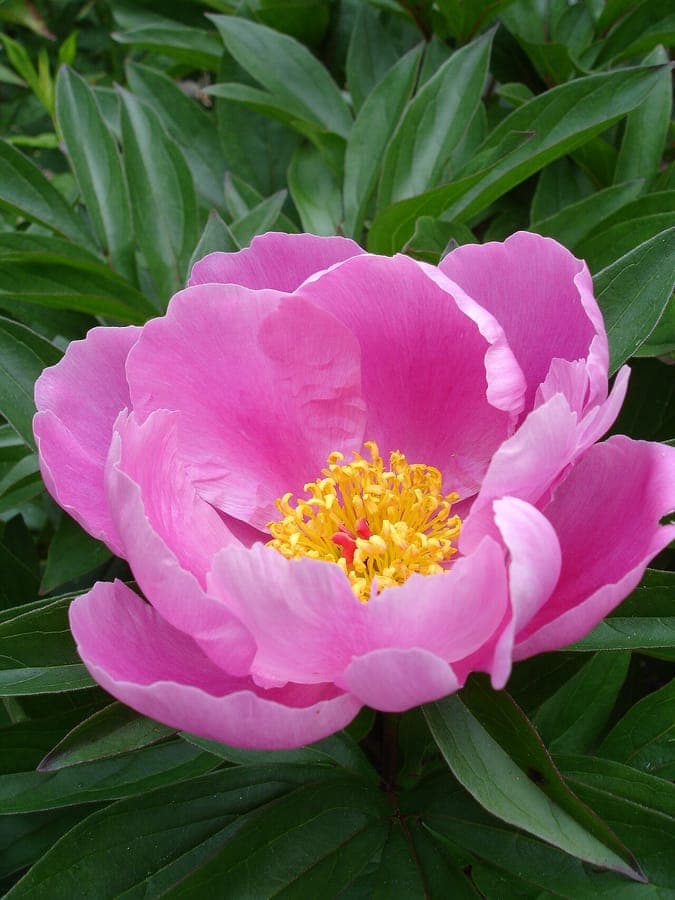
Ulf Eliasson / CC BY-SA 3.0, via Wikimedia Commons
Garden peony: complete guide
Paeonia lactiflora
Want to see Garden peony: complete guide in your garden?
1 minute, no credit card
Overview
The garden peony (Paeonia lactiflora) belongs among the most beloved and coveted perennials in the world. Anyone who has witnessed a peony in full bloom - those enormous, sumptuous flowers in shades of white, pink, red, and coral, releasing a heady fragrance that fills the entire garden - never forgets the sight. The peony is the queen of the border, a plant that endures for generations and only blooms more richly and abundantly with every passing year.
Paeonia lactiflora is the most widely cultivated species among herbaceous peonies, originally native to the cooler regions of Siberia, Mongolia, and northern China. Since the eighteenth century, hundreds of cultivars have been bred, from single flowers with an open golden centre to bomb-shaped, densely packed blooms that resemble scoops of vanilla ice cream. On gardenworld.app you can create a garden design where the peony takes the starring role - as an eye-catching border feature, a fragrant hedge along a path, or a source of spectacular cut flowers. With proper planting, a peony will endure for decades, sometimes an entire human lifetime.
Appearance and bloom
Paeonia lactiflora is a herbaceous perennial reaching 60 to 100 centimetres in height. The foliage is dark green, deeply divided, and glossy, forming an attractive, dense clump that remains a handsome presence even after the flowers have finished. In autumn the leaves sometimes take on bronzy tones, adding a modest but welcome extra dimension.
The flowers are the undisputed highlight. They appear in May and June and vary enormously in form: single (a ring of petals around a golden centre), Japanese (broad outer petals surrounding a cushion of transformed stamens), semi-double (multiple layers of petals with visible stamens), and double/bomb (a dense sphere of hundreds of petals with no visible centre). The colour palette spans pure white, shell pink, deep magenta, cherry red, and even coral.
Fragrance varies by cultivar from light and fresh to deep and rosy. Some celebrated cultivars: 'Sarah Bernhardt' (pink, double, the most widely grown peony in the world), 'Bowl of Beauty' (pink outer petals, creamy-white centre, Japanese type), 'Festiva Maxima' (white with red flecks, double, dating to 1851), 'Karl Rosenfield' (deep crimson, double), and 'Coral Charm' (coral-pink fading to peach, semi-double, highly prized by florists).
Ideal location
The garden peony demands a sunny position: at least six hours of direct sunlight per day are necessary for abundant bloom. In partial shade the plant flowers less freely and the stems grow weaker. The peony prefers an open site with good air circulation - this reduces the risk of botrytis (grey mould), the most common disease.
Choose a permanent position, because peonies resent being moved. A well-established peony can remain on the same spot for decades, growing more productive with each passing year. Do not plant it where you plan to redesign in a few years. Shelter from strong wind is a bonus, especially for the double cultivars whose heavy flower heads can topple in rain and wind - support rings or grow-through grids provide a straightforward solution.
Soil requirements
The garden peony prefers a fertile, deeply worked soil that is moisture-retentive but well-drained. A humus-rich loam or clay with good structure is ideal. The pH may be neutral to slightly alkaline (6.5–7.5). On heavy, compacted clay it is advisable to enlarge the planting hole generously and mix the soil with compost and coarse grit for better drainage.
The planting hole must be generous: at least 40 centimetres deep and 50 centimetres wide. Mix the excavated soil with a good shovelful of well-rotted compost or manure (never fresh manure - it burns the roots). Planting depth is critical and the most common cause of non-flowering peonies: the eyes (the pink-red growth points on the rootstock) must sit no more than 3 to 5 centimetres below the soil surface. Planting too deep results in lush foliage but no flowers - the single most frustrating mistake peony growers make.
Bare-root crowns with clearly visible eyes are available at garden centres and specialist nurseries across the UK, the USA, Australia, and South Africa from September to November. This is the best way to buy peonies: cheaper than potted plants and with the certainty of controlling the planting depth precisely.
Watering
Once established, the garden peony is remarkably drought-tolerant thanks to its thick, fleshy roots that function as water reservoirs. During the first growing year after planting, regular watering is important: give 10 to 15 litres weekly in dry weather so the roots can establish properly.
During the flowering period (May–June), the plant benefits from adequate moisture for developing its large blooms. Water thoroughly once a week on the root zone in dry weather. After flowering, water needs diminish, but do not allow the soil to dry out completely. Always water at ground level, never over the foliage - wet leaves promote botrytis.
A mulch layer of 5 centimetres of composted bark or leaf mould around the plant (but not directly over the rootstock) retains soil moisture and suppresses weeds. Take care that the mulch is not piled too thickly above the eyes - this has the same effect as planting too deep.
Free design
Want to see Garden peony: complete guide in your garden? Make a free design now.
Pruning
The garden peony requires minimal pruning, but there are a few important rules. Remove spent flowers as soon as they have finished - this prevents seed formation that wastes the plant's energy and reduces the risk of botrytis. Cut the flower stem back to the first mature leaf, but do not remove more foliage than necessary: the leaves produce the energy the plant stores in the rootstock for next year's bloom.
Leave the foliage intact after flowering until it dies back naturally in autumn. Only when the first frost has collapsed the leaves (usually November) should you cut all stems back to just above ground level. Remove the cut material from the garden completely and dispose of it with household waste - not the compost heap - to prevent the carry-over of fungal spores to the next season.
Maintenance calendar
March–April: Red shoots emerge from the ground. Carefully remove winter mulch so the eyes are not buried. Apply a potassium-rich fertiliser (avoid excess nitrogen, which promotes leaf growth at the expense of flowers). Place support rings around cultivars with double flowers.
May–June: Flowering begins. Enjoy the spectacular blooms and intoxicating fragrance. Remove spent flowers. Provide extra water in dry weather.
July–August: After flowering, the plant is an attractive green presence. Water moderately. Check for botrytis (brown spots on leaves and stems) and remove affected parts.
September–October: Foliage begins to die back. Reduce watering. This is also the best time to plant or divide peonies.
November: Cut all stems back to just above ground level after the foliage has fully died. Remove all plant material from the garden. Apply a thin mulch layer.
December–February: Dormancy. The rootstock sleeps underground. Peonies need cold to flower (vernalisation) - a minimum of 6 weeks below 5°C.
Winter hardiness
Paeonia lactiflora is outstandingly hardy and tolerates temperatures down to -30°C and below (USDA zones 3–8). The plant originated, after all, in the cold steppes of Siberia and Mongolia. Across the UK, the USA, Australia's cooler regions, and South Africa's highveld, winter cold is never a problem - on the contrary, the peony needs cold. A mild winter without a sufficient chill period can result in fewer flowers the following spring.
Late spring frost can damage the young shoots as they emerge from the ground (March–April). If frost is forecast, protect the shoots with a layer of straw or horticultural fleece. The damage is usually limited: the plant typically recovers without significant impact on the bloom.
Companion plants
The garden peony combines beautifully with plants that complement or extend its short but intense flowering period. At the base of peonies, early-flowering bulbs such as tulips and daffodils look splendid - they finish before the peony starts, and the peony foliage covers their yellowing leaves.
For a classic border combination, plant peonies with foxgloves (Digitalis purpurea), delphiniums, purple loosestrife (Lythrum), and ornamental grasses such as Stipa gigantea that frame the peony heads. Roses are the traditional partners: plant them alongside shrub roses or climbing roses for a lush, romantic picture. Lavender (Lavandula angustifolia) or catmint (Nepeta faassenii) at the front of the border provides a fine colour contrast.
After the peony has finished, hydrangeas (Hydrangea macrophylla) and summer-flowering perennials such as Echinacea and Rudbeckia take over the colour relay.
Closing
The garden peony is a plant for patient gardeners who think in generations. The first years after planting, the bloom is modest - sometimes not a single flower appears in year one. But give the peony three to five years, and you are rewarded with an ever-richer, ever-more-abundant display that endures for decades. There are documented peonies still flowering after a hundred years on the same spot.
Plant your peonies in autumn (September–October), ensure the eyes sit no deeper than 5 centimetres below the soil surface, and give them a sunny position with good soil. On gardenworld.app you can create a garden design where the peony holds centre stage - with well-matched companion planting that places the short flowering period in context and keeps the border attractive all season. Give a peony the chance, and you will receive a lifetime of beauty in return.
Want to see Garden peony: complete guide in your garden? Make a free design now.
Upload a photo, pick a style, and get a photorealistic design with plant list in under a minute.
No credit card required


Similar plants
Rugosa Rose: complete guide
Rosa rugosa
Everything about the Rugosa Rose (Rosa rugosa): planting, pruning, care and winter hardiness. Practical tips for abundant blooms in your garden.
English Lavender: complete guide
Lavandula angustifolia
Everything about English Lavender (Lavandula angustifolia): planting, pruning, care and overwintering. Practical tips for lush purple blooms.
Bigleaf Hydrangea: complete guide
Hydrangea macrophylla
Everything about the Bigleaf Hydrangea (Hydrangea macrophylla): planting, pruning, flower colour control and winter protection. Practical tips for lush blooms.