Consultaplantas / CC BY-SA 4.0, via Wikimedia Commons
Cape daisy (Osteospermum ecklonis): complete guide
Osteospermum ecklonis
Want to see Cape daisy (Osteospermum ecklonis): complete guide in your garden?
Full design in HD: €7.99
Look after your Cape daisy with the GardenWorld app
Identify plants with your camera and get a care calendar with reminders for this plant.


Overview
Cape daisy (Osteospermum ecklonis) is one of the most popular patio and balcony plants for spring and summer. Its large, radiant flowers with white rays and a dark blue centre catch the eye at once, and it keeps flowering from May until the first frost. Botanists now place the species in the genus Dimorphotheca, as Dimorphotheca ecklonis, but garden centres and catalogues almost always still sell it as Osteospermum. It is also widely known as African daisy.
The plant comes from the Eastern Cape in South Africa, where it grows on grassy slopes and along streams. There it is an evergreen subshrub that lives for many years. In a north-west European climate it rarely survives winter outdoors, so it is grown as an annual or overwintered under frost-free cover. The many bedding series you find in spring are almost all derived from this species, sometimes crossed with close relatives, and flower in white, pink, purple, yellow, orange and even bicolours. On gardenworld.app you can have a garden design made in which Cape daisies in pots and borders join other sun lovers to create a colourful patio.
The wild species can reach 1 metre, but the usual garden forms stay compact at 25 to 45 cm tall and about as wide. They are ideal for pots, troughs, wall planters and sunny edges of a border.
Appearance and bloom cycle
The leaves are lance-shaped to oblong, 5 to 10 cm long, fresh green and often slightly toothed. They feel a little fleshy and slightly sticky to the touch. The stems become somewhat woody at the base and branch well, especially if you pinch out the young plant once.
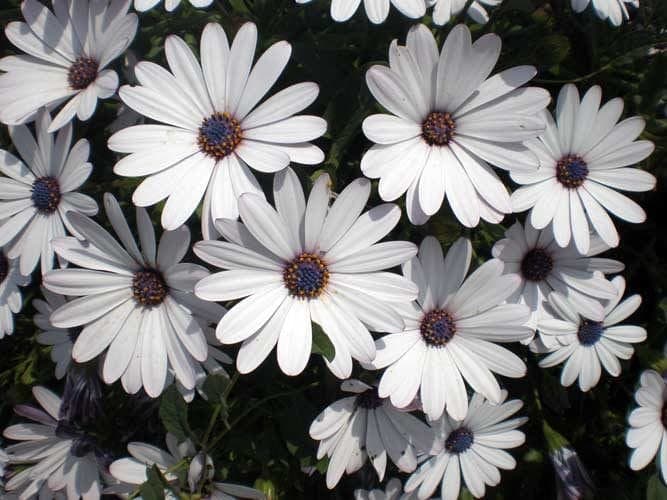
The flowers are the main attraction. Each one is 5 to 8 cm across, with white rays tinged blue-violet on the reverse and a deep indigo-blue centre dotted with paler stamens. The photo shows these white flowers with their blue eyes packed closely together in full sun. The flowers only open in good light: in the evening and in dull or rainy weather they close, revealing the purple undersides.
Flowering runs from May to October. In very hot spells in July and August the plant may pause briefly; as soon as the nights cool down, a fresh, generous flush follows. Bees and hoverflies visit the flowers readily.
Ideal location
Cape daisy is a true sun lover. Give it the sunniest spot you have: a south-facing patio, a balcony facing south or west, or a sunny edge of a border. In shade the flowers stay closed and the plant grows leggy and weak. It copes well with wind and salt air, which makes it a good choice for coastal gardens.
Do not plant outside until mid-May, once the risk of night frost has passed. In a border, space plants 30 cm apart. In containers, choose a pot at least 20 cm across per plant, or put three plants in a 40 cm trough. Always make sure there is a good drainage hole.
Soil requirements
Osteospermum ecklonis needs free-draining, moderately fertile soil. In the border, light sandy or loamy soil is ideal. Heavy clay that stays wet quickly leads to root rot, so mix in coarse grit or grow it in a pot instead. A slightly acid to neutral pH is fine.
In containers, use a good-quality compost for patio plants and mix in about one fifth perlite or grit. A layer of gravel or clay pebbles at the bottom helps excess water drain away. Because the plant flowers for months in a pot, it needs feeding: from May to September give a liquid feed for flowering plants every two weeks, ideally one low in nitrogen and higher in potassium.
Free preview
Want to see Cape daisy (Osteospermum ecklonis): complete guide in your garden? Make a free preview of your design.
Watering
In open ground, Cape daisy is fairly drought tolerant once established. Water when the top few centimetres feel dry, but avoid waterlogging. Overwatering is the main cause of limp, yellowing leaves and rotting plants.
In pots the compost dries out quickly in summer. Check daily and water as soon as the surface is dry, preferably in the morning and at the base. Never leave a pot standing in a saucer of water. Slightly wilted plants usually recover within a few hours of watering.
Pruning
Remove faded flowers regularly, stalk and all. This stops the plant putting energy into seed and keeps it producing new buds. Pinch out the tips of young plants in spring so that they branch out and become bushier.
If the plant becomes leggy and untidy in midsummer, cut all the stems back by a third and give it an extra feed. It will flower again within a few weeks. If you plan to overwinter it, cut it back by about half in October before bringing it indoors.
Maintenance calendar
March to April: Move overwintered plants to a brighter, slightly warmer spot. Take cuttings if you like. Buy new plants only once the weather turns milder.
Mid-May: Put plants outside, first for a few days in a sheltered spot to harden off.
June: Full flowering. Feed every two weeks and deadhead faded blooms.
July to August: Water in dry spells. Cut back by a third if the plant gets untidy.
August to September: Take 8 to 10 cm cuttings from non-flowering shoots to raise new plants for next year.
October: Bring plants inside before the first frost, or let them finish flowering.
November to February: Overwinter in a bright, frost-free place with very little water.
The plant calendar on gardenworld.app reminds you of these tasks month by month, for your other patio plants too.
Winter hardiness
Osteospermum ecklonis is not reliably hardy in the UK and the Low Countries. It sometimes survives a short, light frost of a few degrees below zero in a dry, sheltered corner, but harder or prolonged frost, and above all cold, wet winter soil, will kill it. If you want to keep it, bring it in in October. A bright, cool spot at 5 to 10 °C is ideal, such as an unheated conservatory, a cool porch or a frost-free garage with a window. In winter, water only when the compost is completely dry.
Taking cuttings is often the easiest route. Young rooted cuttings take up less space, overwinter more easily and flower freely the following year. If you have no room, simply buy new plants in spring.
The plant is not known to be toxic to people, dogs or cats. In Australia the species has naturalised in places; in our climate it cannot survive winter outdoors, so it does not spread into the wild.
Companion plants
On the patio, Cape daisy combines well with other sun-loving container plants. The sky-blue flowers of blue marguerite (Felicia amelloides) echo the blue centre of the white blooms. Marguerite (Argyranthemum frutescens) offers a similar daisy shape in white or yellow, while treasure flower (Gazania rigens) adds warm oranges and yellows.
For silver foliage among the flowers, use liquorice plant (Helichrysum petiolare), which trails attractively over the edge of a pot. In the border, English lavender (Lavandula angustifolia), low ornamental grasses and thyme suit the white flowers well, as they all enjoy the same dry, sunny conditions.
Final thoughts
Cape daisy is a rewarding plant for anyone with a sunny patio or balcony. Give it full sun, free-draining soil, regular feeding in pots and prompt deadheading, and it will flower from May to October. Take a few cuttings in late summer so that you can enjoy those radiant white flowers with their blue eyes again next year.
Frequently asked questions about Cape daisy
Is Cape daisy winter hardy?
Osteospermum ecklonis is not reliably hardy in the UK and the Low Countries. It sometimes survives a short, light frost of a few degrees below zero in a dry, sheltered corner, but harder or prolonged frost, and above all cold, wet winter soil, will kill it.
When and how do you prune Cape daisy?
Remove faded flowers regularly, stalk and all. This stops the plant putting energy into seed and keeps it producing new buds.
How much water does Cape daisy need?
In open ground, Cape daisy is fairly drought tolerant once established. Water when the top few centimetres feel dry, but avoid waterlogging.
Where does Cape daisy grow best?
Cape daisy is a true sun lover. Give it the sunniest spot you have: a south-facing patio, a balcony facing south or west, or a sunny edge of a border.
What soil does Cape daisy need?
Osteospermum ecklonis needs free-draining, moderately fertile soil. In the border, light sandy or loamy soil is ideal.

See it in your garden
See Cape daisy in your garden
One photo of your garden and a few questions. You see the result in about a minute.
Try it with a photoIdentify this plant in your own garden. Identify a plant
Similar plants
Boston daisy: complete guide
Argyranthemum frutescens
Boston daisy is a prolific Canary Island shrub with vibrant green foliage and abundant flowers from spring through autumn. Ideal for borders, containers, and patio plantings.
Blue daisy: complete guide
Felicia amelloides
Discover the Blue daisy, a South African blooming machine with sky-blue flowers. Perfect for borders and containers with year-round blooms.
Treasure-flower: complete guide
Gazania rigens
How to grow Gazania rigens in your garden: full sun, drought-tolerant, long bloom time. Perfect for borders, rock gardens and containers.
