
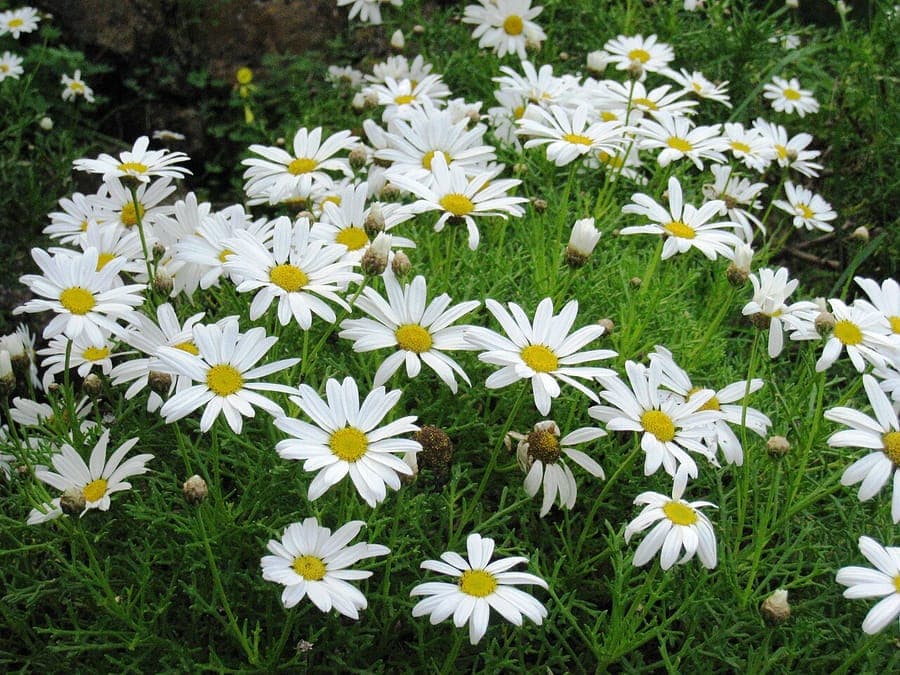
Dryas / CC BY-SA 3.0, via Wikimedia Commons
Boston daisy: complete guide
Argyranthemum frutescens
Want to see Boston daisy: complete guide in your garden?
1 minute, no credit card
Boston daisy (Argyranthemum frutescens), also called Paris marguerite or simply daisy, is an energetic, long-flowering shrub native to the Canary Islands. This plant is celebrated for prolific flower production, usually white blooms though pink and yellow cultivars exist. The plant grows compact, is highly responsive to pruning, and serves brilliantly in borders, containers, and as a patio specimen.
The plant reaches 60 to 100 cm in height and spread, with finely branched, green foliage with soft-finely divided leaves. The foliage has aromatic scent when brushed, making interaction with the plant pleasant.
From April through October (in mild regions to December), numerous single or semi-double flowers appear, each measuring 3 to 4 cm. Flowers are typically white with yellow disk centers, but cultivars like 'Buffy' are pink, 'Jamaican Primrose' is bright yellow, and 'Sungold' is also golden. Flower coverage is dense - a healthy plant may carry hundreds of flowers simultaneously.
Site in full sun (minimum 6 to 8 hours daily) for optimal flowering. Shade causes sparse, leggy growth and reduced flowers.
Soil: free-draining, not overly nutrient-rich soil. In containers: standard potting mix suffices. In borders: ensure good drainage. Heavy clay improves with coarse sand or perlite additions.
Watering: water regularly during growing season, especially in containers where soil dries rapidly. Prevent waterlogging, which causes root rot. Keep dry in winter.
Feeding: fertilize every two weeks from April to August with a flowering fertilizer (higher phosphorus). This promotes flower buds. From September, gradually reduce feeding frequency.
Pruning: regularly pinch young plants in May-June to promote denser growth. After first flowering cycle (late June), cut back hard to 20 cm height to stimulate second flush. This maximizes overall flower production.
Winter survival: this plant is not hardy outdoors in northern Europe. Treat as annual (discard after season) or lift and winter in frost-free greenhouse or conservatory. When overwintering: minimal water, no feeding, cool location (10 to 15 degrees Celsius).
Diseases: in wet conditions, fungal issues may arise. Ensure good air circulation. Spider mites possible in dry environments; regular misting helps.
Propagation: take cuttings in August-September from non-flowering shoot tips (7 to 10 cm). Root in humid soil under plastic cover; rooting occurs in 2-3 weeks. Easier than seed.
Container culture: excellent in larger pots (40 to 60 cm diameter) where multiple plants planted together create full effect. Combine well with blue Lobelia flowers or silvery Senecio foliage.
In the UK and northern Europe, garden centers stock assortments March-May: white, pink, yellow varieties. Prices typically 3-5 euros per small plant.
Retailers: UK garden centres; Germany OBI/Hornbach; France Truffaut/Jardiland; Belgium Intratuin.
A must-have plant for gardeners seeking prolific, uncomplicated flowers with minimal fuss.
Want to see Boston daisy: complete guide in your garden? Make a free design now.
Upload a photo, pick a style, and get a photorealistic design with plant list in under a minute.
No credit card required


Similar plants
Calendula stellata: complete guide
Calendula stellata
Complete guide to Calendula stellata, the star-flowered marigold from Sicily: location, soil, watering and companion planting tips.
Korean chrysanthemum: complete guide
Chrysanthemum x rubellum
Chrysanthemum x rubellum is a hardy autumn perennial with single pink to copper flowers from August to November. Care and combinations.
Helianthus divaricatus: complete guide
Helianthus divaricatus
Helianthus divaricatus is a North American woodland sunflower with yellow summer blooms, ideal for naturalistic borders and shady edges.