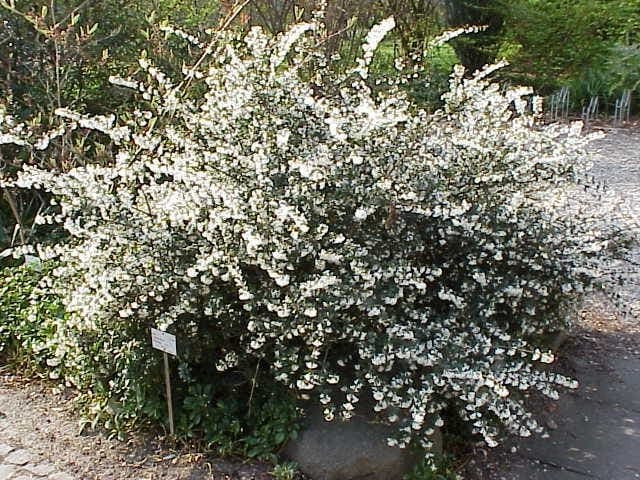
Kurt Stüber [1] / CC BY-SA 3.0, via Wikimedia Commons
Delavay osmanthus: growing Osmanthus delavayi
Osmanthus delavayi
Want to see Delavay osmanthus: growing Osmanthus delavayi in your garden?
Full design in HD: €7.99
Look after your Delavay osmanthus with the GardenWorld app
Identify plants with your camera and get a care calendar with reminders for this plant.


Overview
Osmanthus delavayi spends most of the year as a neat, dark green shrub that quietly holds a border together. Then, in March and April, it covers itself in small, pure white tubular flowers with a sweet, jasmine-like scent that carries right across the garden on a mild spring afternoon. Its usual English name is Delavay osmanthus, and it has long been a favourite in British country-house gardens, where it holds the RHS Award of Garden Merit.
The species belongs to the olive family (Oleaceae), alongside privet, lilac and jasmine. It is native to south-west China, chiefly Yunnan and Sichuan, where it grows on scrubby mountain slopes. The French missionary and plant hunter Jean-Marie Delavay found it there and sent seed to the Vilmorin nursery near Paris in 1890, which is how the plant reached European gardens and how it got its name.
It is easy to confuse with its better-known cousin Osmanthus heterophyllus, but the two are very different in the garden. Osmanthus heterophyllus has spiny, holly-like leaves and flowers in autumn; Osmanthus delavayi has tiny, spineless leaves and flowers in spring. As far as is known it is not toxic to people or pets, and it is not invasive anywhere in Europe. If you are unsure where a compact evergreen like this would fit, gardenworld.app can create a garden design that takes account of your space, light and existing planting.
Appearance and bloom cycle
Delavay osmanthus grows slowly into a dense, rounded shrub with finely divided, gently arching stems. In most gardens it reaches about 1.5 to 2 metres in height and spread after ten years. Very old plants can top 3 metres, but that takes decades. The leaves are small, only 1 to 2.5 cm long, oval, finely toothed and glossy dark green, paler underneath and dotted with minute glands. That fine foliage gives the shrub a tidy, almost box-like texture.
Flowering begins in late March and continues through April, into May after a cold spring. Each flower is a slender tube about 1 to 1.5 cm long that opens into four spreading lobes. They are borne in clusters of four to eight in the leaf axils and at the shoot tips, so densely that from a distance the shrub looks like a white cloud. The fragrance is sweet and remarkably strong, especially in the evening and in warm, sheltered corners. Early bees and bumblebees visit freely.
Small oval, blue-black fruits about 1 cm long sometimes follow, though they are rarely seen in British gardens. Besides the species there are a few selections, such as 'Pearly Gates', with slightly larger flowers. If you want something bigger with broader leaves, look at Osmanthus × burkwoodii, a hybrid between Osmanthus delavayi and Osmanthus decorus.
Ideal location
Osmanthus delavayi thrives in full sun to partial shade. It flowers most freely in sun; in light shade the leaves stay a deeper green and the habit becomes a little looser. Deep shade means fewer flowers. Choose a spot sheltered from cold easterly and northerly winds, which can scorch the foliage and damage the flower buds in a hard winter.
Plant it near the house, a seat or a path so that you actually notice the scent. Its slow growth and fine texture make it a good choice for smaller gardens, as a specimen in a mixed border, a low informal hedge or a large pot on a patio. For a hedge, space plants 50 to 60 cm apart. It copes well with coastal gardens as long as it is not in the full force of the sea wind.
Soil requirements
One of the great strengths of this shrub is its indifference to soil type. It grows happily on mildly acid, neutral and chalky soils, which sets it apart from many spring-flowering evergreens such as rhododendrons and camellias. What matters most is a reasonably fertile soil that drains well but does not dry out completely in summer.
On heavy clay, improve the planting hole with compost and some grit so that excess water can drain away. On light, sandy soil, dig in well-rotted compost or leaf mould to help retain moisture. Make the hole twice as wide as the root ball and plant at the same depth as it sat in the pot. A 5 cm mulch of bark or compost keeps the roots cool and suppresses weeds.
Free preview
Want to see Delavay osmanthus: growing Osmanthus delavayi in your garden? Make a free preview of your design.
Watering
In the first year after planting, give around 10 litres per plant each week during dry weather, aimed directly at the root ball, so that the shrub develops a deep root system. Once established it is fairly drought tolerant and needs only an occasional thorough soak during long dry summers.
Keep an eye on it in midsummer, though: the flower buds for next spring form in July and August, and severe drought then means fewer flowers. Plants in containers need watering two or three times a week in summer, until water runs from the drainage holes. In winter, water pots only during dry, frost-free spells, since evergreens keep losing moisture through their leaves even then.
Pruning
Osmanthus delavayi flowers on wood made the previous year, so always prune straight after flowering, during May. Anything you cut away in summer or autumn will not flower the following spring. Usually a light trim is all that is needed: shorten over-long shoots and remove dead or crossing stems.
The shrub responds well to clipping and can even be kept as a neat dome or low hedge. For a natural, loose shape with the most flowers, prune as little as possible. If an old plant has become bare at the base or simply too large, renovate it gradually in May by cutting a third of the oldest stems back to about 30 cm above ground each year. It regrows well, although those stems will miss a season of flowering.
Maintenance calendar
March to April: Full bloom. Enjoy the scent and cut a few sprigs for a small vase.
May: Prune straight after flowering. Feed with a handful of organic shrub fertiliser and top up the mulch.
June: New shoots extend. A good time to take semi-ripe cuttings.
July to August: Next year's flower buds are forming. Water during prolonged dry spells and do not prune.
September to October: A good planting season while the soil is still warm. Check the undersides of leaves for scale insects now and then.
November to February: Dormant period. Protect young and container plants with fleece in severe frost and move pots against a sheltered wall.
Winter hardiness
Delavay osmanthus is reliably hardy in most of Britain. The Royal Horticultural Society rates it H5, which corresponds to roughly -10 to -15 °C. Established plants come through such frosts without trouble. After an exceptionally harsh winter some leaves may brown or drop, but the shrub usually reshoots well in spring.
Young plants and those in containers are more vulnerable. Give them a sheltered position for the first two winters and drape fleece over them when temperatures fall below -10 °C. Wrap pots in hessian or bubble wrap and raise them on feet so that water can drain freely. Late frosts in March can brown open flowers, although the plant itself is not harmed.
Companion plants
Osmanthus delavayi pairs beautifully with other spring-flowering shrubs. The star magnolia (Magnolia stellata) flowers at the same time with large white stars, and together they create a luminous white spring scene. Pieris japonica and Camellia japonica add colour, but both need acid soil, so they are only good partners if your ground suits them.
At its feet, daffodils (Narcissus pseudonarcissus) and the blue forget-me-not flowers of Brunnera macrophylla stand out well against the dark foliage. In summer, when the osmanthus becomes a calm green backdrop, hostas, ferns or hydrangeas keep the border going. As a hedge it makes a fine, dark backdrop for white and pink roses.
Final thoughts
Osmanthus delavayi is a shrub you rarely see in garden centres, which is a shame. It stays compact and tidy, grows on almost any soil, is hardy and produces a flood of scented white flowers every spring. The only thing it really asks is pruning at the right moment: straight after flowering.
The plant calendar on gardenworld.app helps you remember that May trim, along with the other jobs month by month. Plant your Delavay osmanthus in spring or autumn somewhere you pass often, and let its sweet scent surprise you every April.
Frequently asked questions about Delavay osmanthus
Is Delavay osmanthus winter hardy?
Delavay osmanthus is reliably hardy in most of Britain. The Royal Horticultural Society rates it H5, which corresponds to roughly -10 to -15 °C.
When and how do you prune Delavay osmanthus?
Osmanthus delavayi flowers on wood made the previous year, so always prune straight after flowering, during May. Anything you cut away in summer or autumn will not flower the following spring.
How much water does Delavay osmanthus need?
In the first year after planting, give around 10 litres per plant each week during dry weather, aimed directly at the root ball, so that the shrub develops a deep root system. Once established it is fairly drought tolerant and needs only an occasional thorough soak during long dry summers.
Where does Delavay osmanthus grow best?
Osmanthus delavayi thrives in full sun to partial shade. It flowers most freely in sun; in light shade the leaves stay a deeper green and the habit becomes a little looser.
What soil does Delavay osmanthus need?
One of the great strengths of this shrub is its indifference to soil type. It grows happily on mildly acid, neutral and chalky soils, which sets it apart from many spring-flowering evergreens such as rhododendrons and camellias.

See it in your garden
See Delavay osmanthus in your garden
One photo of your garden and a few questions. You see the result in about a minute.
Try it with a photoIdentify this plant in your own garden. Identify a plant
Similar plants
Star Magnolia: complete guide
Magnolia stellata
Everything about Star Magnolia (Magnolia stellata): planting, care, pruning and siting. Practical tips for spectacular star-shaped spring flowers.
Japanese pieris: complete guide
Pieris japonica
Complete care guide for Japanese pieris (Pieris japonica): ideal location, soil, watering, pruning and companion plants. Perfect for shaded, acidic gardens.
Japanese Camellia: complete guide
Camellia japonica
Everything about Japanese Camellia (Camellia japonica): planting, care, pruning and overwintering. Practical tips for stunning winter and spring blooms.
