
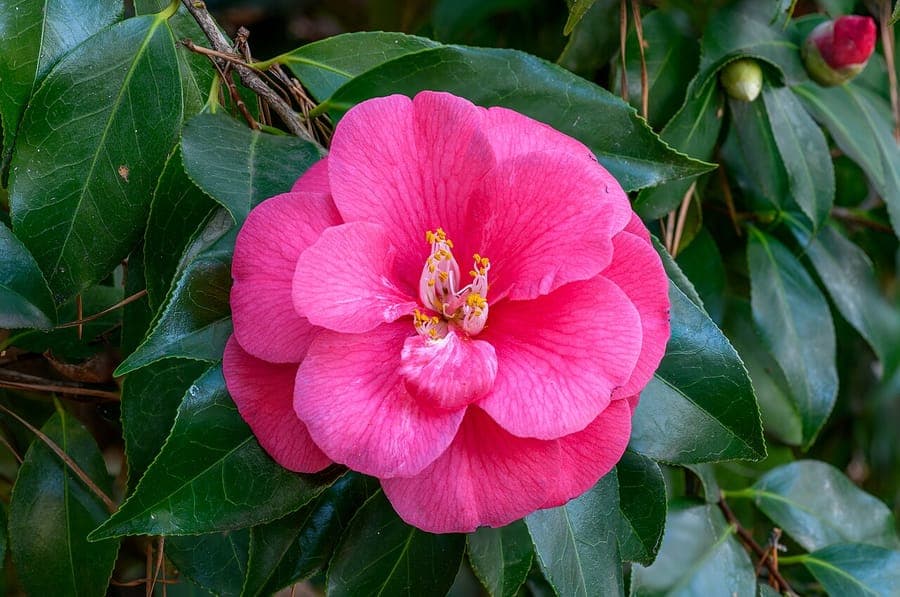
PumpkinSky / CC BY-SA 3.0, via Wikimedia Commons
Japanese Camellia: complete guide
Camellia japonica
Want to see Japanese Camellia: complete guide in your garden?
1 minute, no credit card
Overview
The Japanese Camellia (Camellia japonica) is one of the most elegant evergreen shrubs you can grow in a garden. Native to the mountain forests of Japan, Korea, and China, this plant belongs to the tea family (Theaceae) and is a distant relative of the tea plant from which millions of cups are brewed daily. What makes the camellia so remarkable is its timing: while most garden plants remain dormant, the camellia displays its spectacular flowers from January to April - robust, rose-like blooms of 7 to 12 cm across in shades of white, pink, red, and bicolour.
As an evergreen shrub, Camellia japonica typically reaches 2 to 4 metres in temperate gardens, though specimens of 6 metres are not uncommon in sheltered positions. On gardenworld.app you can create a garden design in which the camellia serves as an elegant winter and spring focal point, combined with other shade-tolerant plants that provide interest year-round. The glossy, dark green, leathery leaves - 5 to 10 cm long - are ornamental in their own right and make the camellia a valuable garden plant even outside its flowering season.
Appearance and bloom period
The flowering period of Camellia japonica extends from January to April, depending on the cultivar and local climate. Early varieties begin as early as January, mid-season types flower in February and March, and late varieties continue into April. This long, staggered bloom time makes it possible, with a thoughtful selection of cultivars, to enjoy four months of camellia flowers in the garden.
The flowers are the camellia's trademark. They range from single (with visible stamens) to peony-form, anemone-form, and formal double (without visible stamens). Three cultivars deserve special mention. 'Adolphe Audusson' is a proven variety with large, semi-double, blood-red flowers featuring prominent yellow stamens - vigorous and free-flowering. 'Nuccio's Gem' produces formal double, perfectly symmetrical white blooms that look as though carved from porcelain. 'Donation' (strictly a Camellia x williamsii hybrid, but often grouped with japonica) bears large, semi-double, orchid-pink flowers and is particularly suited to cooler maritime climates thanks to its cold tolerance.
Garden centres stock a wide range of camellias, often sold in flower during the winter months. When purchasing, look for a plant with several flower buds at different stages - this guarantees a longer display.
Ideal location
Site selection is the single most important decision with camellias. The ideal spot is partial shade: dappled light beneath the canopy of tall deciduous trees, or the north or west side of a building or wall. Morning sun must be avoided: when frozen flower buds thaw rapidly in early morning sunshine, the petals split and turn brown. A western exposure, where gentle afternoon light warms the plant gradually, is ideal.
Protection from cold, drying wind is essential. A sheltered spot against a wall, behind a hedge, or beneath trees is preferable to an open, windy location. The wall need not face south - a west or north-west wall that breaks the worst winter wind is often better than a southern exposure with harsh sun.
Camellia japonica is hardy to approximately -10 to -15 degrees Celsius (USDA zones 7 to 9), provided it has a sheltered position. In most parts of the UK and lowland western Europe it survives winter without difficulty, but in colder inland areas extra protection is prudent. Container-grown plants can be moved to a cool, frost-free space (0 to 5 degrees Celsius) during severe cold spells.
Soil requirements
Camellias are strictly acid-loving and demand a soil pH of 4.5 to 6.0. On limy or alkaline ground they develop chlorosis - yellowing of the leaves due to iron deficiency - and slowly decline. Test your soil pH before planting and amend with ericaceous compost, peat-free acidifiers, or sulphur as needed.
The soil must be humus-rich, well-drained, and simultaneously moisture-retentive. This sounds contradictory, but a blend of garden soil, leaf mould, and coarse sand in equal parts fulfils the requirement perfectly. Most garden centres stock ericaceous compost that is also ideal for camellias.
Avoid limy tap water for irrigation - use rainwater whenever possible. If only tap water is available, let it stand for a day or add a splash of vinegar (1 tablespoon per 10 litres) to lower the pH. Mulch annually with a 5 to 8 cm layer of leaf mould, pine needles, or bark to keep the soil acidic and moist.
Planting
The best planting season is autumn (September to November) or early spring (March to April). Avoid summer planting, when heat and drought hinder establishment. Dig a planting hole three times as wide as the root ball and the same depth. The top of the root ball should sit precisely at ground level - planting too deep is a common mistake that leads to collar rot.
Mix the excavated soil with ericaceous compost and leaf mould. Set the plant in the hole, backfill, firm gently, and water immediately with 10 to 15 litres of rainwater. Apply a thick mulch layer but leave 10 cm clear around the stem. Staking is advisable for specimens above 1 metre on windy sites.
For a camellia in a pot, choose a container at least 10 cm larger than the root ball, with generous drainage holes. Use a mix of ericaceous compost, perlite, and coarse sand. Repot every two to three years into a larger container.
Free design
Want to see Japanese Camellia: complete guide in your garden? Make a free design now.
Watering
Camellias need a consistently moist but never waterlogged root zone. The critical periods are summer (when the plant forms flower buds for the following season) and late winter (when buds are swelling). Drought stress in summer causes bud drop - buds fall off before opening, a frustrating but preventable problem.
From May to September, give 10 to 15 litres of rainwater per plant weekly if it does not rain. In winter, supplementary watering is usually unnecessary, but check container plants regularly - the root ball must not dry out, even in winter. Always water at the base and avoid wetting the flowers, which causes brown spotting.
Feeding
Camellias are not heavy feeders but benefit from regular, modest fertilisation. Use an ericaceous plant food (rhododendron fertiliser) in two applications: the first in April after flowering, the second in June when the plant is actively growing and forming flower buds. Follow the dosage on the packaging and err on the side of under-feeding rather than over-feeding.
Avoid lime-containing fertilisers and never feed after August - late feeding encourages soft growth that does not harden before winter and is vulnerable to frost damage.
Pruning
Camellias need very little pruning, which is one of their charms. The natural growth form is dense and regular. After flowering (April to May) you can give a light shaping cut: remove dead branches, crossing twigs, and any frost-damaged shoots. You can also shorten over-long branches to just above a side branch or leaf node.
Older, overgrown specimens can be hard-pruned in April back to old wood - camellias reshoot readily. Expect two years without flowers after severe pruning. Remove spent flowers as they turn brown and cling to the branches - this improves appearance and reduces the risk of grey mould.
Pests and diseases
The most common problem is petal blight (grey mould, Botrytis cinerea), which turns petals brown and causes them to rot. Remove affected flowers immediately and ensure good air circulation. Avoid overhead watering.
Scale insects and mealybugs can colonise the glossy leaves. Check the undersides of leaves and leaf axils regularly. Control is possible with biological insecticidal soap or ladybirds as natural predators. Sooty mould - a black fungal film on the foliage - results from insect honeydew excretions and disappears once the pests are controlled.
Chlorosis (yellow leaves with green veins) indicates soil pH that is too high and consequent iron deficiency. Lower the pH with sulphur or replace the top layer with acidic soil. Chelated iron as a foliar feed gives quick but temporary relief.
Winter protection
In most years, camellias in mild maritime climates overwinter without difficulty. At temperatures below -10 degrees Celsius or during prolonged frost with sharp east wind, protection is wise. Wrap the shrub loosely in horticultural fleece (not plastic - that causes condensation) and mulch the root zone extra thickly with straw or leaves.
Container plants are more vulnerable because the roots are less insulated. Wrap the pot in bubble wrap or hessian, place it against a sheltered wall, and stand the pot on an insulating slab of polystyrene. Bring the plant indoors only if prolonged severe frost (below -12 degrees Celsius) is forecast, and choose a cool, bright space - not the warm living room.
Companion plants
Camellias combine best with other acid-loving, shade-tolerant plants. Hydrangeas (Hydrangea macrophylla) are ideal partners: they take over the display once the camellia finishes flowering and share the same soil preferences. Rhododendrons and azaleas thrive in similar conditions and together with camellias form a classic woodland planting.
Underplant with ferns, hostas, and spring bulbs such as snowdrops and bluebells for a layered composition. Japanese Maples (Acer palmatum) offer contrasting leaf shapes and spectacular autumn colour above a bank of camellias. Skimmia japonica with its red berries is a decorative winter companion.
Final thoughts
The camellia is an investment that repays itself year after year with winter blooms when the rest of the garden still sleeps. With the right position, an acidic soil, and protection from morning sun and cold wind, you will enjoy magnificent flowers that brighten the grey winter months. Purchase a flowering camellia from a reputable garden centre and let yourself be enchanted by this winter queen.
On gardenworld.app you can create a garden design that pairs the camellia with the right companions for your specific garden, taking into account soil pH, light, and shelter. Give this evergreen beauty a place of honour in your garden and revel in luxurious blooms at the moment you need them most.
Want to see Japanese Camellia: complete guide in your garden? Make a free design now.
Upload a photo, pick a style, and get a photorealistic design with plant list in under a minute.
No credit card required


Similar plants
Bigleaf Hydrangea: complete guide
Hydrangea macrophylla
Everything about the Bigleaf Hydrangea (Hydrangea macrophylla): planting, pruning, flower colour control and winter protection. Practical tips for lush blooms.
Rhododendron: complete guide
Rhododendron
Everything about Rhododendron: planting, care, pruning and the right soil. Practical tips for an abundant spring display.