Didier Descouens / CC BY-SA 4.0, via Wikimedia Commons
Black mondo grass (Ophiopogon planiscapus): complete guide
Ophiopogon planiscapus
Want to see Black mondo grass (Ophiopogon planiscapus): complete guide in your garden?
Full design in HD: €7.99
Look after your Black mondo grass with the GardenWorld app
Identify plants with your camera and get a care calendar with reminders for this plant.


Overview
Few garden plants have a colour as striking as black mondo grass. Ophiopogon planiscapus is a low, evergreen perennial from Japan that forms tufts of narrow, leathery leaves. The wild species is simply dark green, yet in British and European gardens you will almost always meet the selection 'Nigrescens', sometimes sold as 'Niger', 'Black Dragon' or 'Ebony Knight'. Its foliage is such a deep purple-black that from a few metres away it reads as pure black.
Despite the name, it is not a grass at all. Ophiopogon belongs to the asparagus family (Asparagaceae) and is a close relative of Liriope, which it resembles when in flower. The plant stays low, 15 to 20 cm, and spreads slowly through short underground runners. After a few years it knits together into a dense, dark carpet that holds its colour all year. That is why it has become a favourite for contemporary and Japanese-style gardens, gravel beds, border edges and containers.
Its real strength is contrast. Set against silver foliage, lime-green grasses or pale gravel, the black leaves stand out immediately. If you would like to see how to use that contrast in your own plot, gardenworld.app can create a garden design for you that places black mondo grass alongside plants suited to your soil and light.
Appearance and bloom cycle
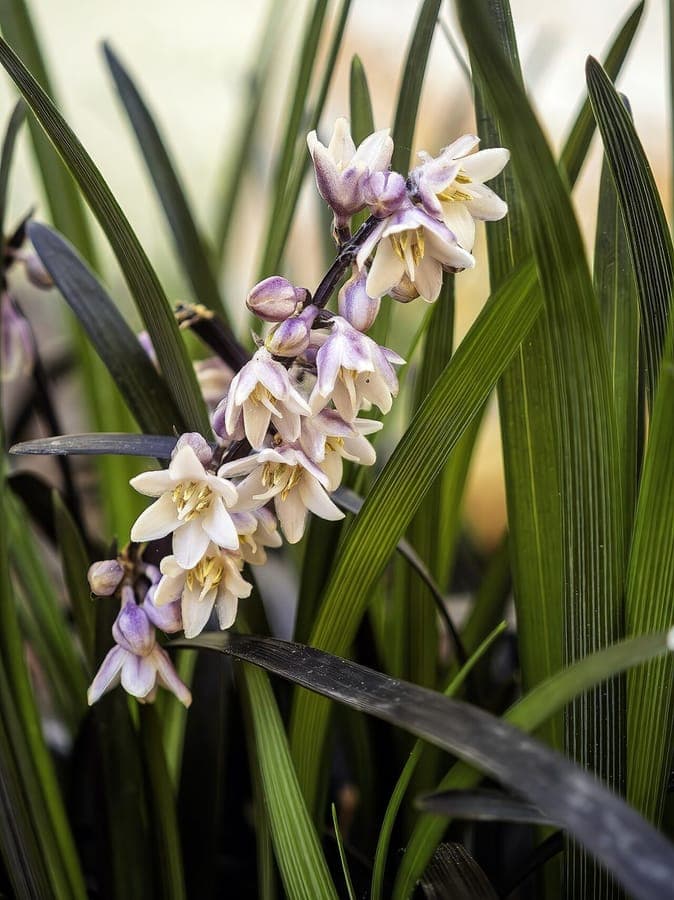
The leaves are strap-shaped, 20 to 35 cm long and 4 to 6 mm wide, arching gracefully outwards. New leaves sometimes emerge with a greenish tint before darkening. In full sun they turn their blackest; in deep shade they develop a greener undertone. The photograph above shows that variation nicely: greener leaves mingle with the dark ones, and the flower spike rises on an almost black stem.
In July and August short flower stems appear, carrying racemes of small, nodding bells 5 to 8 mm across. They are pale pink to lilac, sometimes almost white, with yellow anthers. The flowers barely clear the foliage, so this is a modest display you notice only when you bend down. Glossy round berries about 7 mm across follow in autumn. They are blue-black and often hang on well into winter, a small bonus that surprises many gardeners.
Little is recorded about toxicity. Ophiopogon does not appear on the usual lists of poisonous garden plants, and its relative Ophiopogon japonicus is regarded as non-toxic to dogs and cats. The berries are not edible, though, so teach children not to put them in their mouths.
Ideal location
Black mondo grass is tolerant when it comes to light. It grows in sun, partial shade and light shade. For the deepest colour, choose a spot with at least a few hours of sun each day, but on a hot, dry south-facing bank the leaf tips can scorch. The best position is often a border with morning sun and afternoon shade, or the edge of a patio where the plant gets light while its roots stay cool.
Think carefully about the backdrop. Black foliage disappears against dark soil or bark mulch. Surround it with pale gravel, pebbles or crushed shell instead, or plant it beside gold, silver or lime-green leaves. In a pot on light paving it looks superb as well. Space plants 15 to 20 cm apart if you want a closed carpet quickly; at 25 cm it takes a few years longer.
Soil requirements
It wants a humus-rich, free-draining soil that does not dry out. Light loam, sandy loam and improved sandy soil are ideal. On heavy clay, work some compost and grit into the top 20 cm at planting time so water does not sit around the roots in winter. A pH from slightly acidic to neutral suits it; on very chalky ground it grows more slowly.
Feeding is hardly necessary. A thin layer of compost in spring is plenty. Too much nitrogen makes the leaves floppy and greener. In containers, use good multipurpose or loam-based compost with some fine grit or perlite for drainage.
Free preview
Want to see Black mondo grass (Ophiopogon planiscapus): complete guide in your garden? Make a free preview of your design.
Watering
After planting, keep the soil evenly moist throughout the first year. Black mondo grass roots slowly and is vulnerable to drought during that time. In dry spells give a thorough soaking once or twice a week rather than a little every day. Once established, it copes well with short dry periods, especially in partial shade, but an extra watering during long heatwaves pays off.
Pots dry out much faster. Check every two to three days in summer and always make sure there is a drainage hole. In winter the compost can stay slightly moist but never wet.
Pruning
There is no real pruning to do. The leaves stay on all year and renew gradually. In March or April, pull or snip away damaged, dried or brown leaves. After a harsh winter the foliage may look tatty; cut it back to a few centimetres above the ground and fresh leaves soon follow. Leave the faded flower stems in place for the berries.
To increase your stock, divide a mature clump in spring. Lift a section with a few runners and replant it straight away. Sowing is possible too, but seedlings are not all equally dark.
Maintenance calendar
March-April: Remove damaged leaves and add a thin layer of compost. The ideal time for planting and dividing.
May-June: New leaves appear. Keep young plants moist and weed around the clumps until they cover the surface.
July-August: Lilac bells in flower. Water during prolonged drought, especially in containers.
September-October: The blue-black berries colour up. Planting is still possible until mid-October.
November-February: Rest period. Protect pots from hard frost and leave the berries for winter interest.
To keep track of these moments, the planting calendar on gardenworld.app shows month by month what to do for black mondo grass and the other plants in your garden.
Winter hardiness
Ophiopogon planiscapus is hardy throughout most of Britain and the Low Countries. Established plants in open ground tolerate frost to around -15 °C, a little more in a sheltered spot. Leaves can turn brown during long frosts and cold winds, but the plant reshoots in spring.
Cold, wet soil is a greater risk than low temperatures. On poorly drained sites the roots can rot. Young plants put in during autumn benefit from a covering of leaves or fleece in their first winter. Containers are more vulnerable because the whole root ball can freeze. Stand them against a wall, raise them on pot feet and wrap the pot in hessian or bubble wrap during severe frost.
Companion plants
The classic partner is lime-green or golden foliage. Japanese forest grass (Hakonechloa macra 'Aureola'), golden sedges and heucheras with orange or lemon leaves make the black look even more intense. Blue fescue (Festuca glauca) and silver plants such as lamb's ears (Stachys byzantina) create a cool, graphic picture.
In partial shade, combine black mondo grass with Lenten roses (Helleborus orientalis), ferns and Japanese maple (Acer palmatum). Beneath a maple it forms a dark carpet that makes the autumn colours glow. Snowdrops, crocuses and white daffodils threaded through it give a lovely spring contrast. Slate, white pebbles and grey stepping stones complete the scene. Its relative Liriope muscari works well too if you want a slightly taller green edge with purple flower spikes in autumn.
Final thoughts
Black mondo grass is a plant you choose for its colour rather than its flowers. It stays low, grows slowly, needs very little work and keeps its dark leaves all year. Give it humus-rich soil that does not stay waterlogged, enough light for a deep colour and pale partners around it, and you have a ground cover that adds depth to any planting. Plant a few clumps of Ophiopogon planiscapus beside pale gravel or golden foliage this spring and watch how the black catches the eye in every season.
Frequently asked questions about Black mondo grass
Is Black mondo grass winter hardy?
Ophiopogon planiscapus is hardy throughout most of Britain and the Low Countries. Established plants in open ground tolerate frost to around -15 °C, a little more in a sheltered spot.
When and how do you prune Black mondo grass?
There is no real pruning to do. The leaves stay on all year and renew gradually.
How much water does Black mondo grass need?
After planting, keep the soil evenly moist throughout the first year. Black mondo grass roots slowly and is vulnerable to drought during that time.
Where does Black mondo grass grow best?
Black mondo grass is tolerant when it comes to light. It grows in sun, partial shade and light shade.
What soil does Black mondo grass need?
It wants a humus-rich, free-draining soil that does not dry out. Light loam, sandy loam and improved sandy soil are ideal.

See it in your garden
See Black mondo grass in your garden
One photo of your garden and a few questions. You see the result in about a minute.
Try it with a photoIdentify this plant in your own garden. Identify a plant
Similar plants
Japanese Maple: complete guide
Acer palmatum
Everything about Japanese Maple (Acer palmatum): planting, pruning, cultivars and autumn colour. Expert tips for a spectacular ornamental tree in your garden.
Alumroot: complete guide
Heuchera micrantha
Discover how to grow and care for Heuchera micrantha: ideal light, soil, watering, and seasonal maintenance for thriving plants in your garden.
Blue fescue: complete guide
Festuca glauca
Festuca glauca, or blue fescue, is a low-maintenance ornamental grass with silvery-blue foliage. Perfect for sunny, dry borders and rock gardens.
