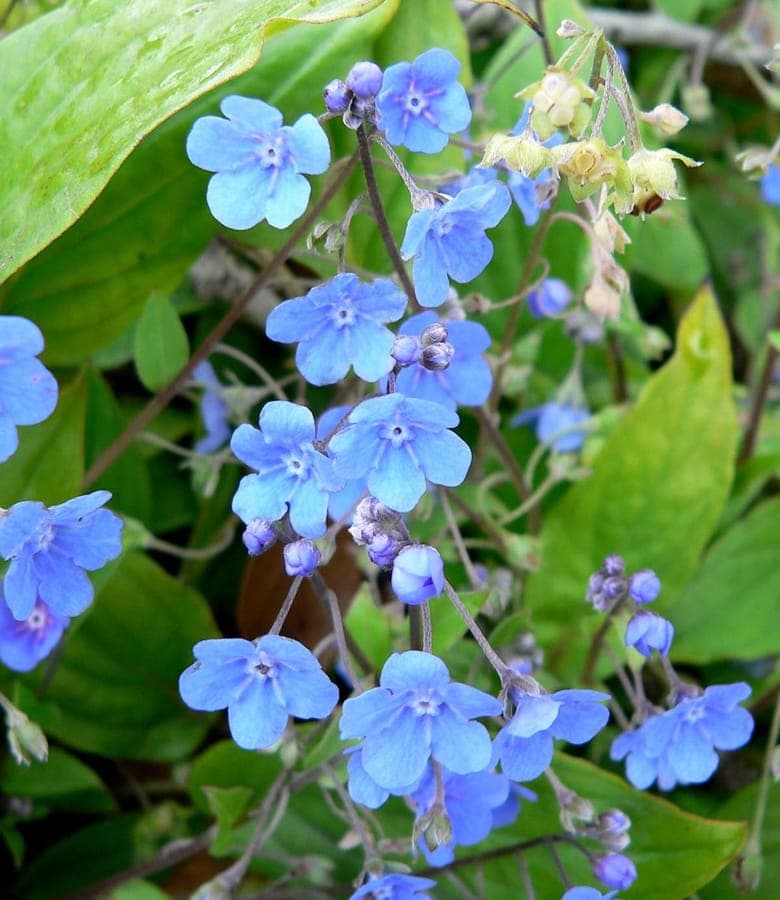
Stan Shebs / CC BY-SA 3.0, via Wikimedia Commons
Cappadocian navelwort (Omphalodes cappadocica): care guide
Omphalodes cappadocica
Want to see Cappadocian navelwort (Omphalodes cappadocica): care guide in your garden?
Full design in HD: €7.99
Look after your Cappadocian navelwort with the GardenWorld app
Identify plants with your camera and get a care calendar with reminders for this plant.


Overview
Omphalodes cappadocica, known in English as Cappadocian navelwort, is a low, evergreen perennial in the borage family (Boraginaceae), the same family as forget-me-not and comfrey. It grows wild in deciduous woodland in north-eastern Turkey and the neighbouring Caucasus; the name refers to Cappadocia, the old name for a region of Asia Minor. Gardeners value it for its sky-blue, white-eyed flowers, which hover above a neat mound of heart-shaped leaves in spring.
The plant reaches about 20 to 25 cm tall and, after a few years, 30 to 45 cm across. It spreads slowly by short rhizomes to form a dense, low clump, without becoming invasive. That makes it excellent ground cover for shady places beneath shrubs and trees, where many other plants struggle.
A few lovely cultivars are available. 'Cherry Ingram' has slightly larger, deep blue flowers and holds the Royal Horticultural Society's Award of Garden Merit. 'Starry Eyes' has blue petals edged with white, giving each flower a star-shaped pattern. 'Lilac Mist' flowers in soft lilac. The species itself is also well worth growing and very reliable.
Appearance and flowering
The leaves are ovate to heart-shaped, pointed, 5 to 10 cm long and a fresh mid-green. They are finely hairy and held on long stalks in a loose rosette. In mild winters the foliage stays green; after hard frost it can look a little tatty, but new leaves soon appear in spring.
Flowering starts in March or April and continues into May. Slender, gently arching stems carry loose sprays of small, five-petalled flowers about 8 to 10 mm across. They are clear azure blue with a small white centre and look very much like large forget-me-nots. In bud they are often tinged purple. After flowering, small nutlets form with a distinctive hollowed, navel-like rim; this gives the genus its name, as omphalos is Greek for navel. In a cool summer the plant sometimes produces a few more flowers in late summer.
The flowers attract bumblebees and other early pollinators in spring.
Ideal position
Omphalodes cappadocica is a true shade plant. It does best in partial or light shade, for example beneath deciduous trees, on the north or east side of a house or among shrubs. It is happy with morning sun, but fierce midday sun in summer scorches the leaves and dries the plant out.
A spot under deciduous trees is ideal: in spring, while it is flowering, there is still plenty of light, and in summer the canopy protects it from heat. Plant 30 to 35 cm apart, about eight or nine plants per square metre, for a closed carpet within two years.
It also looks at home in a shady rock garden, along a woodland path or at the front of a north-facing border. A pot or trough is possible too, as long as it stands in shade and the compost never dries out. Choose a roomy container that is not too shallow, because the rhizomes like to spread sideways.
Soil requirements
The ideal soil is humus-rich, loose and moisture-retentive, like a woodland floor. Slightly acidic to neutral pH suits it best, though it tolerates slightly limy soil. When planting, work plenty of leaf mould or well-rotted compost into the top 20 cm. On heavy clay, extra organic matter opens up the soil; on sandy soil, it helps retain moisture.
The plant dislikes winter wet, so good drainage matters as much as moisture retention. An annual autumn mulch of leaf mould mimics the natural woodland floor and provides all the nutrients it needs. Extra fertiliser is unnecessary. The best planting times are spring, in March or April, or early autumn while the soil is still warm and moist. Set the plant at the same depth as it was in its pot and water in well.
Free preview
Want to see Cappadocian navelwort (Omphalodes cappadocica): care guide in your garden? Make a free preview of your design.
Watering
After planting, keep the soil evenly moist during the first year. Water once or twice a week in dry weather, especially in spring and summer. An established plant in good, humus-rich soil under trees usually looks after itself and will tolerate a short dry spell. During prolonged summer drought, however, give extra water, or the leaves will wilt and the clump may develop bare patches.
Water in the morning if possible, at the base of the plant. There is no need to wet the foliage.
Pruning
Omphalodes cappadocica needs hardly any pruning. After flowering, cut off the spent flower stems; the plant looks tidier and puts more energy into new leaves. In February or March, remove old and damaged leaves so the new flower sprays are clearly visible.
To rejuvenate or propagate the plant, divide it. The best times are just after flowering, in May or June, or in early autumn. Slice off a section of the clump with a few rhizomes and replant it straight away. Water generously until the new piece is well rooted.
Slugs may nibble young leaves in spring. Check in damp weather and remove them by hand. Otherwise the plant is rarely troubled by disease.
Care calendar
February–March: Remove old and damaged foliage. Watch for slugs on the first new growth.
April–May: Full flower. Keep the soil moist. A good time for planting.
May–June: Cut off spent flower stems. Divide clumps that have grown too large.
July–August: Water during prolonged drought. Sometimes a small second flush of flowers.
September–October: Second window for planting and dividing. Apply a layer of leaf mould.
November–January: Dormant season. Leave fallen tree leaves among the plants as natural protection.
If you would like jobs like these served up at the right moment for your own garden, use the planting calendar at gardenworld.app.
Hardiness
Omphalodes cappadocica is very hardy and tolerates frost below -20 °C. No winter protection is needed in Britain or northern Europe. In severe frost without snow cover the leaves may brown, but the rhizomes survive and reshoot in spring. A layer of fallen leaves among the plants acts as a natural blanket.
As far as is known, Omphalodes cappadocica is not poisonous to people or pets. Some related plants in the borage family do contain pyrrolizidine alkaloids, which can harm the liver if eaten over a long period. So do not eat the plant, and do not let rabbits or horses graze on it.
Companion plants
This plant is an ideal partner in a shady spring border. Combine it with Brunnera macrophylla, which has similar blue flowers but larger, coarser leaves. Lungwort (Pulmonaria saccharata) flowers at the same time in pink and blue and has silver-spotted leaves. Lenten roses (Helleborus orientalis) provide flowers in late winter, before the Omphalodes begins.
Epimedium grandiflorum shares its taste for shade and humus-rich soil, and the soft shield fern (Polystichum setiferum) adds structure in summer once flowering is over. Beneath a group of shrubs, together with spring bulbs such as snowdrops and daffodils, it creates a natural-looking woodland scene.
Final thoughts
Omphalodes cappadocica is a modest but very rewarding plant for shady corners. It asks for humus-rich, moist soil, some water in dry summers and a quick tidy after flowering, and every spring it rewards you with a haze of bright blue flowers. It does not run rampant, it is very hardy and after a few years it forms a dense, low carpet. At gardenworld.app you can have a garden design made in which this ground cover joins ferns, lungworts and epimediums in a shade border that holds interest all year.
Frequently asked questions about Cappadocian navelwort
Is Cappadocian navelwort winter hardy?
Omphalodes cappadocica is very hardy and tolerates frost below -20 °C. No winter protection is needed in Britain or northern Europe.
When and how do you prune Cappadocian navelwort?
Omphalodes cappadocica needs hardly any pruning. After flowering, cut off the spent flower stems; the plant looks tidier and puts more energy into new leaves.
How much water does Cappadocian navelwort need?
After planting, keep the soil evenly moist during the first year. Water once or twice a week in dry weather, especially in spring and summer.
What soil does Cappadocian navelwort need?
The ideal soil is humus-rich, loose and moisture-retentive, like a woodland floor. Slightly acidic to neutral pH suits it best, though it tolerates slightly limy soil.

See it in your garden
See Cappadocian navelwort in your garden
One photo of your garden and a few questions. You see the result in about a minute.
Try it with a photoIdentify this plant in your own garden. Identify a plant
Similar plants
Great forget-me-not: complete guide
Brunnera macrophylla
Brunnera macrophylla, also known as Great forget-me-not, is a shade-loving perennial with heart-shaped leaves and spring blue flowers. Learn care, soil and planting tips.
Bethlehem lungwort: complete guide
Pulmonaria saccharata
Learn how to grow and care for Pulmonaria saccharata: ideal conditions, watering, pruning, and companion planting for a thriving shade garden.
Lenten-rose: complete guide
Helleborus orientalis
Learn how to grow and care for Helleborus orientalis. This early-blooming perennial thrives in shady spots and flowers from February to April, adding colour when little else is blooming.
