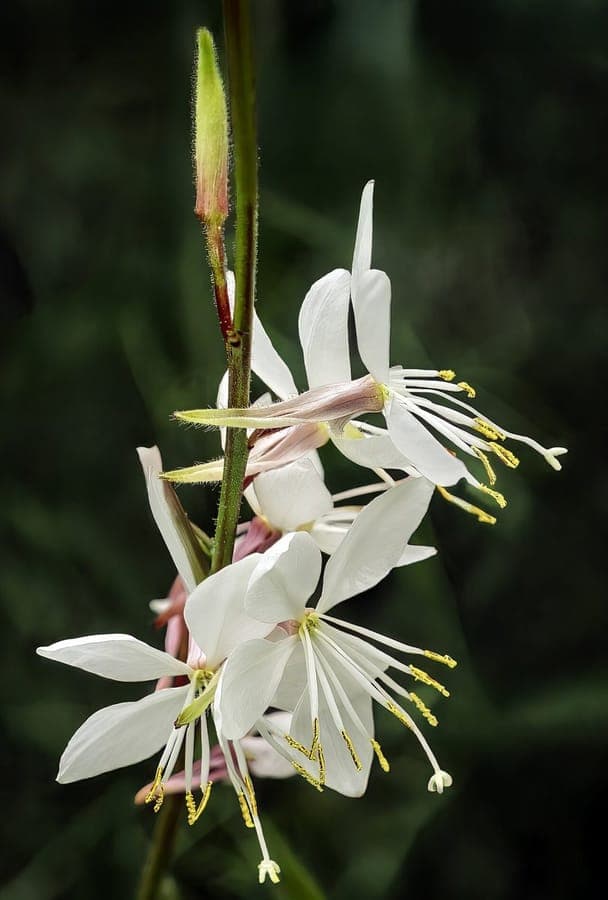
Didier Descouens / CC BY-SA 4.0, via Wikimedia Commons
Gaura (Oenothera lindheimeri): complete guide
Oenothera lindheimeri
Want to see Gaura (Oenothera lindheimeri): complete guide in your garden?
Full design in HD: €7.99
Look after your Gaura with the GardenWorld app
Identify plants with your camera and get a care calendar with reminders for this plant.


Overview
Gaura, now correctly called Oenothera lindheimeri, is one of those plants that instantly lifts a border. On long, wiry stems, hundreds of small white or pink flowers hover above the foliage, and the slightest breeze sets them moving. That is why American gardeners nicknamed it "whirling butterflies", and why it has become a staple of naturalistic planting across Europe. Most garden centres still label it Gaura lindheimeri. Botanists moved the genus Gaura into Oenothera, the evening primrose genus, a few years ago, but the plant in your border is exactly the same.
The species is native to the southern United States, mainly Texas and Louisiana, where it grows on open prairies and woodland edges in warm, well-drained ground. That origin explains its tolerance of heat and drought, and also its one real weakness: cold, wet winter soil. In British and northern European gardens it behaves as a perennial that lasts three to five years, sometimes longer on a dry site. It is not long-lived, but it often self-seeds gently, so you rarely lose it altogether.
Gaura grows 60 to 120 cm tall and 50 to 80 cm wide, although compact cultivars stay below 50 cm. Popular selections include 'Whirling Butterflies' (white and very floriferous), 'Siskiyou Pink' (deep pink), 'Crimson Butterflies' (pink flowers over reddish leaves) and the low Gaudi series for containers. If you are unsure where such an airy plant fits best, gardenworld.app can create a garden design that places gaura alongside grasses and other summer flowers in a way that suits your own plot.
Appearance and bloom cycle
The plant forms a loose clump of narrow, lance-shaped leaves 3 to 9 cm long, sometimes speckled with dark spots or flushed red. From June onwards, numerous thin, slightly hairy flowering stems rise from the clump, branching into long spikes. Each spike opens a few flowers at a time from the bottom upwards, which is why the display lasts for months.
Individual flowers are 2 to 3 cm across with four slender, slightly asymmetric petals and eight long stamens and a style that project well beyond the petals. They usually open white and fade to pink as they age, so a single stem often carries two colours at once. The buds are pink to reddish. The photo shows this nicely: white flowers, yellow anthers and pink buds on the same stalk.
Flowering runs from June into October, and in a mild autumn right up to the first frost. Bees, bumblebees and hoverflies visit the blooms by day, while moths come at dusk. Gaura is not considered toxic to people or pets, which makes it a sensible choice for family gardens with children, cats or dogs.
Ideal location
Give gaura the sunniest spot you have. At least six hours of direct sun a day are needed for generous flowering and sturdy stems. It will grow in partial shade, but the stems become floppy, the clump opens up and flowering is noticeably weaker. A south or west-facing border, a gravel garden or a bed against a warm wall is ideal.
Because of its see-through habit, gaura looks best planted in groups of three to five, spaced 40 to 60 cm apart. You can happily place it near the front of a border: you look through the wiry stems, so it does not hide the plants behind. On a windy site the stems usually stay upright, although tall plants may lean after a heavy summer downpour. To avoid that, choose a compact cultivar or cut the plant back once in June, as described below.
Soil requirements
Gaura is not fussy about fertility, but it is very particular about drainage. Sandy, gravelly or loamy soil that does not stay wet in winter is perfect. On rich, moist ground the plant grows too lush, falls apart and is far less likely to survive the winter.
On heavy clay, work coarse grit and sharp sand into the top 30 cm, or plant on a slightly raised bed. Soil pH is not critical: anything from slightly acidic to chalky will do. Feeding is rarely necessary. A thin layer of compost in spring is plenty, and too much nitrogen gives you leaves and floppy stems rather than flowers.
As the plant forms a deep taproot, it resents being moved. Choose the right spot from the start and, ideally, plant young specimens from small pots, which establish more quickly than large ones.
Free preview
Want to see Gaura (Oenothera lindheimeri): complete guide in your garden? Make a free preview of your design.
Watering
Once established, gaura is remarkably drought tolerant. The taproot draws moisture from deeper layers, so the plant keeps flowering through dry summers. In the first season after planting, water regularly, roughly one full watering can a week, to encourage the roots to grow down.
From the second year onwards, plants in the ground only need watering during prolonged drought lasting more than three weeks. When you do water, give a thorough soak rather than a little every day. Overwatering leads to soft growth and root rot.
Pruning
Pruning keeps gaura compact and flowering. In spring, at the end of March or early April, cut all of last year's stems back to just above the new shoots at the base. Deliberately avoid doing this in autumn: the old stems protect the crown from wet and cold.
During summer you can remove spent spikes, cutting back to a side shoot. This encourages new flowers and stops the plant seeding everywhere. If the clump becomes untidy or splays open in midsummer, cut all stems back by about a third. Two to three weeks later a fresh, more compact flush of flowers follows. A light trim in June, before the main display, produces sturdier, slightly shorter plants.
Maintenance calendar
March-April: Cut old stems back to just above the new shoots. Plant new specimens once the soil is no longer cold and wet.
May: Water young plants in dry spells. Weed around the base so the young plant gets light and air.
June: The first flowers appear. For more compact plants, cut the stems back by a third now.
July-August: Peak flowering. Remove spent spikes and water container plants regularly. If the plant flops, cut back by a third for a second flush.
September-October: Flowering continues until the first frost. Leave a few spikes for seed if you wish.
November-February: Leave the old stems in place as protection. Make sure water does not collect around the crown and move pots to a sheltered, dry spot.
The planting calendar on gardenworld.app gives a month-by-month overview of border tasks, so you do not have to remember all these moments yourself.
Winter hardiness
On well-drained soil, Oenothera lindheimeri is hardy to around -15 °C. In most gardens in Britain and the Low Countries it therefore survives winter without trouble, provided the crown stays dry. Cold, wet soil kills it far more quickly than hard frost. A layer of gravel around the base helps keep the crown dry.
Bear in mind that gaura is naturally short-lived. If a plant starts to lose vigour after a few years, let a seedling or a new plant take over. In warm, dry parts of southern Europe the species has naturalised here and there, but it is not on the European Union list of invasive species.
Companion plants
Gaura's airy flowers show up best beside plants with a firmer outline or a contrasting texture. Ornamental grasses are classic partners: Calamagrostis × acutiflora 'Karl Foerster' adds a strong vertical line, while low grasses such as Stipa tenuissima bring movement. Violet-blue flowers such as Salvia nemorosa and Russian sage (Perovskia atriplicifolia) contrast beautifully with the white and pink blooms.
For a prairie-style border, combine gaura with purple coneflower (Echinacea purpurea) and Verbena bonariensis, which shares its see-through habit and long season. In a gravel garden, lavender, catmint and sedums also work well. Avoid plants that demand plenty of water and feeding, such as hydrangeas or phlox on damp ground: their needs clash with those of gaura.
Final thoughts
Gaura is a rewarding plant for anyone with limited time who still wants a long, natural-looking display. Sun, well-drained soil and a spring cut are the three things it really needs. Respect those basics and you will enjoy a cloud of dancing flowers from June to October, busy with bees and moths and lightening every border it grows in.
Plant it in groups, pair it with grasses and purple flowers, and let it leave a seedling or two to replace the parent plant in time. That way this American prairie native will remain a reliable feature of your garden for years.
Frequently asked questions about Gaura
Is Gaura winter hardy?
On well-drained soil, Oenothera lindheimeri is hardy to around -15 °C. In most gardens in Britain and the Low Countries it therefore survives winter without trouble, provided the crown stays dry.
When and how do you prune Gaura?
Pruning keeps gaura compact and flowering. In spring, at the end of March or early April, cut all of last year's stems back to just above the new shoots at the base.
How much water does Gaura need?
Once established, gaura is remarkably drought tolerant. The taproot draws moisture from deeper layers, so the plant keeps flowering through dry summers.
Where does Gaura grow best?
Give gaura the sunniest spot you have. At least six hours of direct sun a day are needed for generous flowering and sturdy stems.
What soil does Gaura need?
Gaura is not fussy about fertility, but it is very particular about drainage. Sandy, gravelly or loamy soil that does not stay wet in winter is perfect.

See it in your garden
See Gaura in your garden
One photo of your garden and a few questions. You see the result in about a minute.
Try it with a photoIdentify this plant in your own garden. Identify a plant
Similar plants
Argentine vervain: complete guide
Verbena bonariensis
Discover how to grow Verbena bonariensis: ideal conditions, pruning tips, hardiness and plant partners. Perfect for wildlife gardens in USDA zones 7-11.
Woodland sage: complete guide
Salvia nemorosa
Everything about Woodland Sage (Salvia nemorosa): planting, care, pruning and combinations. Expert tips for months of blue-violet flower spikes.
Perovskia atriplicifolia: complete guide
Perovskia atriplicifolia
Russian sage is a semi-shrub with purple-blue flowers and grey-green foliage that blooms from July to October. Perfect for dry gardens and landscape design.
