Qwert1234 / CC BY-SA 3.0, via Wikimedia Commons
Nepeta subsessilis: Japanese catmint for part shade
Nepeta subsessilis
Want to see Nepeta subsessilis: Japanese catmint for part shade in your garden?
Full design in HD: €7.99
Look after your Nepeta subsessilis with the GardenWorld app
Identify plants with your camera and get a care calendar with reminders for this plant.


Overview
If catmint makes you think of a low, grey cushion sprawling over a hot path, Nepeta subsessilis will come as a pleasant surprise. This species comes from Japan, where it grows along mountain streams, in damp upland meadows and at woodland edges. It has larger, fresh green leaves, stands more upright and is genuinely happy in a spot with some shade and soil that does not dry out. That makes it something of a gap-filler: a blue-flowered catmint for the part-shade border.
It goes by Japanese catmint or short-stalked catmint. The second name explains the Latin: subsessilis means almost stalkless, because the leaves sit on very short stalks against the stem. Nurseries usually list it as Nepeta subsessilis, often followed by a cultivar name.
The plant forms an upright, clump-forming perennial 50 to 90 cm tall and about 40 cm across. It does not run and self-seeds only modestly. Wondering how it would work in a border that gets only half a day of sun? gardenworld.app can create a garden design that accounts for shade and moisture, so the less sunny corners of your plot get a plan too.
Appearance and bloom cycle
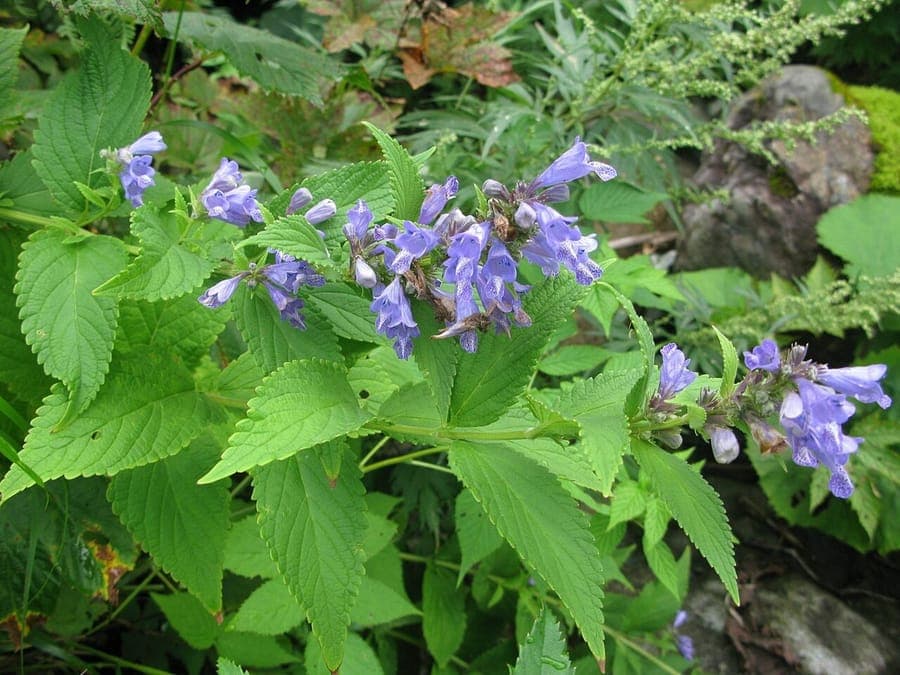
The leaves are ovate to broadly lance-shaped, 5 to 10 cm long, with coarsely toothed margins and a slightly puckered surface. They are bright to dark green, far less grey than the familiar Nepeta × faassenii. Brush them and you get the typical herby catmint aroma, though milder than in many relatives.
Flowering begins in late June or July and, with a little care, carries on into September. The blooms are held in dense whorls at the top of the stems and are large for a catmint, roughly 2 to 3 cm long. They are a clear blue-violet with fine darker spots on the lower lip and a paler throat. The calyces sometimes flush purple, which adds depth to the spikes.
There are now several named forms. 'Washfield' is deep blue-violet, 'Blue Dreams' a lighter blue, 'Sweet Dreams' soft pink and 'Nimbus' pale blue on a more compact plant. All of them attract bumblebees, honeybees and hoverflies; long-tongued bumblebees in particular reach the nectar easily.
Ideal location
Nepeta subsessilis looks its best in light shade or a spot with morning sun and afternoon shade. Full sun is fine as long as the soil stays reliably moist; otherwise the leaves scorch and flowering stops early. Deep, dry shade beneath trees, on the other hand, is too dark and too dry.
East- or west-facing borders, the edge of a shrub border, a place near a pond or a bed on the north side of a hedge that does not rob too much water are all ideal. Space plants 40 to 50 cm apart, in groups of three or five for a fuller effect. A large container works too, provided you water regularly.
Soil requirements
Where many catmints prefer lean, dry ground, this one wants humus-rich soil that holds moisture yet drains well. Ordinary, well-cultivated garden soil with some compost is usually ideal. On light, sandy soil, dig a few buckets of compost or leaf mould into the top 30 cm at planting time to help it retain water.
Heavy clay is acceptable as long as water does not sit there in winter. A slightly acidic to neutral pH suits it. An annual spring mulch of compost or leaf mould provides all the feeding it needs; synthetic fertiliser is unnecessary and mainly produces soft, floppy stems.
Watering
In the first year, water once or twice a week in dry weather so the roots establish well. After that the plant usually manages on rainfall, especially in part shade. During long dry spells in summer, a thorough soak at the base is welcome; drooping leaves are the signal.
A mulch of compost, leaf mould or fine bark helps keep the soil cool and moist. Water in the morning where possible and avoid wetting the leaves, which reduces the risk of powdery mildew. Container plants may need water almost daily in summer.
Free preview
Want to see Nepeta subsessilis: Japanese catmint for part shade in your garden? Make a free preview of your design.
Pruning
After the first flush of flowers, usually in August, cut the spent stems back to just above a couple of good pairs of leaves. A second, slightly smaller flush often follows into September. If you prefer seed heads for birds or a calmer look, leave some stems standing.
In late autumn or early spring, cut all the stems down to a few centimetres above ground. Leaving old stems over winter gives insects somewhere to shelter; just remove them in March before the new leaves appear. Every three or four years, divide the clump in spring to keep it vigorous and gain extra plants.
Maintenance calendar
March: Remove old stems if you left them over winter. Divide older clumps.
April: Spread a layer of compost around the plants. Watch for slugs on the young leaves.
May: Plant new specimens. Water in dry spells.
June and July: Flowering begins. Support tall stems with a few twiggy sticks if needed.
August: Cut back spent stems for a second flush. Water during hot weather.
September: Repeat flowering. Collect seed or take cuttings if you wish.
October and November: Leave the plant standing or cut it back. Plant more if the soil is not too wet.
December to February: Dormancy, nothing to do.
The plant calendar on gardenworld.app reminds you of jobs like these at the right moment, so you do not miss that second flush.
Winter hardiness
Nepeta subsessilis is fully hardy. The RHS rates cultivars such as 'Blue Dreams' and 'Nimbus' at H6 and 'Washfield' at H7, which means frost of -20 °C and below. Across Britain and the Low Countries it needs no winter protection. The top growth dies back in autumn and new shoots emerge from the rootstock in spring.
The main winter risk is soil that stays waterlogged for months. In a reasonably well-drained spot that is unlikely to be a problem. Stand containers against a wall so the root ball does not freeze solid and is not sitting in water.
On toxicity: catmint is not known to be poisonous to people, dogs or cats. Cats may be drawn to the scent, though this species is less irresistible to them than true catnip (Nepeta cataria).
Companion plants
Nepeta subsessilis fits perfectly into a part-shade border alongside other plants that like moist, humus-rich soil. Masterwort (Astrantia major) and lady's mantle (Alchemilla mollis) are classic partners: the lime green of the lady's mantle and the blue of the catmint lift each other. Geranium macrorrhizum makes a scented ground cover at the front.
For contrasting foliage, hostas are ideal, for example Hosta sieboldiana with its big blue-grey leaves. An airy grass such as tufted hair grass (Deschampsia cespitosa) adds movement and light. In a sunnier but moist bed, pair it with Japanese anemones or asters to stretch the season well into autumn.
Final thoughts
Nepeta subsessilis is the catmint for gardeners without a baking hot corner. It flowers for months in a clear blue, draws in bumblebees and honeybees, needs little maintenance and is completely hardy. What it asks for is simple: some shade at the hottest time of day, soil that does not dry out and a trim after the first flush.
Plant a group of three at the edge of a shrub border or beside a pond, and you will have a blue haze from summer into September in places where most other catmints would struggle.
Frequently asked questions about Nepeta subsessilis
Is Nepeta subsessilis winter hardy?
Nepeta subsessilis is fully hardy. The RHS rates cultivars such as 'Blue Dreams' and 'Nimbus' at H6 and 'Washfield' at H7, which means frost of -20 °C and below.
When and how do you prune Nepeta subsessilis?
After the first flush of flowers, usually in August, cut the spent stems back to just above a couple of good pairs of leaves. A second, slightly smaller flush often follows into September.
How much water does Nepeta subsessilis need?
In the first year, water once or twice a week in dry weather so the roots establish well. After that the plant usually manages on rainfall, especially in part shade.
Where does Nepeta subsessilis grow best?
Nepeta subsessilis looks its best in light shade or a spot with morning sun and afternoon shade. Full sun is fine as long as the soil stays reliably moist; otherwise the leaves scorch and flowering stops early.
What soil does Nepeta subsessilis need?
Where many catmints prefer lean, dry ground, this one wants humus-rich soil that holds moisture yet drains well. Ordinary, well-cultivated garden soil with some compost is usually ideal.

See it in your garden
See Nepeta subsessilis in your garden
One photo of your garden and a few questions. You see the result in about a minute.
Try it with a photoIdentify this plant in your own garden. Identify a plant
Similar plants
Astrantia: complete guide
Astrantia major
Complete care guide for Astrantia major: bloom time, ideal location, soil, watering and companion plants. Perfect for shady borders.
Rock crane's-bill: complete guide
Geranium macrorrhizum
Rock crane's-bill (Geranium macrorrhizum) is a tough groundcover thriving in sun or partial shade. Great for rock gardens and dry spots. Grows 20-30 cm tall.
Garden lady's-mantle: complete guide
Alchemilla mollis
Alchemilla mollis, or garden lady's-mantle, is a graceful perennial perfect for borders, shade gardens, and low-maintenance landscapes. Grows 15–30 cm tall, blooms June–August.
