Wikimedia Commons / CC BY-SA 3.0, via Wikimedia Commons
Burnt tip orchid: complete guide
Neotinea ustulata
Want to see Burnt tip orchid: complete guide in your garden?
Full design in HD: €7.99
Look after your Burnt tip orchid with the GardenWorld app
Identify plants with your camera and get a care calendar with reminders for this plant.


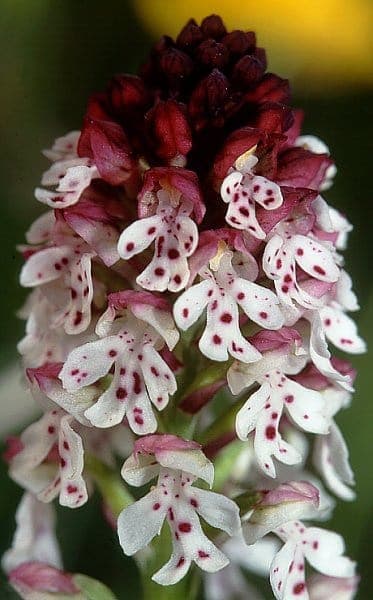
Burnt tip orchid, scientifically known as Neotinea ustulata, is a small but highly attractive European orchid. This native plant is valuable for natural gardens and specialized collections. The plant reaches only 10-30 cm height and is characterized by two basal leaves and a very distinctive flowering panicle with dual tones - pale pink flowers with dark brown to black tips, giving it its common name.
Appearance and bloom
Burnt tip orchid presents itself as a small, elegant plant with two elongated, greenish basal leaves growing close to the ground. The flower stem is leafless, narrow and stiff, approximately 15-30 cm tall. From May through June, the very characteristic flowering panicle appears - a dense spike of approximately 50-100 small flowers. Each flower has a white to light pink color with red or dark brown spots and markings, especially prominent on the lips. The top segments of the flower often have a very dark, almost black applied tip making the flower look "burnt" - hence the English common name.
Ideal location
Burnt tip orchid grows best on open, sunny locations receiving at least 6-7 hours direct sunlight daily. The plant grows naturally in dry, open grasslands and is not found in forests or shady environments. Shelter from strong winds is beneficial, but windy sites are tolerated in the wild.
Soil and planting hole
Burnt tip orchid prefers alkaline, well-draining soils with pH between 6.5 and 7.5. This is very important, as acidic soils are highly harmful to this plant. Plant on sunny slopes with alkaline soil or add limestone-rich sand to planting. The plant can also be grown in containers in a mixture of 50% orchid potting soil, 30% alkaline sand and 20% peat.
Free preview
Want to see Burnt tip orchid: complete guide in your garden? Make a free preview of your design.
Water management
After planting, keep the plant carefully moist in the first year until growth roots establish. Once established, Burnt tip orchid can tolerate reasonable drought. Ensure water drains well - excess moisture and root rot are fatal. During dry periods in summer, water carefully once weekly.
Pruning and maintenance
Burnt tip orchid requires no pruning. Remove only dead leaves carefully in spring. After flowering, flower stems can be removed to ground level. Avoid all fertilization - this plant grows in naturally nutrient-poor habitats.
Maintenance calendar
March to April: awaken after winter rest, water carefully. May through June: flowering period. July to September: growth period, minimal watering. October through February: quiet period.
Winter hardiness
Burnt tip orchid is fully hardy to minus 15 Celsius and grows naturally across much of Europe from Belgium to the Mediterranean. The plant survives cold winters without protection. Buds rest below ground level within the plant heart.
Planting dimensions
Burnt tip orchid grows slowly. Plant 30-40 cm apart, depending on desired density. Mass planting for wild effect requires more plants.
Companion plants
Burnt tip orchid grows well with other alkaline, dry-site plants such as small orchids, sheep's fescue (Festuca ovina), and dyer's broom (Genista tinctoria). Combinations with lavender are also workable.
Availability and purchase
Burnt tip orchid is not always easy to find at regular garden centers. Search specialized orchid growers or online suppliers. Some retailers stock it seasonally. Prices range from 8-15 euros per plant. Seed is also available but difficult to germinate.
Closing remarks
Burnt tip orchid is a very special and beautiful orchid for garden owners with dry, alkaline locations who enjoy exclusive plants. The plant offers value from conservation perspective and is attractive to various insects and birds.
Frequently asked questions about Burnt tip orchid
Is Burnt tip orchid winter hardy?
Burnt tip orchid is fully hardy to minus 15 Celsius and grows naturally across much of Europe from Belgium to the Mediterranean. The plant survives cold winters without protection.
When and how do you prune Burnt tip orchid?
Burnt tip orchid requires no pruning. Remove only dead leaves carefully in spring.
Where does Burnt tip orchid grow best?
Burnt tip orchid grows best on open, sunny locations receiving at least 6-7 hours direct sunlight daily. The plant grows naturally in dry, open grasslands and is not found in forests or shady environments.
What soil does Burnt tip orchid need?
Burnt tip orchid prefers alkaline, well-draining soils with pH between 6.5 and 7.5. This is very important, as acidic soils are highly harmful to this plant.

See it in your garden
See Burnt tip orchid in your garden
One photo of your garden and a few questions. You see the result in about a minute.
Try it with a photoIdentify this plant in your own garden. Identify a plant
Similar plants
Jewel Orchid (Ludisia discolor): complete guide
Ludisia discolor
Everything about the jewel orchid (Ludisia discolor): velvety veined leaves, light, compost, watering, cuttings and its winter flowers indoors.
Ram's-head lady's slipper: complete guide
Cypripedium arietinum
Everything you need to know about growing Cypripedium arietinum, a rare woodland orchid for cool, moist garden settings. Soil, care and planting tips.
Sparrow's-egg lady's slipper: complete guide
Cypripedium passerinum
Everything about growing Cypripedium passerinum, a cold-hardy subarctic orchid suited to cool, moist, shaded garden spots. Soil, care and companion plants.
