Nitesh8de at English Wikipedia / Public domain, via Wikimedia Commons
Jewel Orchid (Ludisia discolor): complete guide
Ludisia discolor
Want to see Jewel Orchid (Ludisia discolor): complete guide in your garden?
Full design in HD: €7.99
Look after your Jewel Orchid with the GardenWorld app
Identify plants with your camera and get a care calendar with reminders for this plant.


Overview
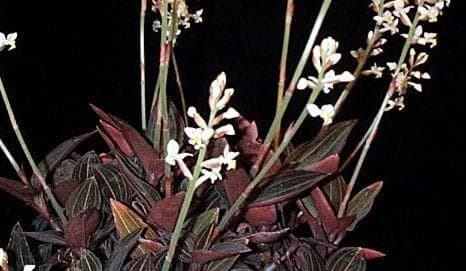
The jewel orchid (Ludisia discolor) is an orchid you buy for its leaves rather than its flowers. Most indoor orchids spend the months after flowering as a few plain green leaves on a windowsill, but Ludisia stays decorative all year round. Its velvety foliage is deep burgundy to almost black, traced with fine pink, red or coppery veins that seem to sparkle when the light catches them. In winter it adds upright spikes of small white flowers on top of that.
Ludisia discolor grows wild in southern China and across much of South East Asia, from Myanmar and Vietnam to Malaysia, Indonesia and the Philippines. There it lives on the forest floor among leaf litter, moss and stones, in damp, shady woodland. That makes it quite different from the familiar moth orchid: Ludisia is a terrestrial orchid, not an epiphyte clinging to tree bark. The difference matters for compost, watering and position, and it explains why many people who struggle with Phalaenopsis find this plant easy.
It stays low, around 10 to 15 cm tall, with flower stems reaching 25 or 30 cm. Fleshy stems creep along the surface of the compost and, after a few years, form a broad, dense clump. It is a rewarding choice for a north- or east-facing windowsill, a bright bathroom or a terrarium. If you would like the green of your living room to carry on outside, you can have a garden design made for your patio or garden on gardenworld.app, so that indoors and outdoors feel connected.
Appearance and bloom cycle
The leaves are the main attraction. Each one is oval to lance-shaped, 3 to 7 cm long and 2 to 3 cm wide, with a soft, velvety sheen. The upper surface ranges from dark purple-brown to olive green, and the underside is often wine red. Five to seven lengthwise veins run across the blade and glow pink, red or gold. There are selections with almost black leaves and silvery veins, and forms with greener foliage; in garden centres they are usually all sold simply as Ludisia discolor.
Flowering normally falls between November and February, sometimes lasting into March. An upright, downy stem rises from the tip of a shoot and carries ten to thirty small white flowers about 2 cm across. The centre of each bloom is a striking yellow, thanks to the twisted column, and the white lip has an asymmetric shape. The flowers are lightly scented and stay fresh for three to four weeks. Once a shoot has flowered it stops growing in length, but new side shoots appear from the leaf joints.
Light and position
Ludisia likes light but not sun. A spot near a north- or east-facing window is ideal, or a couple of metres back from a south-facing one. Direct midday sun bleaches the leaves, turning them a dull reddish brown, and can even scorch them. Too little light shows as long, floppy stems with wide gaps between the leaves and a greener colour overall.
A warm room between 18 and 26 °C suits it best. Avoid placing the pot above a radiator or in the draught from a door that opens often in winter. Humidity can be higher than in a typical living room: 50 to 70 % is ideal. In a bathroom with a window, a glass cabinet or a large open terrarium it grows noticeably fuller. In an ordinary room, a saucer filled with clay pebbles and water beneath the pot helps, provided the pot itself does not sit in the water.
Compost and repotting
Because Ludisia is a ground orchid, it does not want pure bark. A good mix is roughly one third fine orchid bark, one third light houseplant or peat-free compost and one third perlite, with a handful of chopped sphagnum moss. The mix should hold moisture without staying wet and let air reach the roots.
Choose a wide, shallow pot with drainage holes. The roots spread sideways rather than down, and the creeping stems need space to grow out. Repot every two years in spring, after flowering, or when the clump spills over the rim. Handle the plant gently: the stems are fleshy and snap easily. Lay the creeping stems on the fresh compost and cover only the roots, not the stems themselves.
Free preview
Want to see Jewel Orchid (Ludisia discolor): complete guide in your garden? Make a free preview of your design.
Watering and humidity
Keep the compost lightly moist, never soggy and never bone dry. In practice that means watering when the top 1 to 2 cm feels dry. In summer that is often once a week; in winter, every ten to fourteen days. Rainwater or lukewarm, soft water is best. Always let excess water drain away, because water standing in an outer pot is the quickest route to stem rot.
Avoid misting the velvety leaves directly. Droplets that linger can leave marks, especially when the room is cool. Raise humidity with a pebble tray, a humidifier or by grouping the plant with other houseplants. Brown, crispy leaf edges point to dry air; soft, glassy stems point to overwatering.
Feeding and pruning
Ludisia is not a hungry plant. From April to September, add orchid fertiliser at half strength to the watering can every three to four weeks. Stop feeding in winter while it flowers. Too much fertiliser burns the roots and makes the veins less vivid.
There is no real pruning to do. After flowering, cut the spent flower stem off just above the leaves. If the plant becomes bare in the middle over the years, or the stems grow long and leggy, you can shorten them in spring. Use those pieces as cuttings straight away: a section of stem with three or four nodes roots in a glass of water or on damp sphagnum within a few weeks. Then lay the cutting flat on the compost. That way you rejuvenate an old plant and easily raise new ones.
Maintenance calendar
March–April: Remove spent flower stems. Repot if needed and take cuttings from leggy stems.
May–June: Strong leaf growth. Start feeding at half strength. Check that the plant is not catching midday sun now the sun is higher.
July–August: Keep the compost evenly and lightly moist and make sure humidity stays up on hot days.
September–October: Last feed in September. Slightly cooler nights, around 16 to 18 °C, help trigger flower buds.
November–February: Flowering season. Water less and stop feeding. Keep the plant away from cold glass and hot radiators.
In the planting calendar on gardenworld.app you can set reminders for watering, feeding and repotting, so nothing slips your mind.
Winter temperatures
Ludisia discolor is a tropical plant and cannot spend the winter outdoors. Below 15 °C growth stops, and if it stays below 12 °C for long, rot and leaf drop soon follow. An ordinary heated living room is therefore the best place for it. A windowsill against cold glass can become chilly at night, so move the plant back a little in winter or put a piece of insulation behind the pot. In summer it can stand in a sheltered, shady corner of the patio as long as nights stay above 15 °C, though it does not need to.
Toxicity to pets
Good news for cat and dog owners: the American ASPCA lists the jewel orchid, under its old name Haemaria discolor, as non-toxic to cats, dogs and horses. No toxic compounds are known. Even so, any plant eaten in quantity can cause a mild stomach upset, and a cat chewing on the soft stems mostly harms the plant. It is best kept out of reach. The plant is not known to be toxic to people either.
Companion plants
Ludisia sits well with other houseplants that like filtered light and humid air. A painted-leaf begonia (Begonia rex) brings silver and pink tones that echo its veins. The peace lily (Spathiphyllum wallisii) and Aglaonema commutatum share its needs for light and water and make a calm green backdrop. A bird's nest fern (Asplenium nidus) adds height and a fresh, bright green next to the dark leaves.
If you already grow a moth orchid (Phalaenopsis amabilis), the two make good neighbours: they flower at about the same time and enjoy similar temperatures, although Phalaenopsis needs bark and Ludisia a damper, soil-based mix. In a terrarium, Ludisia pairs nicely with mosses, small ferns and other low-growing jewel orchids.
Final thoughts
Ludisia discolor is the ideal orchid for anyone who believes they lack green fingers. It needs no sun, no special tricks to flower and no bark mix, just a warm room, filtered light and compost that stays lightly moist. In return you get glossy, patterned foliage all year and a fresh white display every winter. Take a few cuttings now and then, and before long you will have plants to pass on to friends who fancy trying an orchid of their own.

See it in your garden
See Jewel Orchid in your garden
One photo of your garden and a few questions. You see the result in about a minute.
Try it with a photoIdentify this plant in your own garden. Identify a plant
Similar plants
Phalaenopsis amabilis: complete guide
Phalaenopsis amabilis (L.) Blume
Phalaenopsis amabilis (Moon Orchid) is an elegant houseplant with gorgeous white flowers. Learn care, watering, and blooming techniques.
King Begonia: complete guide
Begonia rex
The painted-leaf begonia, Begonia rex, is a spectacular foliage plant with incredible leaf patterns in silver, red, pink, and purple. Discover everything about care, propagation, and enjoying this prima donna of the plant world.
Peace lily: complete guide
Spathiphyllum wallisii
How to grow a peace lily (Spathiphyllum wallisii): light, watering, repotting, getting it to flower again, and why it is toxic to cats and dogs.
